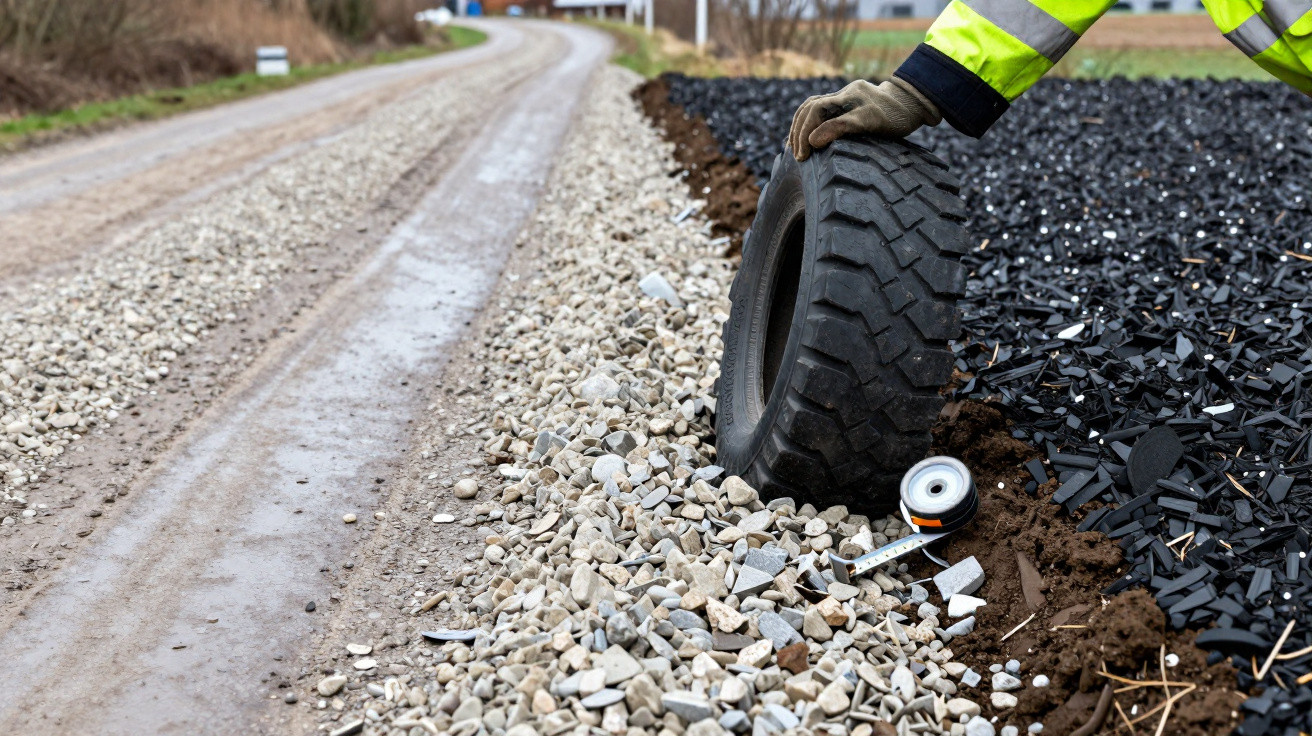
A rutted gravel lane after winter is not always fixed by tipping on more stone. When frozen ground begins to thaw, water trapped beneath the surface can leave the road base soft and unstable. The unusual trick tested on one road in Maine was to place processed tyre chips below the gravel, where their light weight and insulating properties could help limit frost damage.
This was not a case of driving on old tyres or a shortcut for repairing a farm track. The tyre material sat within a designed road foundation, covered by conventional aggregate. It is an interesting engineering approach, but one that needs proper design, drainage and regulatory checks before it is considered in the UK.
The important idea is not a rubber road surface. It is a carefully designed layer beneath an ordinary gravel road.
Why gravel roads fail during the thaw
Road damage often starts below the surface. In prolonged cold weather, water in the soil can freeze and frost can extend down through the road structure. When temperatures rise, the ground may thaw unevenly while meltwater has nowhere to drain.
That can leave a saturated, weak layer below the gravel. Passing traffic then pushes the gravel into the softened ground, forming wheel ruts, potholes and loose stone. Heavy vehicles speed up the process, but a deeply rutted lane can also become difficult for ordinary cars.
The UK generally has milder winters than Maine, but freeze-thaw damage still occurs during cold spells. It is most likely on unmade rural lanes, forestry tracks, farm access roads and private roads with poor drainage or waterlogged subsoil.
Adding aggregate can improve the running surface, but it cannot always solve a weak foundation. If the formation beneath is wet and unstable, fresh stone may simply sink or become mixed into the underlying soil.
The Maine tyre-chip road trial
A demonstration project on Dingley Road in Richmond, Maine, used roughly 20,000 end-of-life tyres beneath a short section of gravel road. The tyres were processed into relatively large chips, rather than fine rubber granules.
Project descriptions said the chips were installed over a stretch of around 600 feet, in a layer of varying depth, before normal gravel road layers were placed above them. From the surface, the experimental section looked like a standard gravel road.
Temperature sensors were installed at different levels in the roadbed to compare frost movement through the tyre-chip section with nearby conventional construction. The trial was intended to assess whether the material could reduce frost penetration and improve performance during the spring thaw.
That distinction is vital: tyre chips were not intended to be the wearing course under vehicle wheels. Properly graded gravel, or a designed paved surface where appropriate, is still needed to carry traffic and resist weathering.
Why tyre chips can be useful below a road
Tyre-derived aggregate has properties that can be useful in certain civil-engineering schemes. Whether it is appropriate depends on the site and design.
1. It is lighter than mineral aggregate
Tyre chips are considerably lighter than stone. On weak ground, lightweight fill can reduce the load imposed on the soil beneath a road, embankment or retaining structure.
This does not remove the need for ground investigation or load calculations. It simply gives designers another possible material where adding a heavy layer of stone could worsen settlement.
2. Its structure can slow heat transfer
The irregular chips leave air spaces between them. Because air transfers heat less readily than dense aggregate, a tyre-chip layer can provide an insulating effect.
The Maine project reported shallower frost penetration in the test section than in its comparison section. That is encouraging, but it should not be treated as a universal result: soil type, local temperatures, road construction and drainage all affect frost behaviour.
3. The spaces can support drainage
Large chips can create a free-draining layer, provided water has a planned route out of the road structure. This may be useful where keeping the sub-base dry is a priority.
Insulation can help with frost, but drainage remains the foundation of a durable gravel road.
A porous layer alone is not enough. Ditches, crossfalls, outlets, edge drains and separation geotextiles may all be needed, depending on the ground and traffic levels.
What this experiment does - and does not - prove
The trial is a useful example of a waste material being assessed for its engineering characteristics. It suggests that processed tyre chips may have a role in frost-prone, lightly trafficked road foundations and other lightweight-fill applications.
It does not show that tyre chips are suitable beneath every road. A private track, a farm lane and a public highway face very different vehicle loads, maintenance demands and approval requirements. A paved road may be particularly vulnerable if movement develops beneath its surface.
Any proposal needs to consider:
- the type and bearing capacity of the soil;
- expected traffic, including delivery and agricultural vehicles;
- drainage routes and flood risk;
- the depth and grading of each road layer;
- fire risk and safe handling during construction;
- local environmental and waste-control requirements.
The sensible conclusion is that tyre chips can be one material in an engineered system, not a replacement for engineering judgement.
A potential use for difficult-to-manage tyres
End-of-life tyres are durable, bulky and can create serious fire-management problems when stored in large quantities. Whole tyres can also hold rainwater when left outside.
Civil-engineering uses can require substantial volumes of fill, which is why processed tyre material has been considered for embankments, retaining-wall backfill and some road foundations. However, using tyres underground is not automatically the best recycling route in every case.
The right option depends on the tyres’ condition, local processing facilities, project specifications and environmental controls. Material should come from an authorised processor and be consistent enough for the intended design.
For motorists in the UK, the practical route is simpler: leave worn tyres with a reputable garage or tyre retailer, use a council recycling centre where tyres are accepted, or use an authorised waste operator. Never abandon tyres on land or in a watercourse.
Where lightweight tyre fill may be considered
Engineers may assess tyre chips or similar tyre-derived aggregate for specialist uses such as:
- lightly trafficked gravel roads in frost-prone locations;
- road embankments over weak soils;
- backfill behind retaining walls;
- schemes needing lightweight, free-draining fill;
- projects where limiting frost penetration is a design objective.
These are professional applications. The material’s size, compaction behaviour, separation from surrounding soil, drainage details and protection from exposure must all be specified properly.
Common mistakes when discussing tyre-based road materials
Assuming tyre chips replace the surface
They do not in this type of construction. Tyre chips sit beneath gravel or pavement layers; the top surface must still be designed for traffic, weather and wear.
Confusing tyre chips with rubberised asphalt
They are different products. Rubberised asphalt uses finely processed rubber within a bituminous mix, while tyre chips are larger pieces used as lightweight fill.
Treating drainage as optional
Water must have somewhere safe to go. A permeable layer cannot compensate for blocked ditches, poor road camber or water flowing towards the road from adjoining ground.
Using random shredded material
Unverified tyre waste, mixed loads and contaminated fill are unsuitable. A construction project needs material of known origin and specification.
Treating one trial as a standard design
A promising field test is not a ready-made detail for every site. Ground conditions and loading must be assessed individually.
Safety, approvals and environmental checks
This is not a do-it-yourself repair method. Do not bury tyres or use chopped tyre material beneath a drive, track or road without specialist advice. Used tyres may be regulated waste before processing, and a project may need permissions, waste documentation and environmental assessment.
For a UK scheme, consult the relevant local planning or highways authority and the environmental regulator for the nation concerned. Appoint a suitably qualified highways or geotechnical engineer before specifying materials or starting excavation.
Workers should wear sturdy footwear, gloves and eye protection when handling tyre chips. Steel wire can remain in some processed material. Do not burn tyres or attempt to cut them with unsuitable tools: tyre fires produce hazardous smoke and can be difficult to extinguish.
The practical takeaway
For drivers, a muddy, broken lane is usually a warning about drainage and weak ground, not simply a lack of gravel. Slow down, avoid spinning the wheels and report serious defects on public roads to the responsible highway authority.
For road managers, the Maine project is a reminder to look below the surface. Processed tyre chips may offer useful insulation, drainage and weight-saving qualities in the right circumstances, but only as part of a properly designed and approved road structure.

















Comments
No comments yet. Be the first to comment!
Leave a Comment