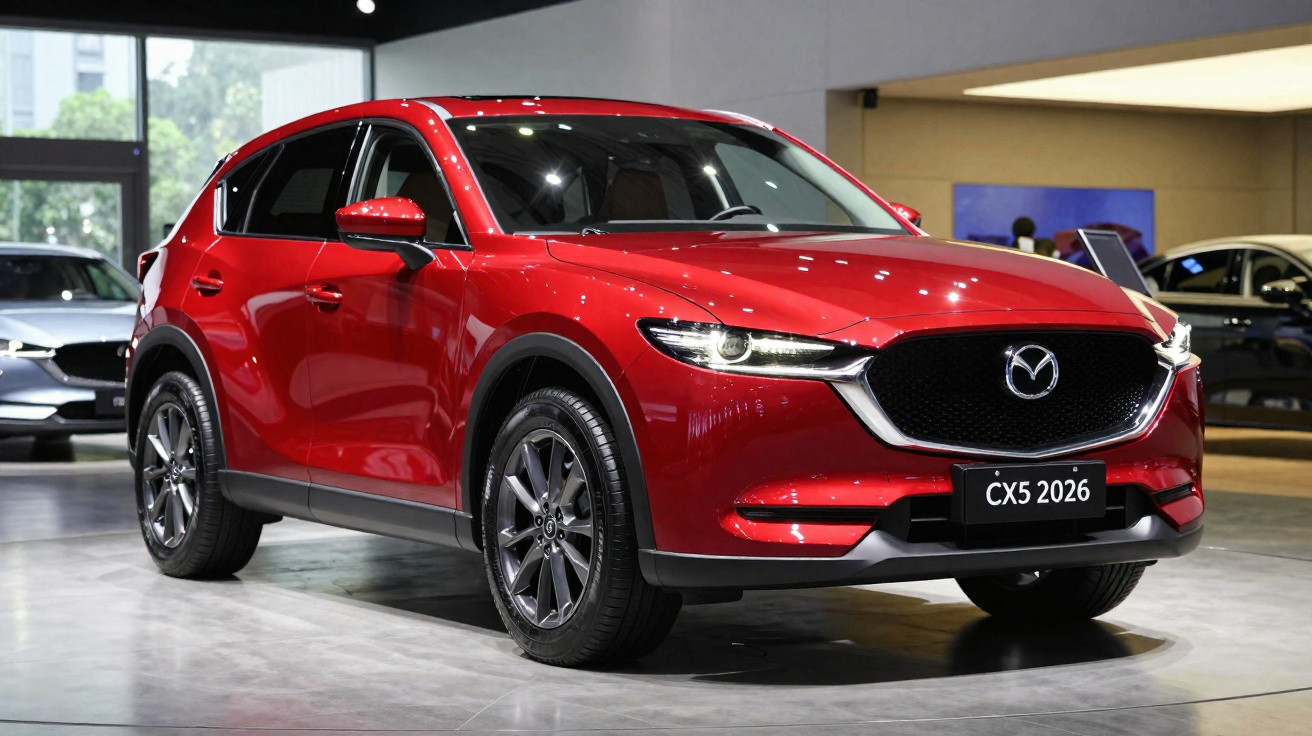
The new Mazda CX-5 moves forward in many areas, but it has also taken one step backwards. In Portugal, the engine may determine everything else.
Since 2012, more than five million examples have been sold, with over 850,000 of those finding buyers in Europe alone. The Mazda CX-5 is not merely an important car for the Japanese manufacturer: it is the brand’s true cornerstone in its largest global markets. It is the model that cannot afford to fail, although Portuguese taxation is set to make life difficult for the CX-5. More on that later.
For all these reasons, this third generation faces a demanding brief: retain the style, quality and “Mazda DNA”. To avoid any suspense, it has managed it. The less positive news? In Portugal, that may not be enough.
That is because it launches with just one petrol engine, a 2.5-litre unit. There will be no diesel, while the hybrid will not arrive until 2027. In a country where tax rules penalise larger engine capacities, this is far from an insignificant detail.
Almost as large as a CX-60
Let us start with what is immediately visible. The third-generation Mazda CX-5 has increased in every dimension - and by no small margin.
It now measures 4.69 m long, with a 2.815 m wheelbase, bringing it very close to SUVs from the segment above. Indeed, it is only 5 cm shorter and 3 cm narrower than the CX-60.
While the benefits are obvious - rear-seat occupants gain considerably - there are drawbacks when it comes to supermarket car parks and tighter manoeuvres. Was it designed for the United States or Europe? Perhaps for both.
The larger body also gives it more favourable proportions. Mazda continues to develop its Kodo design language, but it has not taken risks with its best-selling model: the new CX-5 could more easily be mistaken for a facelift of the previous one than an all-new generation.
Is it overly cautious? Possibly. Even so, it remains one of the class’s most distinctive, sophisticated and successful designs. In Soul Red, it looks especially good.
More technology, less tactility
Although the exterior has evolved cautiously, the cabin is a revolution. Mazda resisted for a long time, but it has now given in to giant screens too.
At the centre of the dashboard sits a 15.6-inch touchscreen. It is larger than my laptop display. Nearly every function is controlled through it, including the climate controls.
It is nevertheless an unusual choice at a time when several manufacturers are reinstating physical buttons for ergonomic and safety reasons - and because customers have been dissatisfied. There are virtually no buttons in the new CX-5’s cabin; even the volume control has disappeared. Ergonomics have taken a step backwards.
That said, the infotainment system deserves praise, as it is far better than before. The reason is its Google-based software, which provides a superior user experience. It is quick, fairly intuitive and gives access to the Google apps we are already used to using on our smartphones.
Yet there is still a sense that something has been lost. Mazda’s physical controls were well executed, whereas smooth, haptic surfaces now dominate. They work, but they are not particularly appealing. The cabin is more technological and minimalist, but also less distinctive.
Mazda offsets that absence with trim materials that, in general, look and feel high-quality, while the assembly quality appears excellent and very sturdy at first glance.
There are some cost-saving measures evident in details such as the plastic used on the A-pillars and, on a more personal note, in the feel of the synthetic leather on the steering wheel, which I found rather unpleasant. Even so, the new CX-5’s interior remains a step above mainstream rivals for presentation and quality, and need not fear comparisons with premium models.
Rear-seat space is impressive
The previous Mazda CX-5 was not cramped, but the new generation’s extra 115 mm of wheelbase makes its second row one of the roomiest in the class. The improvement starts with access, courtesy of wider doors that open to almost 90 degrees. For parents putting child seats in or taking them out, that makes a major difference.
Once seated, the available room is remarkable - it is easy to cross your legs. With so much space on offer, it is a shame the seats do not slide, as they do in some rivals. Such a solution would increase the 583-litre boot (+61 litres over its predecessor) while retaining very reasonable space for rear passengers.
Mazda being Mazda
Under the bonnet, the new CX-5 could hardly be more Mazda: the marque continues to follow its own path. Unlike rivals with 1.5- or 1.6-litre turbocharged engines, the new CX-5 launches exclusively with a 2.5-litre powertrain. Output? Just 141 hp.
It is not especially impressive on paper, but it is more convincing on the road. That is because the 2.5 e-Skyactiv G, paired with a 24 V mild-hybrid system, produces 238 Nm (between 3500 rpm and 3750 rpm), a figure comparable with smaller-capacity turbo engines.
In everyday driving, this naturally aspirated petrol engine can even bring a diesel to mind, as it favours low and mid-range revs, although its response is typical of this type of engine: immediate, without the hesitation found in some turbo units. It is also pleasant to use provided it is not worked too hard, as the noise becomes intrusive above 4000 rpm.
Mazda has also dropped the manual gearbox from the new CX-5. It is offered solely with the six-speed automatic torque-converter transmission carried over from its predecessor. It has been recalibrated and is generally smooth in operation. When more is demanded of it, however, it does not always respond with the necessary speed or decisiveness.
The greater engine capacity and preference for lower revs mean that the engine and gearbox do not need to be “worked” as hard as they did with the 2.0-litre unit, which could result in better fuel economy in the “real world”.
Although the fuel consumption recorded during these first drives is not especially representative, the 7.7 l/100 km achieved (a mix of road and motorway driving) is not excessively far from the official 7.0 l/100 km combined WLTP figure.
The most comfortable CX-5 ever
Dynamically, it remains a Mazda, retaining the sense of precision that usually distinguishes the brand. However, comfort is the clear priority for this new generation.
Road imperfections are absorbed far more gently than before, making every journey considerably more comfortable - particularly important in a family SUV.
This may not be welcome news for enthusiasts who appreciate Mazda’s traditionally sharper dynamic edge, but the CX-5 does not disappoint on the road. Yes, it is softer and leans slightly more in corners, yet it still shows excellent control of body movements and remains above average dynamically for the class. It also impressed on the motorway, where it offers excellent stability and careful sound insulation, except once again when higher engine speeds are repeatedly explored.
The controls - steering wheel and pedals - remain exceptionally precise, though I would personally welcome slightly more steering weight in Normal mode; it is better in Sport mode.
When 2.5 litres matter more than 141 hp
The new Mazda CX-5 starts at €39,988 in Portugal - see the full range prices here. This is competitive against rivals such as the Volkswagen Tiguan and Hyundai Tucson, and several thousand euros lower than premium alternatives including the Audi Q3 and BMW X1.
The issue lies with the engine’s 2488 cm³ capacity, which means higher annual vehicle tax (IUC) than competitors fitted with 1.5- or 1.6-litre turbocharged units. The difference can exceed €100 per year and, although it may not be a decisive purchase factor, it is unlikely to make the new CX-5’s prospects in Portugal any easier.
Engine size also affects perception: in a market dominated by hybrids and modest-capacity engines, a naturally aspirated 2.5-litre petrol unit seems out of place, even if its “real-world” fuel consumption is not disappointing.
Even so, it should have offered more choice from launch. Until then, the CX-5 is playing a single card, and it is far from the most suitable one for a market such as Portugal.




Comments
No comments yet. Be the first to comment!
Leave a Comment