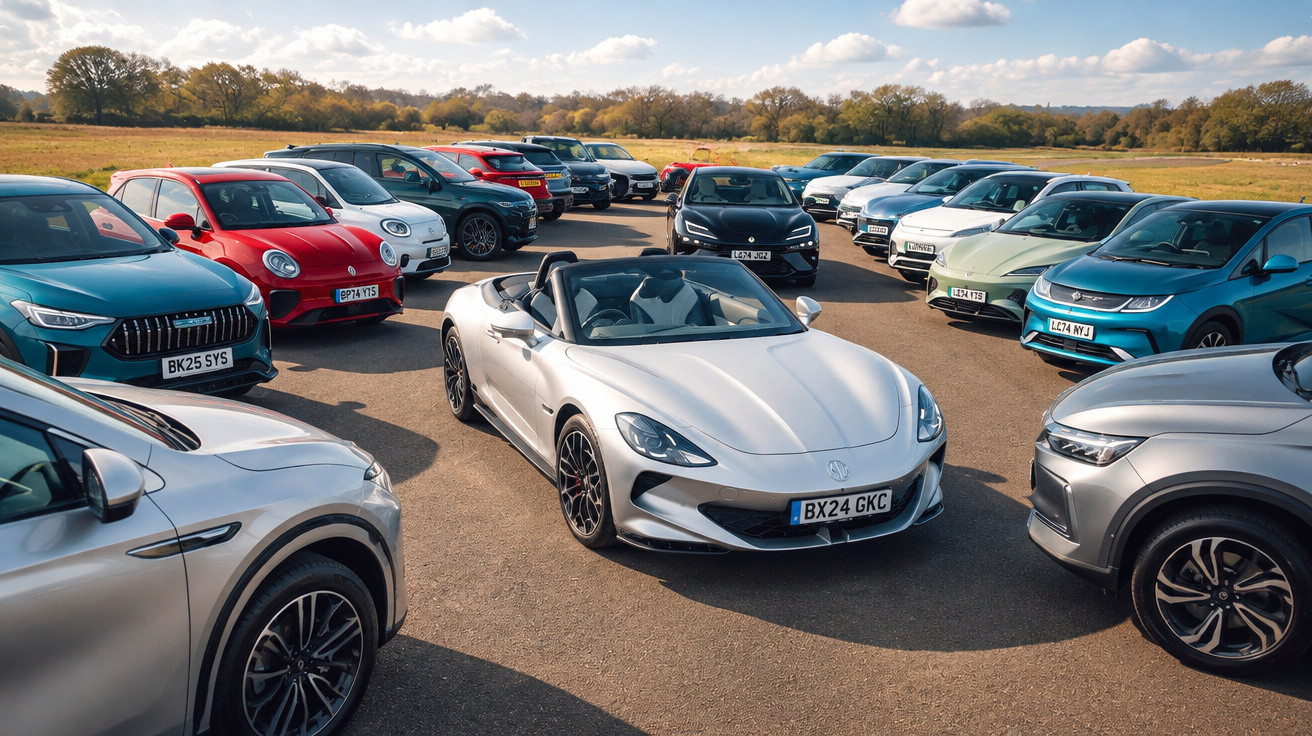
Every Chinese car currently on sale in the UK. That means today; by tomorrow, there will be more. Chinese-built vehicles represented only three per cent of European sales three years ago. That figure has now reached 20 per cent.
Before we begin, though, that statement needs an asterisk. From an eight-model line-up, we have included just one MG. Why? At first, MG declined to loan us cars for this feature, maintaining that it was a British company. It raises an interesting question of definition: where exactly should the line be drawn? Volvo belongs to Chinese giant Geely, while electric Minis are made in Zhangjiagang rather than Cowley. Are they Chinese cars? Then there is Lotus, Chinese-owned and Chinese-built for a worldwide market seeking electric SUVs.
So where does MG fit? Its British credentials amount to a London design studio, a small engineering operation that remains at Longbridge, and its name. Everything else is Chinese. Does it matter to you where a car originates or who owns its maker? MG plainly thinks it does, otherwise it would not have objected to lending us vehicles. Perhaps it only matters because of the scare stories suggesting that your car might spy on you.
Photography: Jonny Fleetwood
We cannot entirely dismiss that concern. What we can say is that every company we approached complies with GDPR data-privacy rules. Yet China is less transparent to us than Korea or Japan, and several of its major car makers - including MG parent company SAIC - are state-owned. If that troubles you, it is reasonable enough to buy elsewhere.
But the real question is whether the cars are any good. That is what we are here to establish, once we have worked out what they all are. Most of these badges are unfamiliar, so in a market without established brand equity, where is the hierarchy? Which is the BMW, Renault, Bentley or Toyota?
MG and BYD: Chinese cars at opposite ends of the scale
Design is the first means of communication, and the MG Cyberster is the standout here. MG made its name with two-seat convertibles, so approving only the second fully electric example ever made - following the Lotus-derived Tesla Roadster - gives the car a certain significance. Its British-led design team has produced a conventionally attractive shape that is restrained and polished, but there are problems. European Cybersters make do with a watered-down, graphically emasculated take on the elaborate displays offered in China, making the crucial technology experience dreadful. Its damping, meanwhile, has the refinement of a waterbed rolling down a spiral staircase. As a result, the 310bhp rear-wheel-drive Trophy is already too fast to be comfortable, never mind the twin-motor 500bhp GT.
Modern MG is nevertheless the brand the others would most like to copy. It has sold cars in Britain since 2011 and last year moved more vehicles than Vauxhall, Skoda or Peugeot. Much of its range is rather uninspiring, but the MG4 is an excellent hatchback and would have performed well in this test. The company most likely to challenge MG’s chart-topping status is BYD. Already the world’s largest electric-vehicle manufacturer, selling more EVs than Tesla, it has assembled a five-model UK range in little more than a year. The Atto 3 and Dolphin arrived first, and they are the least exciting of the lot.
Despite being only a year or two older than the other BYDs, both feel a generation behind. The Dolphin is a supermini-sized hatch, but at £26k it is priced alongside the MG4, which outclasses it in every respect - including its ability to exhibit several unrelated handling characteristics through a single bend. The Atto 3, meanwhile, takes an ill-judged swing at a themed cabin, complete with guitar-string door pockets and 1950s jukebox-style air vents. It is appropriately sized for Qashqai-owning families looking to go electric, with a 440-litre boot and a 60kWh battery offering 260 miles of range. Yet the plastics feel cheap, the styling appears to borrow from a 15-year-old Mitsubishi, and behind the wheel it is the very definition of indifferent. The entire car feels slightly out of tune.
Do not start rubbing your hands expecting a bargain, either. The Atto 3 costs £37,140, and residual values are poor because BYD has not yet built a reputation or inspired buyer confidence. That is true of plenty of these cars and brands. The Atto feels like something BYD has simply flung at the UK to see whether it sticks. Hopefully, it will slide down the wall and disappear into obscurity.
The Seal, Sealion 7 and Seal U make a far stronger case. The Seal U in particular succeeds because it is both larger and less expensive than the Atto 3. This £33k PHEV combines a 1.5-litre engine with either an 18.3 or 26.6kWh battery, using petrol power either as a range extender or to drive the wheels directly. It is generously soft-riding, unexpectedly plush inside and best enjoyed at a more relaxed pace.
The Seal saloon and Sealion 7 SUV use the same 400V architecture, although Chinese buyers get an Evo variant with 800V capability for faster charging. This will not be the first or last occasion when it feels as though China is holding the best products back for itself. Both cars are plainly aimed at the Tesla Model 3/Y. They are streamlined and refined, with double-laminated glass joining the silent powertrain to keep noise levels low - until the unavoidable active-safety systems start bonging, naturally. A mildly untidy ride prevents the Seal from providing genuinely luxurious wafting progress, while the taller Sealion 7 SUV is, as its name suggests, somewhat more gelatinous to drive. There is a misleadingly large amount to like for less than £45k, along with a six-year warranty. But could you really spend that much on a brand you had never heard of a week ago, whose products are as difficult to pin down as their namesakes?
That is the central problem. A decade or more ago, numerous Chinese companies produced copies of European cars such as the Evoque. They now create their own designs, and they are tidy but anonymous and forgettable. Hyundai passed through much the same phase before emerging firmly on the other side. However, Hyundai had to cater for worldwide tastes because Korea’s domestic market is small. China has the world’s biggest car market, so BYD and its peers have less reason to adapt to our preferences.
Lotus, Smart and Volvo with Chinese backing
Consider the firms that have adapted: Lotus, Smart and Volvo. There is a spectrum at work. Volvo continues to behave as it always has, albeit with Chinese support in the background. Lotus has been comprehensively repositioned: it is no longer a lightweight sports-car maker, but a luxury performance brand trying to challenge Porsche. Smart, meanwhile, is a Mercedes-Geely joint venture, meaning the 1 and 3 - we refuse to use the dreadful hashtags - sit on Zeekr architecture also used by the Volvo EX30. It is all rather bewildering.
26 minutes 31 seconds
All three feel European. The Emeya may lack the final layer of chassis finesse, the Smart’s bulbous styling will not appeal to everyone, and Volvo’s determination to bury every function in the central touchscreen is maddening from a company that makes so much noise about safety. Even so, they are good cars. No Lotus has ever matched the Emeya for build quality; the EX90 represents the high point of Volvo’s family-oriented approach; and the Smarts are inventive, striking, well packaged and keenly priced. Fine, the lower-roofed 3 has a purpose that is impossible to identify, but you can be certain that the phrase ‘urban style’ appears somewhere in its brochure.
They are all easy to recommend. Some of the rest most certainly are not. Take the Omoda 5, Skywell BE11 and GWM Haval Jolion Pro. They are crossovers, which is hardly surprising when almost everything is one now. These are vehicles that appear to have skipped development altogether. In the £25,915 Omoda, the engine and gearbox - expecting an EV? The £33k Omoda E5 will be along shortly - seem not to be on speaking terms. The Skywell’s suspension is so readily overwhelmed that its occupants imitate novelty bobblehead dolls. And we remain completely baffled by the Haval’s ability to deliver so little performance with so much noise.
Finding redeeming qualities is genuinely difficult. The Omoda offers a seven-year warranty and a five-star Euro NCAP score, but the way it drives suggests you may need both. Do you ever suspect that nobody has carried out any chassis tuning? That the makers have simply ensured the electronic safety systems function, confirmed it will not roll over however clumsy or panicked the driver becomes, and sent it out of the factory? Yes, precisely that. The Haval is bizarrely packaged, its boot is tiny, and its wheels sit so deeply inside their arches that they look as if they have gone into hibernation. Skywell? It is the union of Golden Dragon Bus Company and electronics brand Skyworth, except it seems they assigned the wrong partner to develop the infotainment.
Prices, partnerships and the next Chinese car wave
You may assume they are cheap, but they are not. This is the key point about Chinese cars: they are not arriving with prices that undercut Dacia. At best, they cost only a couple of thousand pounds less than comparable mainstream rivals, and lease prices deserve close attention because residual values are unlikely to be attractive. Nor are prices being inflated by import duties, as the UK - unlike the EU - does not currently penalise Chinese marques.
The Leapmotor T03 is the exception. It does come with a Dacia-beating price: only £15,995 for 94bhp and 165 miles of range. Like Smart, it is the product of a partnership, in this instance with Stellantis, and the T03 is built on the former Fiat 500 production line in Poland. It is... all right. Apart from its appearance. A price that low excuses a great deal - until you remember that you could buy something used instead.
There’s diversity in the products and brands, but as yet little character. That’s what we love and where we differ
Leapmotor’s other model, the C10, shares nothing with its sibling but rather a lot with the Xpeng - pronounced chow-pung - G6. Both take aim directly at Tesla. They are not the only ones, but they are the least subtle about it. Examine the C10’s cabin: it seems to have been copied wholesale, right down to the precise grey shade and the texture of the materials. It is uncanny. With the Xpeng, you do not even need to get inside. Its high roofline is so close to the Model Y’s that it feels as if copyright law is being stretched. Both cost below £40k and feature smooth, unadorned lines and flush-fitting door handles. The C10 is a lumbering pudding; the G6 is more appealing. It is our preferred Chinese newcomer, and the best car outside the European-influenced models.
Jaecoo, Omoda’s upmarket arm within the Chery empire - mapping the family tree is easier in a rabbit warren - says it competes at that level. Yet cars sold primarily on their badge require that intangible, impossible-to-package ‘want one’ quality. A rejected team name from The Apprentice and an XXL touchscreen will not achieve it. There is not even a parking-brake switch. Are they not mandatory?
The car once called the Funky Cat has lost its sole USP and is now the Ora 03. Made by GWM, it has a reasonable amount in common with the electric Mini thanks to a joint venture with BMW. Drive them consecutively, though, and you will quickly learn that this is rather like Danny Dyer’s connection to King Edward III. Starting at £24,995, it is neither especially cheap nor cheerful when considered alongside cars such as the Renault 5 or Fiat Grande Panda.
This is where things stand today: a small group of new companies has arrived with cars of uneven quality. Some are acceptable; others are laughable. It will not stay that way for long. If European marques have been caught out by one thing, it is the extraordinary development speed of Chinese brands. Some designers we have spoken with believe they can progress from sketch to production in 18 months or less. In Europe, the process takes four to six years. Competition is fundamental to the system. The Chinese state funded companies to get them started, then allowed them to battle one another. The resulting failure rate has been brutal. Three years ago, China was thought to have 652 car firms; today, after collapses, takeovers and mergers, only 150 remain. British buyers can currently choose from about 57 brands.
Bringing them together demonstrated that the products and brands are diverse, but character remains scarce. That is what we value, and where our tastes diverge. China has no longstanding car culture; instead, it promotes and celebrates technology and autonomous driving. Whether it can, or even wants to, change course and make cars that interest us is still unclear. But those of us who love cars are a minority, and despite tariffs, Europe’s mainstream marques appear vulnerable to an incoming product onslaught. It is arriving quickly.





Comments
No comments yet. Be the first to comment!
Leave a Comment