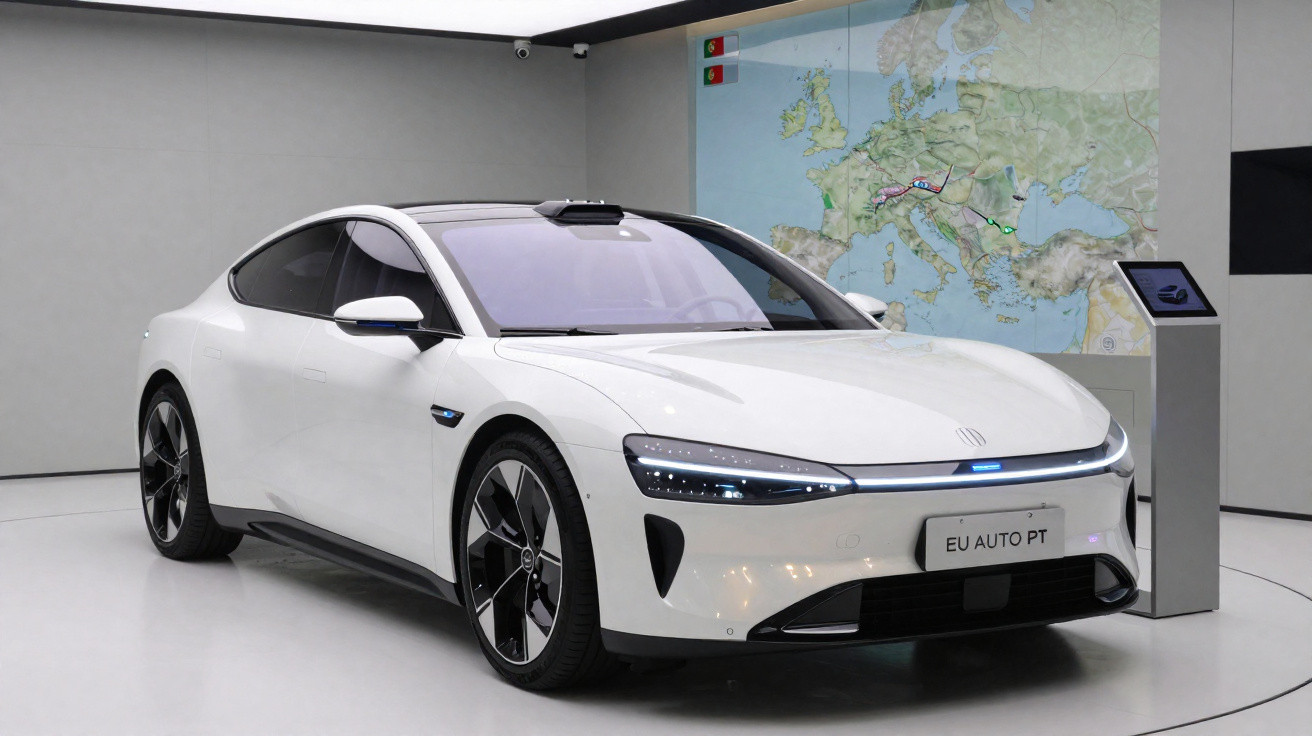
An autonomous car could one day cross a European border without having to navigate a maze of rules, permits and procedures. Portugal took another step towards that goal this week by signing the European declaration intended to establish cross-border testing areas for autonomous vehicles.
The country’s accession was formalised yesterday, 29 September, in Brussels at Connecting Europe Days 2026, when Secretary of State for Mobility Cristina Pinto Dias signed the Joint Declaration of Intent. Slovakia and Norway joined the initiative alongside Portugal, while Spain signed up last week.
The project now involves 22 countries, having been launched in June by 18 Member States. Its aim is to allow autonomous vehicles to be tested and gradually deployed across several European countries under harmonised rules and procedures.
Less red tape for autonomous vehicles
At present, testing an autonomous driving system in several countries can require dealing with different legal frameworks and approval processes. The European initiative is specifically designed to reduce this fragmentation.
Under the declaration signed by the 22 countries, participants will work towards a shared set of technical requirements for approving autonomous vehicles and will cooperate throughout approval and testing procedures.
The plan also seeks to make it easier for participating countries to mutually recognise vehicles that have already been approved by their authorities. However, this does not mean that an autonomous car approved in Portugal could simply cross the border and begin operating in Spain. Each country remains responsible for authorising the use and deployment of vehicles on its own roads, in line with national legislation.
The key change lies in efforts to bring these processes closer together. The countries undertake to work on common principles and, where needed, support the granting of national, regional or local permits and licences.
Although “autonomous cars” is the most immediately recognisable term, the initiative covers a wider range of applications. The declaration envisages these systems being used for passenger transport, freight transport and logistics.
Participating countries will work with operators, private companies and research organisations to identify uses that can be tested and subsequently replicated.
Industrial element
The initiative extends beyond mobility. The 22 countries aim to involve automotive and technology companies, along with other players in the European value chain, with the stated objective of supporting the growth of European innovation ecosystems linked to autonomous driving. In particular, the declaration sets out specific conditions for the participation of companies from outside the EU.
It also provides for the sharing of safety-relevant data, including information on accidents, near misses and cybersecurity-related incidents.
As an initial support measure, the 2026 work programme of the Connecting Europe Facility (CEF) allocates €20 million to digital infrastructure for autonomous driving. Find out more here.
Portugal’s case
Portugal’s entry into the initiative comes just months after the country introduced a dedicated framework for testing autonomous driving systems.
Decree-Law No. 113/2026, in force since 8 July, sets out the legal regime governing tests of automatic driving systems fitted to vehicles that have not been type-approved, or where the systems are installed after type approval. The legislation also defines the procedure for testing connectivity systems.
When Portugal’s participation was announced, the Institute for Mobility and Transport (IMT) told ECO that it had already received several requests for preliminary meetings to clarify the new framework. However, at that point it had not yet received any formal licence application or request to recognise licences issued by other Member States.

















Comments
No comments yet. Be the first to comment!
Leave a Comment