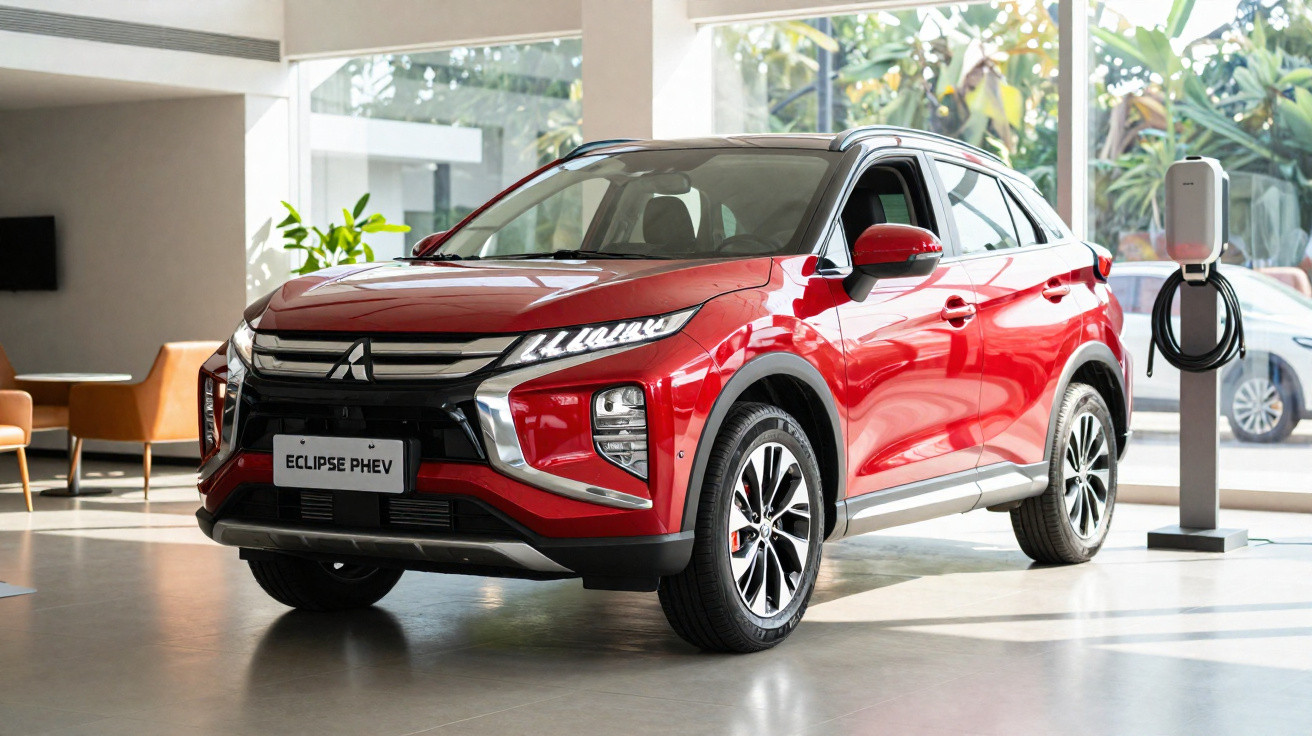
Recently facelifted, the Mitsubishi Eclipse Cross has not only adopted a more conventional appearance - particularly at the rear - but has also, at least in our market, dropped its combustion-only powertrains. In their place is a new plug-in hybrid system, one that has already brought considerable success to its larger ‘brother’, the Outlander.
The sole ‘problem’ is that, whereas the Outlander faced little or no opposition when it arrived, the Eclipse Cross PHEV enters the fray against a genuine ‘army’ of rivals ready to ‘make life difficult’ for it in one of Europe’s most fiercely contested segments.
So, has the Eclipse Cross facelift given it enough strengths to take on the competition? Or is this Japanese model ‘destined’ for a low-profile existence in the domestic market?
It could offer more space
The cabin has changed less dramatically than the exterior, with one of its biggest updates being the new 8-inch display. It is well placed and runs an infotainment system supported by useful physical controls. The system is very comprehensive - especially when it comes to hybrid-system information - although its graphics already look dated beside those of other models.
The materials deserve praise, too, as most are soft to the touch. In fact, the overall ambience of the Eclipse Cross PHEV was a pleasant surprise: every control has a reassuringly solid feel, while the assembly quality lives up to the reputation of Japanese manufacturers.
Staying with the cabin, it is worth noting the retention of numerous physical buttons. Some may regard this as old-fashioned, but I consider it an ergonomic benefit. The only drawback is the odd placement of the controls for the rather limited trip computer.
While the Eclipse Cross PHEV can go toe-to-toe with its rivals for overall quality, the Japanese offering is somewhat disappointing in terms of passenger space.
Rear legroom is merely adequate - although the almost non-existent central floor hump is a positive - and its boot is among the smallest in the class, at just 359 litres. For comparison, plug-in hybrid versions of rivals such as the Opel Grandland (390 litres), Citroën C5 Aircross (460–600 litres) and Ford Kuga (411 litres) all provide larger boots.
Efficiency is the priority
Using the same plug-in hybrid setup already familiar from the Outlander PHEV - and still unique in how it operates - the Eclipse Cross PHEV impresses with the smooth way it manages the combustion engine and its two electric motors, one on the front axle and the other on the rear.
In urban driving, particularly with a charged battery, the combustion engine remains virtually ‘silent’ at all times, helping to save a considerable amount of fuel.
Indeed, electric driving is so dominant - the system automatically switches between EV (electric), Series (only the electric motors drive the vehicle, with the combustion engine acting as a generator) and Parallel (the combustion engine and rear electric motor work together) modes - that, during my first few kilometres behind the wheel of the Eclipse Cross PHEV, the trip computer showed a negligible average of 1.5 l/100 km.
In fully electric mode, I covered around 35 km. That is below the claimed 45 km and the figures offered by rivals, although I must admit that this electric range was achieved without paying particular attention to consumption.
Finally, once the battery had run out of charge, the 2.4-litre engine was ‘called into action’. Its smooth operation again deserves recognition, as do the fuel-consumption figures, which remained between 6 l/100 km and 6.5 l/100 km even with brisk driving and lengthy traffic queues included.
Comfort comes first in the Mitsubishi Eclipse Cross PHEV
As you will already have gathered, the Eclipse Cross plug-in hybrid system places efficiency at the heart of its brief. As a result, despite a combined output of 188 hp, Mitsubishi’s model is most at home at a more measured pace.
That is not to suggest it is slow, but its performance is, as expected, only reasonable when set against rivals offering considerably more power. Its near-two-tonne weight does not help matters here, either.
Its dynamic behaviour further underlines the more relaxed nature of this Japanese model. The suspension is clearly tuned for comfort - and performs very well in that respect - but, once the road turns twisty, it does not maintain the same composure as some rivals or even the former combustion-engined version, as the damping is somewhat soft.
Even so, the steering is accurate and its overall behaviour is safe and predictable; it simply does not have the handling focus displayed by other alternatives (we cannot all be the same, can we?).
The Eclipse Cross PHEV has five driving modes in total: Snow, Gravel, Eco, Normal and Tarmac. Since the first two are intended for highly specific situations, I will focus only on the latter three.
Eco makes the accelerator response excessively ‘relaxed’, so it is best used only once you are already travelling at a steady speed. Tarmac - effectively a sport mode - makes the response too abrupt and, oddly, at odds with the character of this Eclipse Cross PHEV. It is therefore easy to see why Normal delivers the ‘best of both worlds’.
Is it the right car for you?
Now featuring a more conventional - and easier-to-accept - design, and with the internal competition from the Outlander having ‘disappeared’, the Mitsubishi Eclipse Cross PHEV has both an easier job in the market and a greater responsibility within the Japanese brand.
With noteworthy overall quality, a proven and appealing plug-in hybrid system, and a strong level of comfort, the Eclipse Cross PHEV does, however, ‘lose’ some ground to rivals in areas such as practicality and passenger space.
Nevertheless, Mitsubishi’s Eclipse Cross PHEV is an option worth considering in one of the most competitive segments. It delivers low real-world fuel consumption, yet the truth is that not even this restyling - more extensive than usual - can conceal the model’s age in several respects. It has already been on the market for five years, after all, and is derived from the even more veteran Outlander.



Comments
No comments yet. Be the first to comment!
Leave a Comment