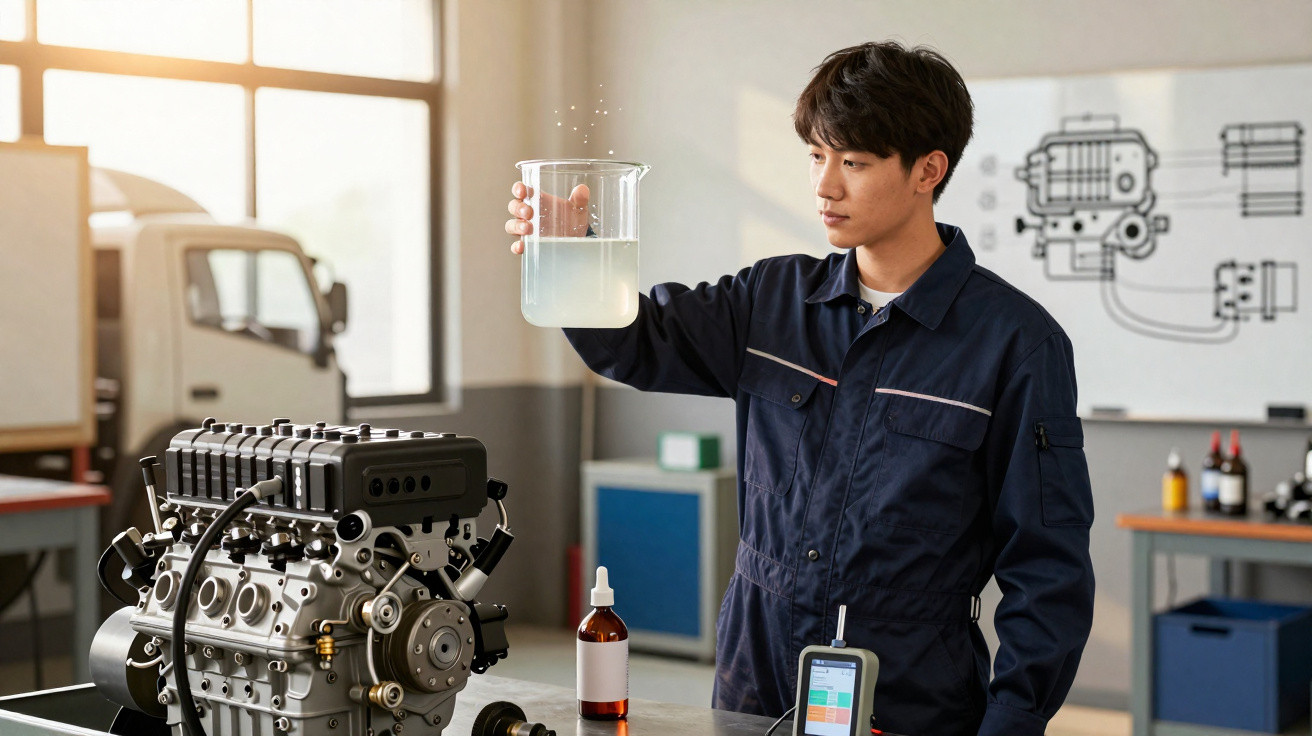
At first glance, it sounds like pub-table magic: pour water into a diesel tank and improve the engine? Yet the idea is not a garage tinkering tale, but the result of a systematic review of international studies by a research team at the Federal University of Technology in Owerri, Nigeria. Their analysis suggests that, when used correctly, water does not have to damage diesel; it can actually make combustion cleaner and more efficient.
How water can improve diesel fuel
The research centres on a concept known in specialist circles as a water-diesel emulsion. Rather than allowing diesel and water to form two distinct layers that separate in the tank, the aim is to keep minute water droplets permanently dispersed throughout the fuel.
This requires substances known as surfactants. They reduce surface tension and act rather like a chemical bridge between oil and water. The result is a relatively stable blend, in which fine water droplets remain evenly suspended in the diesel.
The researchers reviewed findings from numerous experiments and simulations, identifying strong evidence that engines using a water-diesel emulsion emit noticeably fewer harmful pollutants without sacrificing performance.
The concept is not entirely new, but it has never achieved a major breakthrough. This latest review study now brings together the scattered findings of recent years and indicates the conditions in which the approach works particularly well.
What happens inside the engine: micro-explosions against soot and nitrogen oxides
The process becomes especially interesting in the combustion chamber. Water does not act as an additional “fuel” there; instead, it provides a physical boost. Once the fuel is injected, the heat in the cylinder raises the temperature of the diesel and finely dispersed water droplets within milliseconds.
The water then vaporises almost instantly. The resulting pockets of vapour break apart the surrounding diesel. Specialists call this a micro-explosion: tiny disruptive effects within the spray plume that distribute the fuel far more effectively.
Better mixing, lower temperatures
These micro-explosions create extremely small diesel droplets with a larger surface area. They mix more thoroughly with the intake air and therefore burn more completely. At the same time, the evaporating water vapour slightly cools the flame in the combustion chamber. This is precisely what changes the composition of the exhaust gases.
- more complete combustion → less soot and particulate matter
- lower peak temperatures → significantly fewer nitrogen oxides
- a more uniform flame pattern → smoother, more efficient running
The experiments cited in the study report up to 67 per cent fewer nitrogen oxides and around 68 per cent fewer particulates than conventional diesel operation - notably without complex exhaust after-treatment.
Lower emissions and higher efficiency - can both really be achieved?
In engine development, the usual rule is that reducing nitrogen oxides often comes at the expense of efficiency or output. Water-diesel emulsion could at least partly ease this dilemma. The reviewed data show that brake thermal efficiency increased in many of the experiments.
Put simply, a greater proportion of the energy contained in the diesel reaches the crankshaft rather than being lost as waste heat through the cooling system or exhaust. The engines therefore made better use of the fuel without a measurable loss of power. In some scenarios, they even achieved a modest increase in output.
Lower emissions while maintaining or even improving efficiency - this combination makes the process especially appealing for commercial vehicles, generators and stationary installations.
This could matter particularly where diesel units operate for many hours under a relatively steady load, as even small efficiency gains and substantial emissions reductions can have a significant impact.
Why surfactants are essential to water-diesel emulsion
Although the underlying principle may sound straightforward, maintaining a stable mixture of water and diesel is challenging in practice. Without suitable surfactants, the water would soon settle out again in the tank. That could lead to corrosion, starting problems and uneven combustion.
The researchers therefore stress that both the choice and dosage of surfactants are crucial. Combinations of several surfactant types often deliver the best results: the emulsion remains stable for weeks, the fuel passes smoothly through the pump and injection system, and combustion remains consistent.
There is still considerable development work to do in this area:
- determining the optimum surfactant formulation for different engine types
- carrying out long-term compatibility tests with seals, fuel lines and injection systems
- assessing possible deposits in the combustion chamber and exhaust system
These issues must be resolved before garages or fleet operators can adopt the concept on a large scale. No one wants to risk injection pumps failing after only a few thousand operating hours.
Not a DIY fix: why water in the tank can be dangerous
The temptation is obvious: if water in diesel supposedly offers so many benefits, why not simply add some yourself? Specialists explicitly warn against doing exactly that.
Without a professionally produced emulsion and a tested formulation, the supposed miracle solution quickly becomes an engine-damaging contaminant.
Uncontrolled quantities of water can cause rust in fuel lines and tanks, damage the highly precise components of modern common-rail systems, and result in misfiring, reduced power and engine damage. Research uses precisely specified blends, specialised mixing equipment and closely monitored test conditions - it has nothing to do with improvised home remedies.
How the technology could reach real-world use
A practical rollout would require more than a new fuel recipe. One option would be to prepare diesel as a water-diesel emulsion at refineries or dedicated blending facilities, then distribute it in that form. Alternatively, fleet operators could use high-quality mixing equipment at their own depots.
Its interaction with other “cleaner” solutions is also promising. The study sees particular potential in combination with biodiesel. An emulsion made from water and bio-based diesel could:
- improve the CO₂ balance,
- reduce local air pollutants,
- while continuing to use existing diesel infrastructure.
Especially in countries with limited investment resources, this could offer a pragmatic way to make diesel fleets progressively more climate-friendly without having to switch immediately and completely to electric or hydrogen vehicles.
Risks, limitations and unanswered questions
Despite the encouraging data, water-diesel emulsion is not an automatic solution. The authors point to several unresolved issues, including how long emulsions remain stable in very cold or very hot climates, cleaning intervals for filters and injectors, and the effects of different water qualities.
There are also regulatory barriers. Fuel standards are tightly specified, and every new formulation must go through testing cycles. The supply industry also faces new demands, such as developing sealing materials and lubricants that can withstand contact with water more effectively.
What drivers and fleet operators can take from this now
For private motorists with diesel cars, nothing will change in the short term. Anyone wishing to look after their engine and reduce environmental harm should continue to use clean, standards-compliant fuel, keep up regular servicing and ensure that the particulate filter is functioning properly. Trying water in the tank remains off limits.
Fleet operators, as well as operators of ships, construction machinery or generators, should keep an eye on further developments. Once approved, production-ready emulsion fuels become available, they could remove a substantial amount of pollutants from exhaust gases where annual operating mileage is high - and, ideally, save a few per cent on fuel costs as well.
For researchers, the direction is clear: diesel remains a fossil energy source, but its harmful impact can be reduced. Water-diesel emulsions are among the approaches that do not immediately consign existing engines to retirement, instead giving them a cleaner remaining service life during the transition to more climate-friendly propulsion systems.
















Comments
No comments yet. Be the first to comment!
Leave a Comment