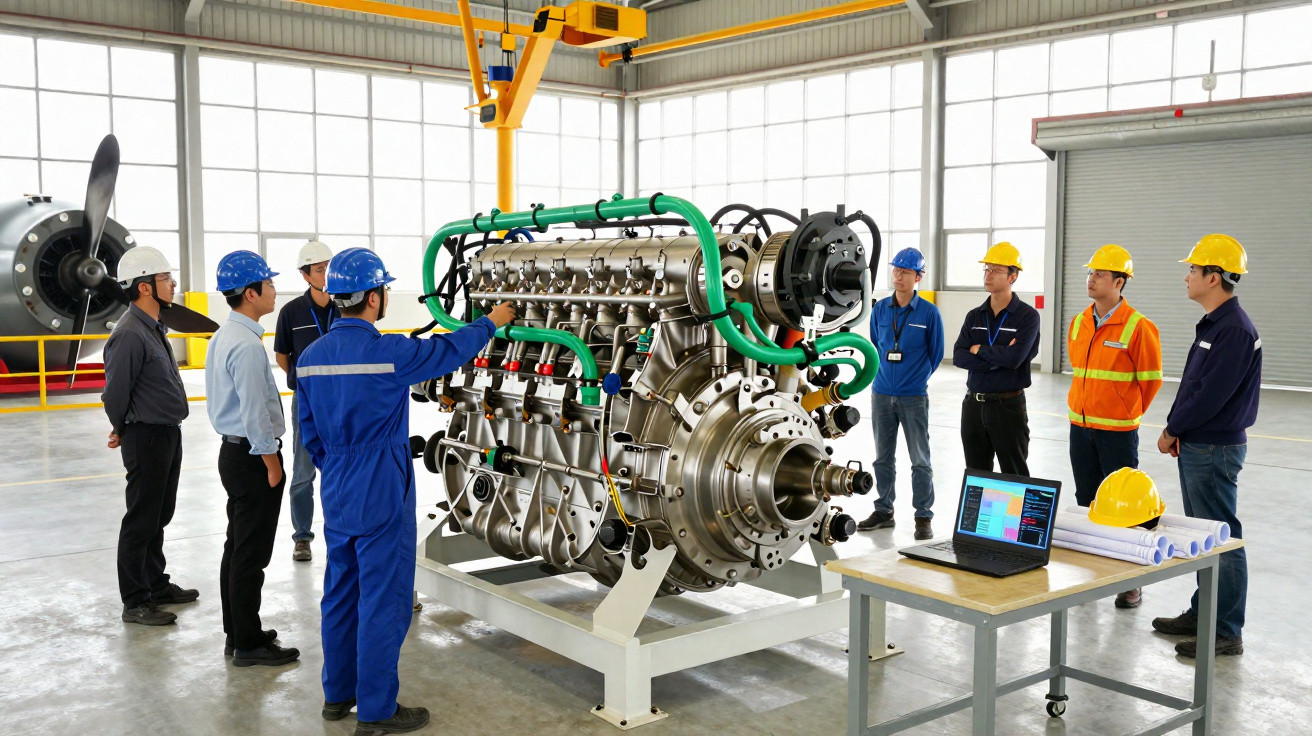
Everllence’s Saint-Nazaire engine factory, now part of the German group, is celebrating its 80th anniversary with a substantial investment programme focused on nuclear safety, cleaner maritime transport and the energy transition.
An 80-year-old factory becoming a heavy-energy “war machine”
Everllence, the German energy specialist previously called MAN Energy Solutions, has unveiled an ambitious expansion plan for its Saint-Nazaire facility in western France. Employing about 600 people, the plant produces some of the world’s biggest four-stroke engines, with certain models weighing as much as 320 tonnes.
These XXL engines are becoming strategic assets for nuclear safety and low-carbon shipping, driving a 40% growth forecast by 2028.
The group anticipates growth of around 40% by 2028, underpinned by two principal trends: the worldwide return of nuclear energy and the rapid transformation of shipping prompted by climate regulation.
The facility traces its origins to 1946, when S.E.M.T. (Société d’Études des Machines Thermiques) started developing and manufacturing diesel engines in Saint-Nazaire. Eighty years on, the historic marque and its plant are fully owned by Everllence. To mark the anniversary, the German parent is preparing what it describes as a “nice gift”: increased manufacturing capacity alongside a thorough site modernisation.
Nuclear engines designed for worst-case events
The enormous engines made in Saint-Nazaire are seldom featured in promotional material for nuclear power stations. Their importance emerges when all other systems have failed.
These powerful units are chiefly deployed as:
- emergency diesel generators,
- backup electricity systems,
- independent power sources when a grid connection fails.
If outside power is interrupted, the engines must start automatically within seconds. They supply electricity to:
- cooling equipment,
- safety pumps,
- control and instrumentation systems.
They are not intended to generate a station’s routine electricity output. Instead, they remain on standby, engineered to deliver exceptional dependability in uncommon but decisive circumstances.
In a total blackout, a nuclear plant relies on industrial engines like these to keep the reactor under control and prevent overheating.
The global nuclear fleet is forecast to expand. The International Atomic Energy Agency expects installed capacity to increase from about 377 gigawatts today to almost 1,000 gigawatts by 2050. Each new reactor, as well as many projects extending the operating life of current stations, requires highly specified backup-power equipment.
This expansion directly supports Everllence’s order book. Saint-Nazaire is established as a reference facility for nuclear emergency-power packages, covering the engine, integrated generating sets and control systems.
How does a nuclear emergency engine differ?
Engines intended for nuclear backup service must meet more demanding requirements than most industrial or marine units. They need to withstand lengthy idle periods before starting on demand in severe conditions.
- Redundant starting systems to limit the risk of failure
- Greater resistance to vibration and seismic events
- Fire resistance and stringent containment arrangements
- Highly intensive monitoring and testing procedures
Such demands require heavy-duty engineering and robust components, helping explain why a single engine may weigh several hundred tonnes.
Maritime pressure: climate regulation is reshaping ship propulsion
The challenge at sea is different, but equally exacting. Shipping is facing increasingly strict climate requirements from the International Maritime Organization (IMO) and the European Union, compelling shipowners to decarbonise their fleets over the coming two decades.
The IMO is aiming for a 40% reduction in carbon intensity by 2030 and 70% by 2040, on the route to net-zero emissions by 2050. Meanwhile, the EU is progressively incorporating shipping into its carbon market. By 2026, 100% of emissions from large vessels visiting EU ports will be included.
These measures are disrupting investment strategies across the global fleet. Lower-carbon vessels and fuels carry considerable costs:
- ships using low-carbon or alternative fuels may cost 30–50% more to construct,
- low-carbon fuels generally cost between two and five times as much as conventional fuels,
- renewing fleets could require up to $28 billion annually,
- alternative fuels and supporting infrastructure could cost as much as $90 billion each year.
For many shipowners, replacing engines with cleaner versions is faster and cheaper than ordering an entirely new vessel from scratch.
Adapting 320-tonne engines to alternative fuels
Against this backdrop, Everllence has chosen to adapt its immense marine engines for alternative fuels made from biomass or low-carbon gas, rather than await a wholesale move to entirely new vessel designs.
The Saint-Nazaire factory is a major centre for engines including the 51/60DF, a four-stroke giant offered in 6, 12 and 18-cylinder configurations. In its largest format, it produces up to 20,700 kW at about 500 rpm and can weigh more than 400 tonnes in total.
The engines can operate on diesel, heavy fuel oil, natural gas and biofuels. When running in gas mode, they require only a modest amount of pilot fuel. This versatility enables shipowners to move part of their fleets towards lower-carbon fuels while retaining the same fundamental propulsion arrangement.
The approach is already reflected in output plans. Everllence intends to add 24 engines to production in 2025, taking Saint-Nazaire’s annual output from 48 to 72 units. This uplift places the factory among the leading global suppliers of very large engines for maritime and energy uses.
6,000 m² of renewed offices to attract scarce expertise
Expansion involves more than additional steel and larger cranes. Everllence is also redesigning its working environment, with around 6,000 square metres of office space due for complete refurbishment over two years.
The scheme has three declared objectives:
- improve everyday working conditions,
- make the facility appealing to hard-to-find engineering and technical professionals,
- enable a greater focus on design and innovation.
The investment is as much about talent and engineering culture as it is about machines and production lines.
Upgraded offices, collaborative workplaces and stronger digital infrastructure are intended to facilitate increasingly complex projects, ranging from hybrid propulsion systems to engines ready for synthetic fuels.
Saint-Nazaire as a strategic energy centre
Saint-Nazaire was not selected for this expansion by chance. The plant forms part of an industrial and port ecosystem that has developed into one of France’s principal Atlantic energy gateways.
Nantes Saint-Nazaire Port processed about 26.4 million tonnes of freight in 2025, including approximately 18 million tonnes of energy products such as oil and liquefied natural gas. The zone receives more than 3,000 vessels annually and sustains nearly 28,700 direct jobs across 1,460 hectares.
Everllence operates alongside major companies including Chantiers de l’Atlantique in shipbuilding, EDF, TotalEnergies and ArcelorMittal. Its engine factory has a dedicated quay of its own, enabling engines weighing up to 320 tonnes to be loaded directly.
| Key figures for Saint-Nazaire energy cluster (2025) | Value |
|---|---|
| Total cargo handled | 26.4 million tonnes |
| Energy-related cargo | 18 million tonnes |
| Ships welcomed | 3,068 per year |
| Direct jobs on site | ≈ 28,700 |
The area is included in France’s “France 2030” strategy and is home to the ZIBaC Loire Estuaire programme, which has €8.2 million in backing. The programme is designed to advance projects involving hydrogen, carbon capture and biofuels. Everllence’s multi-fuel engines fit naturally within that environment.
Engines, biomass and lower-emission pathways
A central element of the Saint-Nazaire modernisation is the use of liquid fuels based on biomass. These include bio-methanol, hydrotreated vegetable oils (HVO), and other advanced biofuels made from waste and residues.
Using these fuels in a ship engine or emergency generator can reduce lifecycle emissions, depending on the feedstock and the production process. However, they remain more costly and available only in limited volumes. The result is a transition period in which many engines must be able to alternate between conventional fuel and bio-based blends.
Multi-fuel engines give operators a way to follow fuel markets and regulations without scrapping assets years before the end of their technical life.
From a risk standpoint, this adaptability lowers exposure to so-called “stranded assets”. Should future climate policies or carbon prices make one fuel uneconomic, shipowners and energy utilities can switch to another solution using the same equipment.
Implications for jobs and industrial capabilities
For local employees, the factory’s 80th-anniversary “nice gift” has practical consequences. Higher production volumes and fresh product configurations generally call for:
- more machining and assembly operatives,
- engineers with expertise in thermodynamics, digital controls and emissions,
- maintenance and testing technicians for large-scale prototypes.
A shortage of qualified workers is the potential threat to the site. This explains the emphasis on office upgrades and employment conditions: Everllence must compete with other advanced-technology sectors to recruit and retain staff, especially as nuclear and maritime engineering become more attractive again.
Safety and training are also central considerations. Running and testing 300-tonne engines for nuclear backup applications requires strict procedures, simulation tools and continuous skills development. The plant’s training resources, including the PrimeServ Academy, help share best practice with customers and service partners.
A factory where energy security meets decarbonisation
The Saint-Nazaire site occupies an unusual position at the intersection of energy-security concerns and climate obligations. Its engines act as a final safeguard in nuclear power stations, while its dual-fuel designs allow shipping to cut emissions without waiting for fully mature zero-carbon options.
Future projections indicate that both functions could expand. Additional nuclear capacity, including potential new reactor designs, would raise demand for backup power. At sea, stricter climate rules and possible fuel taxes could speed up conversion work across existing fleets, further supporting demand for large, flexible engines.
At present, the “beau cadeau” announced by Everllence combines higher production, upgraded facilities and closer integration with a rapidly evolving energy ecosystem. For a factory established in the diesel era 80 years ago, it represents an important new phase.










Comments
No comments yet. Be the first to comment!
Leave a Comment