
You spot it a moment later. In the white hatchback alongside you, the driver is looking down into their lap, their right hand wrapped around an illuminated screen. The vehicle inches ahead, jolts, then stops. Horns begin sounding further back in the queue. A cyclist squeezes past the door mirror and shakes his head. The driver never raises their eyes.
Half a minute later, that brief lapse in attention almost ends in twisted metal, shattered glass and emergency sirens.
Across Europe, police are steadily tightening enforcement against a behaviour at the wheel now regarded as nearly as dangerous as drink-driving. For a growing number of motorists, the consequences follow a familiar pattern: a €135 fine, three valuable points removed… and, in severe cases, a driving ban of up to three years.
€135, 3 points and a 3-year ban: what is really happening on our roads?
Look through the windscreens at any busy junction during rush hour and the usual habits are easy to spot. Coffee cups are wedged against dashboards. Children argue on the back seats. Sat-navs are propped up with strips of tape. Yet one sight stands out above the rest: a smartphone glowing in a driver’s hand. In France and several other EU countries, using a handheld phone while driving can now mean a €135 penalty, three points taken from your licence and, if you reoffend or cause a collision, a genuine possibility of being banned from driving for as long as three years.
Police officers repeatedly report the same warning signs: a vehicle wandering slightly across its lane, braking a little too late at traffic lights, or missing a pedestrian stepping into the road. When the driver is stopped, the handset is often still warm in their hand. The law treats this supposedly “small” lapse as a serious failure of responsibility. It is not limited to making a call with the phone held to your ear: scrolling through social media, reading texts, changing music, or even holding the device while it sits on your leg may be enough to result in the fine and the feared loss of points.
During a one-day operation on the ring road outside Lyon last autumn, officers stopped 312 motorists for using handheld phones. One in five said they were “just answering a quick message”. Another said he had been looking at work emails, “because my boss expects me to reply fast”. Within that group, three drivers had already committed previous mobile-phone offences. They received immediate licence suspensions and now face court bans that could run to three years. There had been no collision and nobody was hurt, but the law considers the danger sufficiently serious.
There is a straightforward reason for the tougher approach. At 50 km/h, a car covers roughly 14 metres every second. Look at a screen for only three seconds near a junction or pedestrian crossing, and you have effectively driven blind for the distance of a swimming pool. Research from European road-safety bodies indicates that motorists using a handheld phone may be up to four times more likely to be involved in a collision. This is why magistrates are increasingly imposing longer bans, particularly when phone use occurs alongside speeding, alcohol, or a previous recorded offence.
Lawmakers say a three-year suspension is not intended as punishment for its own sake. Rather, it is meant to make clear that distraction caused by a phone is no longer a “minor habit”. It is now placed in the same category as drink-driving and aggressive speeding: a decision capable of killing within seconds. For many motorists, the reality only lands when they are standing at the roadside, licence in hand, and hear that figure said aloud.
How to keep your licence – and your sanity – in the age of constant notifications
For regular drivers, being without a licence for three years is far more than an inconvenience. It can jeopardise work, family arrangements and even where they are able to live. That is why increasing numbers of people are changing their habits before starting the engine. The most useful solution sounds almost childish: place the phone somewhere physically unreachable. Put it in the glove box, a zipped bag on the rear seat, or even the boot. The important point is that you cannot casually pick it up at the next red light.
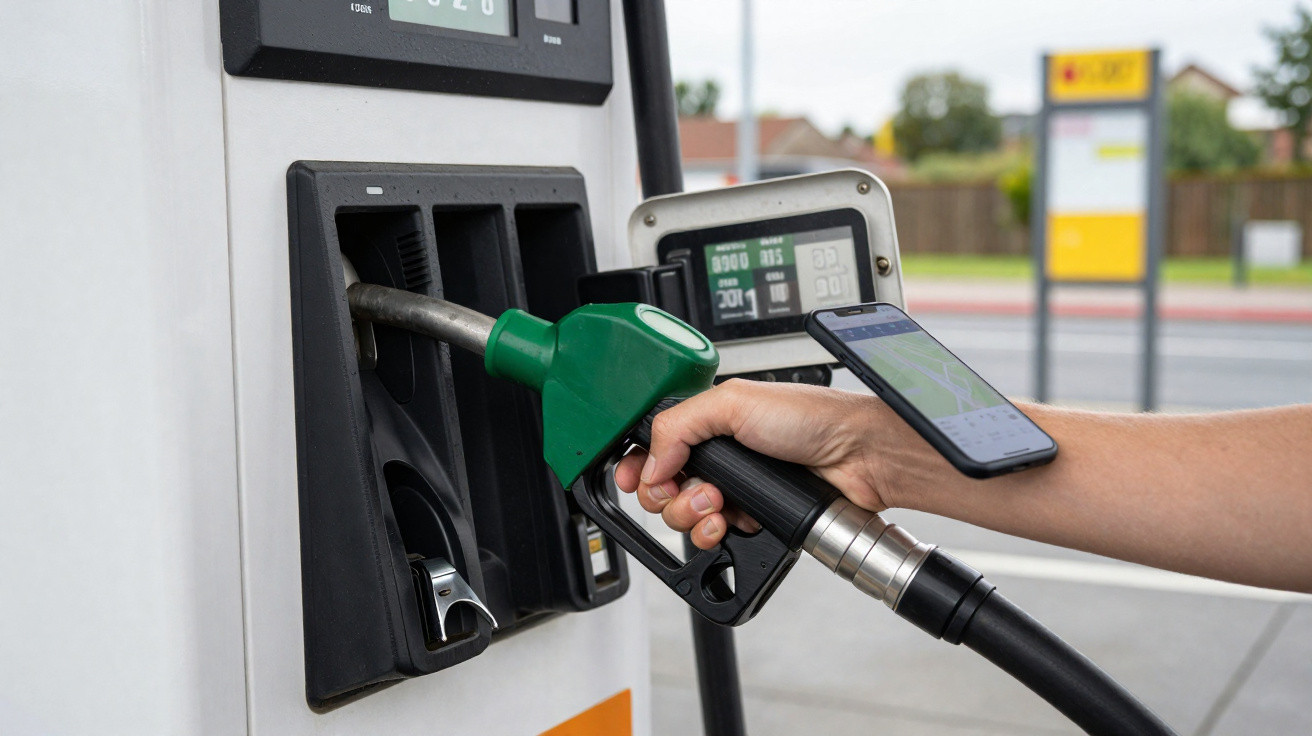
Drivers who depend on a phone for GPS navigation still have an option under the law, provided the handset is secured in a suitable hands-free mount and is not touched while the vehicle is moving. Entering the route while parked, locking the screen and following spoken directions is much safer than tapping at a moving map. It may seem a minor distinction, but the gap between your hand and the display can separate an ordinary commute from a €135 shock.
On a dull Tuesday in Marseille, a delivery driver called Karim explained his own rule: “Phone goes in airplane mode the moment I start the engine.” In one year, he lost two colleagues: one in a collision caused by a motorist sending texts, and another to a lengthy driving ban following repeat phone offences. Those experiences led him to adopt a quiet form of discipline. Other people activate “focus” settings that silence alerts when the car’s Bluetooth connects, or use applications that automatically respond to messages with a brief note: “I’m driving right now, I’ll read this later.”
At a human level, technology is not the biggest challenge. It is the reflex in your mind when you hear a vibration or catch the screen lighting up at the edge of your vision. Many motorists admit feeling an odd obligation to remain available at every moment, whether for a manager, partner or friends. That expectation does not disappear once you join the motorway. That is precisely where the real risk lies.
Some people are therefore beginning to reset those expectations openly. Saying to your manager, “When I’m driving, I don’t touch the phone – if it’s urgent, call twice and I’ll pull over safely,” may feel awkward initially. However, it returns responsibility to life outside the vehicle, where it belongs. Let’s be honest: nobody actually does this every day. But the more often you say it, the more natural it becomes to protect that small space of concentration on the road.
A traffic officer at a roadside stop near Lille put it plainly:
“You don’t control the truck behind you. You don’t control the kid who runs after a ball. The only thing you really control is whether you pick up that phone or not.”
The legal danger is only part of the issue. There is also the mental burden of driving while remaining partly tied to a digital world that constantly demands attention. After a long day, the steady drip of alerts can leave you anxious, on edge and distracted long after the engine has been switched off.
- Activate a “driving mode” that blocks or silences notifications as soon as your car connects.
- Use a secure holder and programme your route before setting off, turning the phone into a quiet map rather than a distraction.
- Tell the people closest to you that you are offline when driving, then keep that promise.
- Stop somewhere safe for genuinely urgent calls instead of trying to manage both wheel and screen.
- Monitor your own routines for a week and identify when the temptation to “just check” is strongest.
The normalised habit – and the penalties that prove it is not
On a warm evening, as traffic crawls towards the suburbs, a strange double standard becomes visible. Plenty of drivers understand the danger. They know about the €135 fine, the three points and reports of lengthy bans appearing on news websites. Yet, when the queue stops and boredom takes over, a thumb still moves towards the notification symbol. On a bus or tram, that action changes nothing. Behind a steering wheel, it changes everything.
At a motorway service station near Bordeaux, a young mother described when she stopped treating phone use as a minor wrongdoing. At a junction, her car was struck from behind by a driver who admitted he was “checking a message really fast”. Nobody died, but her son spent one night in hospital with whiplash. Months afterwards, her shoulders still tighten whenever she hears a phone vibrate in a moving vehicle. She never saw the ban imposed on the other motorist; all she saw were the ambulance doors shutting around her child.
Road safety is often discussed in detached figures: points, euros and years without a licence. In reality, it is harsher than that. A three-year driving ban for repeated phone use is not an arbitrary sanction plucked from nowhere. It is the legal system attempting, sometimes imperfectly, to reflect the scale of possible harm. Perhaps that seems severe if you have never had a near miss. But almost everybody now has a story: a sudden swerve, sharp braking, a horn sounding half a second before one vehicle struck another. On a quiet evening, those memories can feel louder than any alert.
More personally, losing a licence does not simply disrupt a timetable. It may mean changing jobs, turning down opportunities, reconsidering where children attend school, or altering how you care for elderly relatives. All of it can stem from a habit that began so subtly it hardly felt like a decision: a quick look, a “just this once”, a message that could easily have waited another ten minutes. In human terms, the real cost of lifting that phone is seldom measured solely in euros and points.
Some drivers hear about the €135 fine, the three points and the possibility of a three-year ban, then dismiss it. Others feel a chill and put their phone in the glove box before they turn the key. Often, the difference between those reactions is whether they have already experienced the close call that remains with them for years.
Next time you stop at a red light, look around – then look at your own hands. Are they resting gently on the wheel, or moving towards a screen through pure habit? That small split-second choice occurs thousands of times every minute across the country. Quiet decisions, unseen consequences. Usually, nothing goes wrong, and the pattern continues into the next journey.
But legislation is changing more quickly than our instincts. Courts are increasingly considering phone use in the same terms as alcohol or excessive speed. Insurers, too, are quietly revising their calculations of risk, using telematics and black-box information to identify distraction patterns that they previously overlooked. The old defence – “everyone does it” – sounds increasingly weak when you are taking the bus because your licence has been gone until 2027.
On a human level, the question is painfully straightforward: what are you truly doing when you check that message at 70 km/h? You may be replying to a friend or perhaps trying to satisfy your boss. But you are also risking your licence, your income and the bodies of strangers sharing the road with you. On a bad day, you are gambling with their lives. On a good day, you simply arrive home and forget that the gamble took place.
We do not normally speak about driving in such blunt language. We would rather complain about fuel costs or traffic jams. Yet a quiet change is unfolding somewhere between the steering wheel and the notification bar. Penalties are becoming more severe. Technology is becoming more intelligent. And the real control remains where it has always been: in the small, ordinary decision to let the phone ring, light up and buzz… while keeping your eyes on the road ahead.
| Key point | Detail | Why it matters to the reader |
|---|---|---|
| Immediate penalty | €135 fine and loss of 3 points for using a handheld phone | Understand the concrete legal risk behind a “small” action |
| Risk of suspension | Licence withdrawal for up to 3 years in the event of repeat offending or an accident | Assess the real impact on everyday and working life |
| Simple strategies | Keep the phone out of reach, use “driving” modes and a hands-free holder | Keep your licence while staying connected in a healthier way |





Comments
No comments yet. Be the first to comment!
Leave a Comment