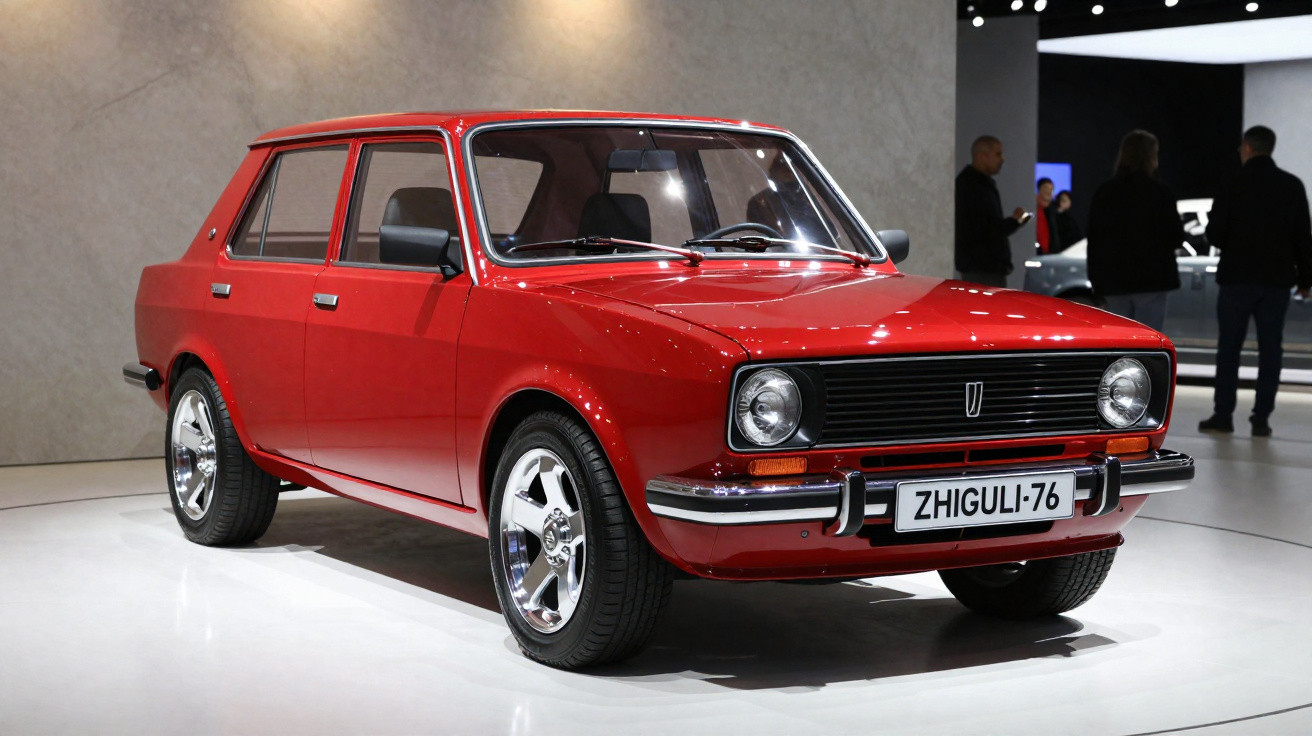
There are plenty of things in the world said to be “indestructible.” The AK- 47. The Nokia 3310. The cockroach. Then there is the Lada: a car that does not merely decline to curl up its tootsies, but keeps existing through pure socialist stubbornness. Rather like Jeremy Corbyn.
The Lada, known in Russia as the Zhiguli, arrived in the 1970s. It was the Soviet Union’s reply to the question nobody can recall asking: “What would happen if we took an Italian family car, drained all the joy out of it, moulded it out of moltendown corned beef tins and sent it into the world with brakes modelled on the Flintstones car?” Thus the Lada came into being. Essentially, it was a Fiat 124 abducted, questioned and politically re-educated by the Politburo until every last hint of Italian flair - admittedly scarce to begin with - had vanished.
Fiat created the original 124 for darting around sunlit piazzas, where a chap called Lorenzo might flirt with a woman named Sofia outside a fashionable café. The Zhiguli, meanwhile, was built for routes that barely qualified as roads: frozen mud tracks pointing more or less towards a dilapidated village containing one cow, six Babushkas with a collective age of 2022, and a lone shop stocking only pickled turnips and eggs.
Lada Zhiguli styling: a box attached to several more boxes
Ever wondered what the offspring of a filing cabinet and a wardrobe would look like? Ladies & gentlemen, meet the Zhiguli. Viewed from the side, it offers nothing but blandness: a long, uninterrupted slab of iron oxide, as though curves had been prohibited by law. Its designers did not bother with tiresome concerns such as aerodynamics.
Still, the square shape has a peculiar charm of its own. Not grace. Not beauty. Charm only in the way that a dog with one eye and a missing limb can be charming.
Performance? Yes, in theory
To discuss horsepower, picture the smallest and most lethargic ass ever to draw breath. There are no thoroughbreds here, only wheezing elderly mules prone to frequent coughing. Early 1200-series models made between 58 and 64 horsepower, approximately the output of a medium-sized leaf blower by modern standards.
Zero to 60? Possibly, if there is a powerful tailwind, a downhill slope and the burden of expectation on your side. Maximum speed? Put it this way: you will not pass anybody unless they have already broken down. Indeed, Zhiguli occupants attained a kind of philosophical enlightenment through travelling slowly enough to consider every mystery of the universe before arriving.
Nevertheless, the communist engineers maintained that speed was unnecessary. It simply had to move. By that measure, the Zhiguli succeeds.
Handling: more rolls than a Swiss bakery
Piloting a Zhiguli resembles trying to steer a sofa perched on four shopping-trolley wheels. It leans and shudders, and when faced with a bend it strongly suggests that it would prefer to be anywhere except where its driver intends.
Its suspension was engineered for potholes capable of swallowing livestock. Consequently, on level tarmac it hops about like a toddler after six cans of cola. At speed - by which we mean anything above 56 km/h - the Zhiguli starts gently weaving from one side to the other, much like a drunken uncle at a wedding reception.
The steering delivers no feedback whatsoever - nyet! Turn the wheel and the car merely considers altering course; it may consent, although it may equally decline. You are not truly driving a Zhiguli so much as negotiating with it.
Interior: Soviet luxury
Open the door cautiously, since the hinges are not a particular strength - or, indeed, strong at all. Inside awaits an assortment of plastics so fragile that dashboards from 1970s British Leyland cars seem to have been carved from solid mahogany. The seats are firm. Very firm. An hour at the wheel will shake your spine as thoroughly as your fillings.
The dashboard represents minimalism at its finest, largely because the Soviet Union was short of nearly everything, switches included. You do at least receive a speedometer and fuel gauge, both of which dispense outrageous propaganda. Warning lamps remain illuminated permanently. Should one ever go out, that does not indicate the fault has been resolved; the bulb has simply failed.
Air conditioning? Do not be absurd: open a window. Heating? In theory, yes, although it operates more like a faint warm breath from someone with bad breath softly exhaling through the vents.
Reliability? Oddly impressive, for entirely wrong reasons
Here is the ingenious part. The Zhiguli is put together like a tractor wearing an unfashionable trouser suit, and almost nothing is sufficiently complex to fail catastrophically. There are no computers and no electronics.
One half of the car can be mended with a hammer; the remaining half requires a second hammer. When something fails - and it will - it can be repaired immediately, wherever you happen to be. Russian owners became remarkably skilled at impromptu roadside repairs, capable of removing and rebuilding an engine with nothing beyond a spanner, a loaf of bread and sheer obstinacy.
Finding parts was never difficult, since virtually every other car was fundamentally identical. This was automotive uniformity on a Maoist scale: a grey suit with wheels. And, when you think about it, it does rather make sense.
Cultural icon
For all its eccentricities, shortcomings and likeness to a miserable refrigerator, the Zhiguli is much loved. It was the first car owned by many Soviet families. It transported wedding parties, holiday luggage, livestock and, on occasion, all three together. It signified freedom: the chance to travel without requiring approval from a man sporting a moustache and an oversized hat.
Beyond Russia, Ladas became the punchline. They were mocked without mercy. In the UK, it was the vehicle purchased when you had abandoned all hope in life.
Why it still matters
Remarkable numbers of Zhigulis remain on the road today. That is not because they are handsome or collectable, but because they will not surrender. It has become retro, iconic and cool in the special manner reserved for things that are absolutely not cool. In a world of modern cars containing twelve computers endlessly disputing tyre pressures, the Zhiguli feels refreshingly straightforward.
The Soviet cockroach of cars
The Lada Zhiguli was never quick or attractive. Objectively, it performs badly at almost every task modern cars are expected to handle well. Yet it has heart. It possesses a cheerful kind of indestructibility that makes you want to give its rusty old roof an affectionate pat. Driving one is like returning to a less complicated era, when cars were machines rather than gadgets.
The Zhiguli demonstrates that automotive charm does not depend on perfection. At times, all that is required is four wheels and a bulletproof engine determined to carry on regardless. For that reason, implausibly, I rather like them.










Comments
No comments yet. Be the first to comment!
Leave a Comment