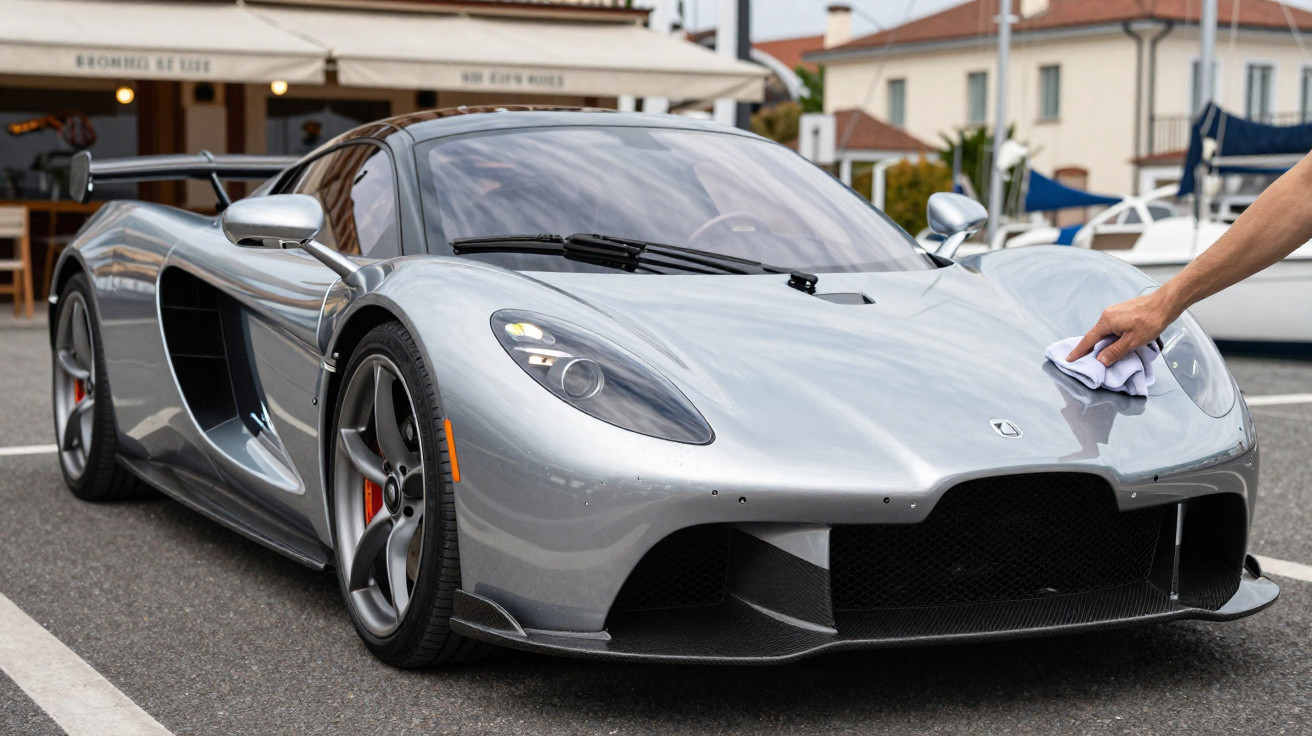
A mirror-finished hypercar looks spectacular in photographs, but it also raises an immediate question: is it polished metal, chrome-effect vinyl or simply a clever paint finish? Footage from Monaco has drawn attention to an unusually reflective Bugatti Veyron Grand Sport Vitesse reportedly linked to Fernando Alonso.
The claimed connection has not been publicly confirmed by Alonso or Bugatti, so it is best treated with caution. What is clear from the images is that this is an exceptionally distinctive Veyron, apparently carrying a bespoke "Vitesse 1 of 1" designation and a surface that reflects its surroundings far more dramatically than normal silver paint.
The Veyron attracting attention in Monaco
The car has been filmed on Monaco roads with bodywork so bright that it appears almost chromed. Buildings, kerbs and passing traffic are visibly reflected in its panels, giving it an appearance unlike that of a standard Veyron Grand Sport Vitesse.
Reports identify it as a Bugatti Veyron 16.4 Grand Sport Vitesse, the most powerful open-top production version of the original Veyron. The Vitesse combined the Grand Sport’s removable roof arrangement with Bugatti’s 1,200 PS quad-turbocharged W16 engine.
The small "Vitesse 1 of 1" marking seen on the car suggests a bespoke specification rather than an ordinary factory colour and trim combination. However, a badge alone does not establish exactly how the body was made or who commissioned it.
The remarkable detail is not simply the shine: a truly reflective finish makes every curve, fingerprint and minor flaw much easier to see.
Is it polished aluminium or a mirror-effect finish?
Pictures can make it difficult to distinguish bare polished metal from paint, wrap or a coated surface. A high-resolution image may show reflections, but it cannot reliably reveal every layer beneath them.
The Veyron’s appearance has widely been described as polished aluminium. If that description is accurate, the panels would have required extremely careful shaping and finishing. Reflections exaggerate tiny ripples, sanding marks and inconsistencies that would barely register on conventional paintwork.
That said, it is sensible not to state the precise construction method as fact without confirmation from the maker or owner. Similar visual effects can be achieved through several routes:
- polished metal panels;
- metallic paint with an unusually high-gloss clear coat;
- chrome-effect or metallic vinyl wrap;
- specialist sprayed finishes; and
- combinations of painted, carbon-fibre and polished components.
Each has different maintenance needs. A vinyl wrap can be damaged by unsuitable solvents, for example, while exposed aluminium can react badly to abrasive polishing or neglected contamination.
The engineering beneath the finish
Whatever its exterior treatment, the Grand Sport Vitesse remains one of the defining hypercars of its era. It used an 8.0-litre W16 engine with four turbochargers, permanent four-wheel drive and a seven-speed dual-clutch gearbox.
Its main published technical features include:
- 1,200 PS;
- 1,500 Nm of torque;
- an 8.0-litre quad-turbocharged W16 engine;
- four-wheel drive;
- a seven-speed dual-clutch transmission; and
- removable roof bodywork based on the Veyron Grand Sport.
The Vitesse was engineered to make huge power usable rather than merely dramatic. Four-wheel drive and sophisticated transmission control were essential, particularly given the torque produced by the W16.
It is also a highly complex car. Routine ownership is not comparable with running an ordinary performance car: specialist servicing, tyres, brakes, diagnostics and cooling-system checks require the correct facilities and trained technicians.
A possible fit alongside Alonso’s other cars
Alonso’s racing career has naturally made him associated with unusual and high-performance machinery. His public links with Aston Martin, Formula 1 and endurance racing mean that any sighting of an unusual road car quickly becomes a story.
One confirmed limited-production model associated with him is the Aston Martin Valiant. The track-focused special was developed from the Aston Martin Valour and uses a front-mounted twin-turbocharged 5.2-litre V12 paired with a manual gearbox.
Aston Martin built 38 examples of the Valiant. It is a very different proposition from the Veyron: rear-wheel drive, a manual transmission and overt motorsport-inspired aerodynamic additions give it a more involved, physical character.
Two contrasting ideas of performance
- Bugatti Veyron Grand Sport Vitesse: four-wheel drive, dual-clutch shifts and immense high-speed capability.
- Aston Martin Valiant: rear-wheel drive, manual gear changes and a more track-orientated feel.
- What they share: rarity, ambitious engineering and a focus on mechanical character rather than everyday practicality.
If the Monaco Veyron does belong to Alonso, the contrast would be especially interesting: one car represents the Veyron era’s pursuit of maximum usable power, while the other celebrates the increasingly rare manual V12 experience.
Monaco is impressive, but not easy motoring
Monaco may be synonymous with supercars, yet it is not a forgiving environment for a wide, low and valuable vehicle. Tight streets, steep gradients, underground car parks, delivery traffic and pedestrians all demand care.
A reflective finish introduces another concern. Water spotting, fingerprints, sunscreen marks, road film and fine wash scratches can be far more apparent on mirror-like surfaces than on ordinary paint. Near the coast, salt-laden air can also be a consideration for any exposed metal or delicate finish.
A show-stopping finish usually demands show-car levels of care, even when the vehicle is used on public roads.
Owners of bespoke cars will normally rely on the manufacturer’s instructions and experienced vehicle-detailing specialists. That is particularly important when different materials meet, such as polished metal, carbon fibre, painted trim, rubber seals and protective coatings.
How to care for highly reflective bodywork
Most drivers will never need to maintain a Veyron, but the same principles apply to chrome-effect trim, polished alloy details, glossy wraps and carefully maintained paintwork.
A safer cleaning routine
- Work on cool panels. Avoid washing in strong sun or while the bodywork is hot, as water and products can dry before they are safely removed.
- Rinse first. Lift away loose grit with plenty of clean water before touching the surface with a mitt or cloth.
- Use pH-neutral car shampoo. Household washing-up liquid is not designed for vehicle finishes and may reduce the durability of protective products.
- Keep tools clean. Use separate wash media for wheels and bodywork, and replace microfibre cloths when they become contaminated.
- Dry gently. Fresh, soft microfibre drying towels are preferable to vigorous rubbing.
- Check before polishing. Do not use metal polish, cutting compounds or machine polishers unless you know the material and coating involved.
For wrapped panels, matte finishes and bare metal, seek advice from the installer, manufacturer or a reputable detailer before applying any treatment. A product that is safe on clear-coated paint may stain, haze or abrade another surface.
Common mistakes with striking finishes
Trying to improve a shiny panel too often can cause more harm than good. The most frequent mistakes include:
- assuming polished aluminium should be treated like clear-coated paint;
- dry-wiping dust or mud from the bodywork;
- using abrasive polish repeatedly to remove light marks;
- applying strong wheel cleaner to unknown metal finishes;
- washing in direct sun and allowing water spots to bake on;
- leaving bird droppings, tree sap or road salt in place for too long; and
- using one cloth for wheels, paintwork and glass.
Never mix cleaning chemicals. In particular, bleach must not be mixed with acidic cleaners, ammonia-based products or other household chemicals, as dangerous fumes can result. Wear gloves where appropriate, work in a ventilated area and keep products away from children and pets.
A distinctive car, whatever the ownership story
The ownership claim may remain unconfirmed, but the Veyron itself is undeniably unusual. Its highly reflective finish gives an already dramatic hypercar a visual identity few modern cars can match.
For enthusiasts, it is a useful reminder that special cars are not defined only by headline power figures. Materials, craftsmanship and specification can make a familiar model feel entirely different - provided the owner is prepared for the extra care that such a finish demands.




Comments
No comments yet. Be the first to comment!
Leave a Comment