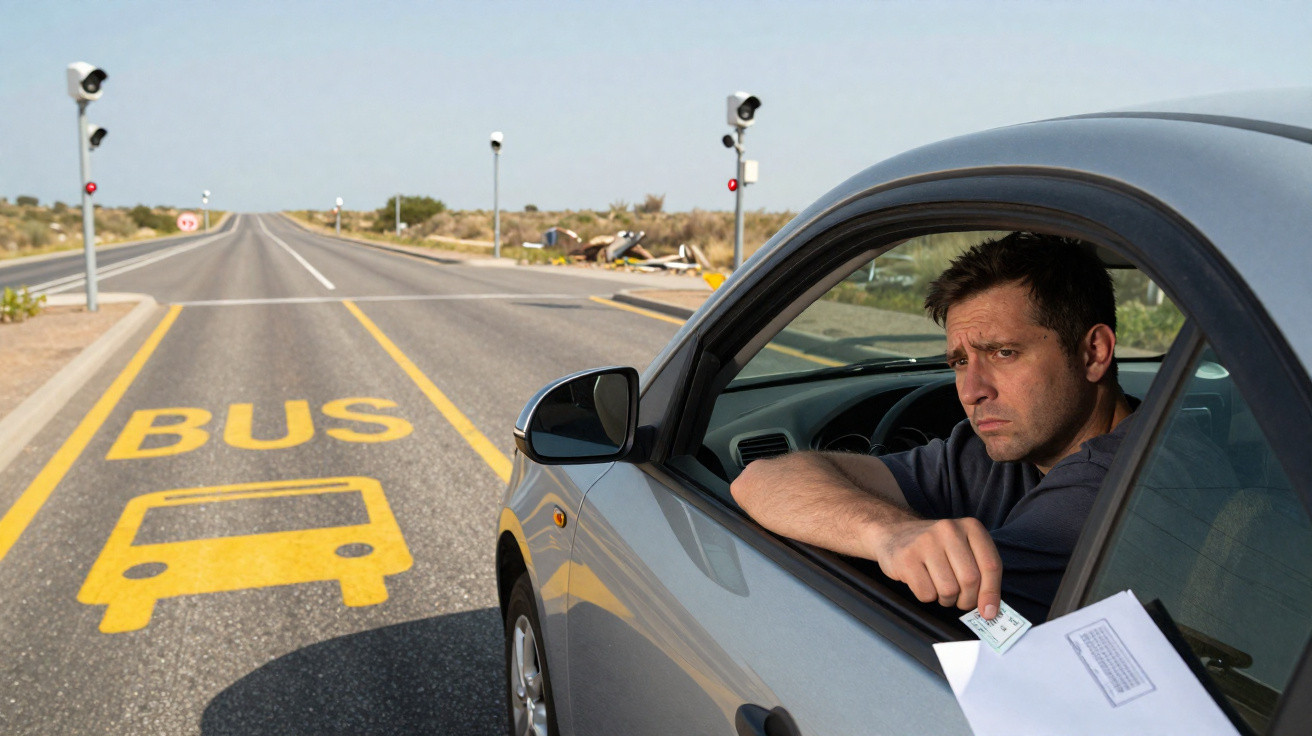
Hazard lights on, engine still running, and a swift drop-off on what appeared to be a quiet stretch of road. A few days later, the consequences arrived heavily through her letterbox: three penalty notices, issued by three separate systems, for the same “one-minute” error.
The photographs left little room for argument. They showed the same vehicle in the same place, from marginally different viewpoints, with timestamps just minutes apart. What had seemed an empty bus lane on a dull weekday afternoon became the costliest stop she made all year.
Behind the three envelopes was an unseen enforcement network doing exactly what it was designed to do - with no allowance for context, pressure or good intentions.
A one-minute stop that became a slow-motion nightmare
It began like countless small urban emergencies. Sarah, 42, was taking her mother to a hospital appointment on the outskirts of town. Traffic was congested, parking was unavailable, and the hospital’s drop-off area was already full. In front of her lay a section of red tarmac, a white “BUS LANE” sign and, as far as she could see, no buses.
She stopped with her hazard lights flashing. Her mother was slow to get out, with one hand on the door and the other clutching her bag. It took sixty seconds, perhaps ninety. Sarah remained in the driver’s seat with the engine on, checking her mirror. Nobody sounded a horn. No official challenged her. There was only the ordinary background noise of the city.
When she drove away, she believed she had found a sensible shortcut. In reality, she had entered a perfect storm of automated enforcement.
The first notice came four days later. It included a sharp black-and-white image of her car, almost as clear as a studio photograph, partly positioned on the red lane. The penalty hurt, though it did not seem outrageous. She sighed, muttered a curse and put it down as an “expensive lesson”.
A second envelope followed two days later. It related to the same day and location, but showed a different time. A separate camera had captured her in a slightly different part of the lane. It brought another fine. Confusion quickly became anger. How could one short stop be handled as two distinct offences?
When a third notice arrived, this time from an entirely different enforcement contractor, she began to wonder whether it was a joke. The timestamps overlapped. One minute, three perspectives and three databases operating side by side. Three chances to get caught, zero chances to explain in real time.
Those letters reflect an expanding reality in many cities: bus lanes are not monitored solely by the occasional traffic warden any more. Interlocking networks of fixed cameras, mobile enforcement vehicles and ANPR systems now compare vehicles with maps of restricted routes.
Every system operates according to its own rules. One may record entry into a restricted area. Another may register a vehicle stopping where only buses are permitted to wait. A third may watch particular pinch points, including junctions or approaches to hospitals. They do not always communicate with one another; instead, they capture, timestamp and submit the evidence.
As a result, a place that seems like a harmless quiet spot may in fact be under three invisible spotlights. In law, the boundary is straightforward: bus lanes are reserved for buses, and even a short pause may count as using one. For drivers such as Sarah, however, it can feel less like fair enforcement and more like an obvious trap.
How to avoid the triple bus lane fine trap
The first difficult lesson is straightforward: a bus lane is seldom open to interpretation. Where a sign says “Bus lane” and lists operational hours, those hours apply exactly as stated. There is no exception for “just thirty seconds”, “there wasn’t a bus” or “I kept the engine running”. The system does not assess what you meant to do; it records where your vehicle was.
So read the sign before stress takes over. Look closely at the smaller details: the hours, the days concerned, whether taxis or cyclists may use the lane, and whether “loading” is allowed. Tiny lines on metal poles often decide whether your next week includes a fine appeal form.
A useful instinct is to ask yourself, whenever you are tempted to “just drop someone quickly”, a question that may sound childish: if a bus appeared suddenly, would I be blocking it?
More broadly, local authorities publish detailed online maps of bus lanes and restricted routes, and these can sometimes be found within navigation apps too. It may sound tedious, and it is. Yet it could save you hundreds of pounds. Many GPS apps now display a warning when you are approaching a bus-only road or lane during its restricted hours.
Let’s be honest: hardly anyone does that every day. We do not study PDF maps or memorise enforcement areas before every school run. Instead, we depend on common sense and what seems permissible. That is precisely how drivers like Sarah are caught - not through defiance, but through assumption.
The other practical step is more emotional than technical: allow enough time in your plans that you are not tempted to take a chance on a red lane outside a hospital entrance or railway station. Rules become blurred when you are rushing.
Once penalties arrive, the worst response is to panic and pay them all without checking the details. Some councils may regard several notices arising from the same brief incident as one continuous contravention, particularly where the images show no meaningful break in time. Others may not take that approach unless you challenge them.
Appeals usually begin online. Submit your explanation along with supporting documents, such as hospital appointment letters, and draw attention to timestamps that overlap. Keep it specific and measured. Do not vent about “money-making schemes”, even if that is exactly how it feels at 2am while reading a third notice.
“I wrote like a human to a human,” Sarah told us. “I said: look, here’s my mum’s appointment, here’s the time we got there, here are your three photos that all show the same moment. I wasn’t proud of what I did, but I asked them to see it as one mistake, not three.”
Results differ, but certain approaches recur. If you find yourself in a similar situation, keep these practical steps in mind:
- Check whether several fines relate to the same location and an overlapping period.
- Collect supporting evidence, including appointments, dashcam footage and GPS records from your phone.
- Appeal promptly and politely, clearly referring to every notice number.
- Specifically request that the penalties be considered one continuous event.
- If one system withdraws a notice, inform the others and include that decision.
When road rules feel tougher than real life
Stories such as Sarah’s resonate because they touch on something people do not always acknowledge. On an exhausting weekday, while balancing work, family and health concerns, the gap between “breaking the rules” and “coping with life” can become uncomfortably narrow. A strip of red tarmac and an anxious driver turn into a small collision between human disorder and machine certainty.
Some readers will argue that rules are rules: bus lanes keep cities moving, and fines are the only effective deterrent. They have a point. Buses delayed by cars lose minutes, and those minutes take time from thousands of people every day. Efficient transport requires discipline.
Yet there is also a familiar shared experience: almost everyone has had a moment of thinking, “Just this once, it’ll be fine.” Perhaps it was an alley that the satnav advised against, a “loading only” bay used while collecting a prescription, or a bus lane outside a hospital where nobody appeared concerned - until the cameras were.
The triple-fine experience is not only about bus lanes. It also illustrates how cities are increasingly filled with sensors, ANPR cameras, congestion schemes and low-emission zones, layered like sheets of transparent glass. You do not notice them until you encounter them, and when you do, the impact can be sharp.
That does not mean giving up or becoming frightened of every road marking. It calls for a slight change in approach: regard certain signs and markings as live wires, rather than loose guidance. Red tarmac. Blue “bus gate” signs. Camera symbols. They are not decorative; they are the points at which the invisible network becomes real.
The next time you consider stopping “just for a minute” in a bus lane that seems unusually quiet, think of the three envelopes on Sarah’s kitchen table. Not as a scare story, but as a prompt: cities monitor us in ways that instinct has not fully adapted to, and one hurried choice can have consequences long after the engine falls silent.
| Key point | Detail | Why it matters to the reader |
|---|---|---|
| Bus lanes are unforgiving | Even very short stops during active hours can trigger multiple fines | Helps avoid costly “just one minute” mistakes |
| Multiple systems overlap | Different cameras and contractors may capture the same incident | Explains how one action can lead to several penalties |
| Appeals can reduce damage | Clear, documented appeals sometimes merge fines into one event | Offers a way to respond intelligently if it happens to you |












Comments
No comments yet. Be the first to comment!
Leave a Comment