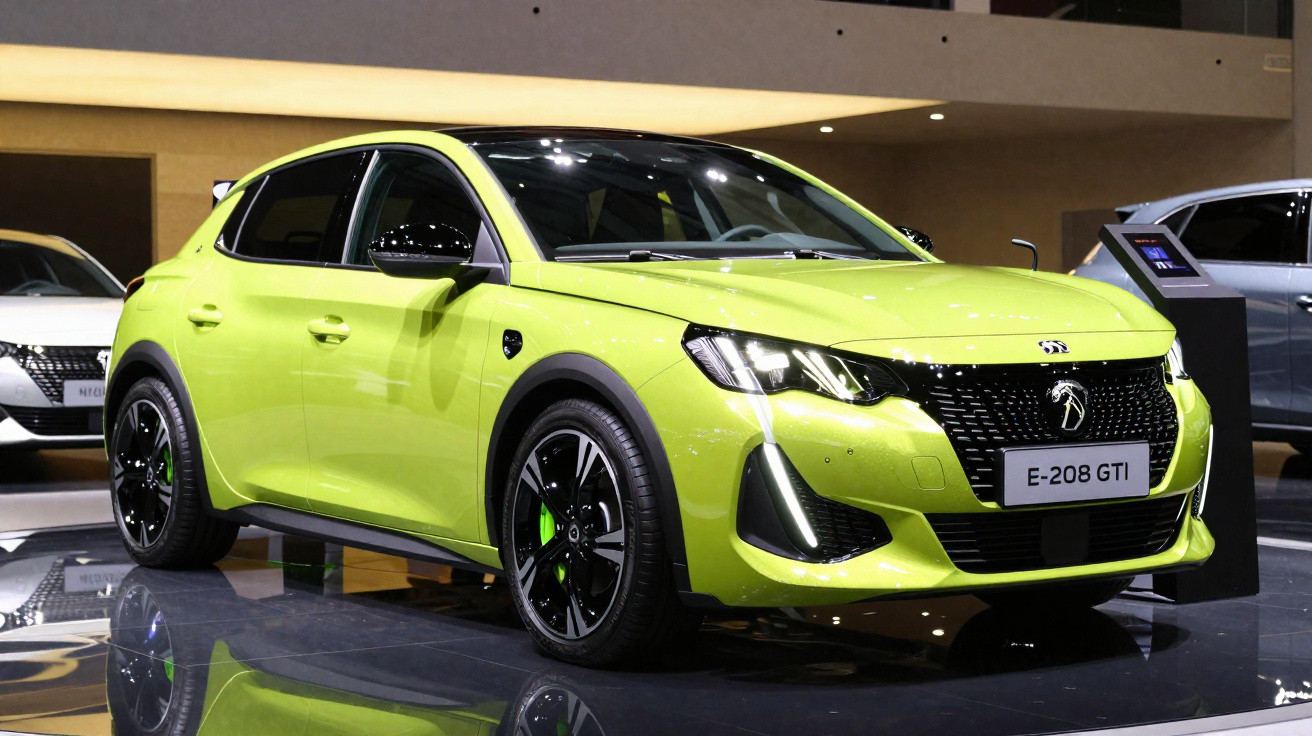
The Peugeot E-208 GTi produces 281 hp and is the fastest car in its class, yet that is not its most impressive quality.
More than 40 years after the revered 205 GTi made its debut, the GTi badge returns to Peugeot. This time, it comes in fully electric form with the E-208 GTi, using a technical package already familiar from other Stellantis models, including the Abarth 600e and Opel Corsa GSE.
However, Peugeot Sport's history makes clear that the sporting division from Sochaux knows exactly how to engineer a compact front-wheel-drive performance car. That heritage places extra responsibility on the E-208 GTi, which begins a new chapter for this iconic badge.
On paper, the E-208 GTi meets every requirement expected of a pocket rocket. There was only one proper way to establish whether it deserved the three legendary letters on its tailgate: drive it on a twisting mountain road. That is exactly what we did in Scotland.
The Peugeot E-208 GTi joins a new generation of compact electric performance cars that includes the Alpine A290, Volkswagen ID. Polo GTI, CUPRA Raval VZ, Opel Corsa GSE, Abarth 600e, Alfa Romeo Junior Veloce and electric MINI JCW.
All of them have struggled to establish themselves in the Portuguese and wider European markets, and it is becoming increasingly apparent that there are not many buyers prepared to spend more than €40,000 on a fully electric pocket rocket.
Despite arriving relatively late to this contest, Peugeot intends to change that picture and is aiming to put the 208 GTi at the top of this performance-car sales chart.
GTi heritage
A glance at the E-208 GTi is enough to show that it is markedly different from a standard 208. Peugeot Sport has revived several historic references to the legendary 205 GTi, though it has done so without turning this compact EV into an overly nostalgic exercise.
The perforated 18-inch wheels and numerous red details around the bodywork illustrate this approach well. Even so, the GTi's lower, more assertive and more aggressive stance is its clearest visual calling card.
That comes courtesy of tracks widened by 56 mm at the front and 28 mm at the rear, along with suspension lowered by 25 mm.
An interior beginning to show its age
Inside, the red floor mats and seatbelts provide a direct link to the original Peugeot GTi. The sports seats, inspired by those in the original 205 GTi, are another of the cabin's strongest features.
I also liked the driving position and the compact Alcantara-trimmed steering wheel. These are details you notice before exploiting the car's performance, and in a GTi they matter just as much as the figures on the specification sheet.
There is, however, an issue that cannot be overlooked: this 208 generation was launched in 2019, even though it was updated in 2023. Its age is now starting to become apparent.
An entirely new 208 generation is also due next year, transforming the model from top to bottom, beginning with the interior. That makes the timing of this GTi questionable, as it could feel dated rather quickly.
The instrument display, for instance, deserved a more engaging presentation. It has dedicated graphics and version-specific menus, but the overall result falls short of what is offered by the Alpine A290 and electric MINI JCW.
The infotainment system tells a similar story. Wireless Apple CarPlay is included, along with all the functions required, but its overall appearance already feels somewhat old-fashioned.
There is better news for anyone wanting a compact performance car that can serve everyday duties. Five doors preserve the 208's versatility, while rear-seat accommodation is respectable.
It is not class-leading, but two average-sized adults can sit in the back, something the Alpine A290, for example, finds more difficult. Boot capacity remains 309 litres.
Peugeot Sport gives the E-208 GTi its distinctive edge
This is where the E-208 GTi truly takes on another dimension. Stellantis' M4+ electric motor produces 281 hp and 345 Nm of torque, enough to cover 0–100 km/h in 5.5 seconds.
The 80–120 km/h acceleration time is only 3.2 seconds, while top speed is limited to 180 km/h. Those figures make the E-208 GTi the quickest model in its class, but it was its ability on corner exits that surprised me most.
Even in rain and on wet roads, the Peugeot displayed a highly confidence-inspiring ability to deploy its power. The mechanical limited-slip differential plays a part in that traction, but Peugeot Sport's work went considerably further.
The body sits 25 mm lower, front and rear tracks are 56 mm and 28 mm wider respectively, and the suspension gains bespoke springs and dampers with hydraulic bump stops. A 31 mm rear anti-roll bar has also been added, while the front item remains 17 mm in diameter. It is a transformation that is evident within the first few kilometres.
Peugeot has achieved a very convincing set-up for the car's 1535 kg weight, creating a machine that makes you want to seek out winding roads. The motor is strong, the steering keeps pace, and the brakes proved capable during this first drive. At the front are 355 mm discs with fixed four-piston calipers, while the rear discs measure 268 mm.
The driving position, seats and steering impressed me from the opening metres. In a car like this, they help establish the connection between driver and machine before you even begin to explore all 281 hp.
Then there is the sound. The E-208 GTi features an interior sound designed to enhance the driving experience. The concept is interesting, although it can become tiring after a while, particularly when you simply want to travel in peace. Fortunately, it can be switched off.
I would like more range
This is precisely where one of this GTi's principal limitations emerges. Peugeot quotes 352 km of range on the combined WLTP cycle with the standard 215/40 R18 Michelin Pilot Sport 4S tyres. That figure rises to 375 km with Hankook Ventus S1 Evo3 tyres.
The choice between the two is free of charge, and the battery remains unchanged: it is a CATL unit with 54 kWh of capacity, of which 51 kWh is usable, and it has received specific calibration to cope with more demanding use.
According to Peugeot, the battery cooling system was designed and developed to ensure convincing performance even during prolonged spirited driving, preventing the power restrictions that occur when the battery overheats.
Yet the E-208 GTi's range issue is not solely about battery capacity; it is chiefly about the efficiency of the overall package. During this first drive, consumption was between 17 and 22 kWh/100 km, exceeding those figures when we increased the pace.
I drove almost entirely in Sport mode, making the most of Scotland's B-roads, so this was naturally not an efficiency test conducted at a relaxed pace. But that is exactly what buyers of cars like this enjoy doing.
Based on those figures, the theoretical range is roughly 230 to 300 km. I did not drive far enough to deplete the battery, so this is an estimate drawn from the consumption recorded.
Higher consumption when exploiting a car like this is no surprise. Even so, I would have liked a little more range so I could use it with fewer compromises. Energy costs can certainly be very low for drivers who charge at home, but that does not remove the need to stop more often on longer journeys.
While on the subject of charging, the E-208 GTi accepts up to 100 kW of DC power, with Peugeot claiming 27 minutes for a 20% to 80% charge. On AC power, the maximum is 11 kW, requiring 2h55 to replenish the same 60% of charge.
The E-208's platform has been around for several years, which helps explain some of the efficiency and charging limitations encountered here. Peugeot Sport has used it very effectively to create a performance car, but it could not solve everything.
More than €40,000 for a compact electric car
The Peugeot E-208 GTi has an announced price of €44,900 in Portugal, although the launch campaign for private buyers reduces it to €42,553. The first examples are expected to reach the Portuguese market at the beginning of 2027.
That price puts the E-208 GTi in a difficult position. The Alpine A290 starts from €39,000, although that applies to the 180 hp GT version, which is substantially less powerful than the Peugeot. Even so, I still consider these compact performance cars expensive, and that is not a criticism aimed solely at the E-208 GTi.
Anyone who remembers the prices of some combustion-engined predecessors, including relatively recent ones, will find it difficult not to make that comparison. It is also one reason why these small electric performance cars continue to struggle to attract a broader audience.
On the other hand, owners who routinely charge at home will have very appealing running costs, while the E-208 GTi retains all the everyday practicality of a five-door 208.
It is therefore necessary to view this car for what it really is: a compact electric performance car developed to deliver driving sensations, rather than merely another 208.
Is it the right choice for me?
Anyone searching for a compact electric performance car to enjoy driving should try this Peugeot. I was particularly impressed by the chassis work, the confidence it inspires and the character Peugeot Sport has given it.
The range, price and instrument display prevent a higher rating, but 8.5 out of 10 demonstrates just how convincing this first drive was. For me, it ranks among the best electric pocket rockets currently available.
This first drive in His Majesty's lands showed that the Peugeot is a clear contender for that crown, although I would need to compare it directly with the Alpine and MINI before awarding it. What I can say is that, after driving it, it is impossible to leave it out of that contest.

Comments
No comments yet. Be the first to comment!
Leave a Comment