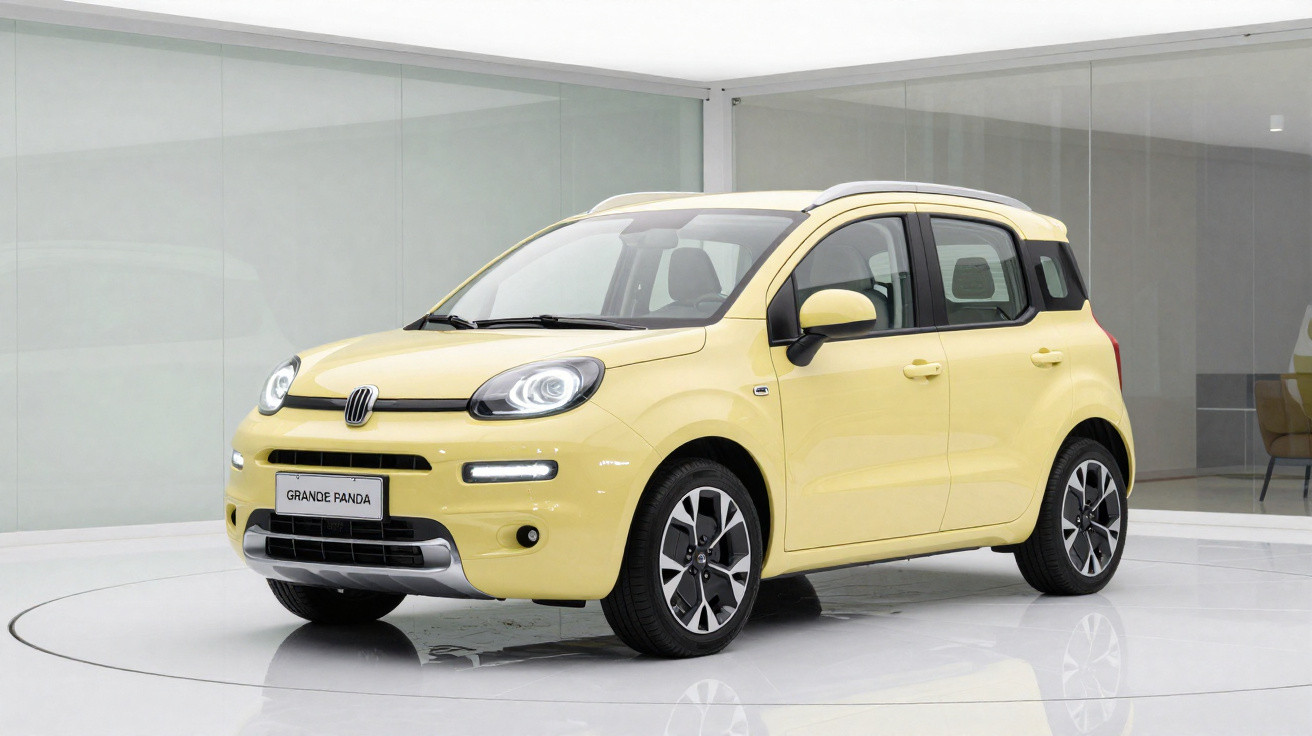
The Grande Panda is the sort of car that reminds us that you do not need vast amounts of technology and power to make a car engaging to drive.
In evolving from the Panda to the Grande Panda, FIAT’s supermini has grown more than ever before, yet one thing remains unchanged: there is still a version for those who simply want a new car without spending more than necessary.
At a time when electrification is the "watchword", combustion-engine versions still serve as the entry point to the range, and the Grande Panda is no exception.
The variant with a 100 hp 1.2-litre turbocharged petrol engine and six-speed manual gearbox took some time to arrive; at one stage, there was even debate over whether it would exist. It is now here, but does it make sense? To find out, we put it to the test.
True to itself
The Grande Panda’s greatest achievement is probably that it has managed to grow without losing its identity. At almost four metres long, it is no longer the tiny city car historically associated with the name it wears.
Even so, its boxy bodywork, sturdy shapes and graphic details inspired by the original make it instantly recognisable. It is also a model with plenty of personality.
Pixel-style light clusters, plastic cladding, recessed lettering in the bodywork and relatively uncomplicated surfaces give it a contemporary yet rugged appearance.
Although I tested the La Prima version, the finest compliment I can give the Grande Panda is that its styling is "spot on" even in entry-level form. This shows that FIAT has applied a formula it has always understood well, creating an affordable model that is still full of character.
Modern and practical
The cabin follows the same approach. Some materials clearly reveal that this is a car designed to keep costs under control, but FIAT offsets this with styling touches such as the plastic trim extending from the central display, which recalls Lingotto’s oval test track.
What is more, its straightforward layout results in ergonomics I have not encountered in a modern car for some time - Chinese brands, take note for the future - with controls that are easy to locate. The elevated driving position also makes getting in and out easier, while improving awareness of what is happening around you.
This La Prima also brings a substantial equipment upgrade, including a digital instrument panel, a 10.25-inch central screen and automatic climate control. Even so, my favourite extra is the second glovebox on top of the dashboard, known as the “Bambox”.
With a three-litre capacity and made using genuine bamboo fibre, it not only adds more storage but also brings a different splash of colour to the cabin, proving that an interior does not need to cost a great deal to feel a little more special.
The Grande Panda makes space a surprise
Its almost square body makes excellent use of the available centimetres, and this is particularly evident in the rear. For a car measuring only four metres in length, there is ample room for passengers and a sense of spaciousness that I did not expect at first glance.
The 412-litre boot is equally generous for the segment. At the end of the day, the Grande Panda follows the original’s lesson "to the letter": when length cannot be increased by much, you improve the efficiency with which the space is used.
Old-school in the best way
In an era dominated by electrification, I must admit that getting behind the wheel of the Grande Panda was a welcome contrast.
Rather than dealing with complex controls or choosing from dozens of safety systems and driving modes before setting off, all I had to do was turn the key in the ignition - yes, there is no button - select first gear and get on the road.
The simplicity and ease of use were such that, during the first few miles, I found myself wondering whether we have overcomplicated cars. After a few days, I already had the answer.
Light, straightforward and easy
The steering is light, as is the clutch, and the manual gearbox demands no particular effort. Everything appears designed to make driving simple and undemanding, especially in town, precisely where the Grande Panda feels like a "fish in water".
The high seating position, good visibility and still relatively compact dimensions make it easy to judge where its four metres begin and end.
Yet this lightness and confidence in urban settings do not mean the Grande Panda is intimidated by open roads. The 100 hp 1.2-litre three-cylinder turbo engine is not exactly a performance marvel, but its 205 Nm of torque makes it responsive enough for everyday use and even motorway driving.
Naturally, and as a reminder of earlier times, outside the city you need to work the pleasant, precise gearbox to "squeeze" everything the 1.2-litre has to offer. Its 100 hp is enough to maintain a good pace, but there is little in reserve. For acceleration or overtaking, particularly at higher speeds, you need to plan ahead.
Yes, you find yourself much more involved in the driving process, but in an age that seems to be moving towards automation, I must admit it is enjoyable. Ultimately, it is not tiring. It is simply… driving.
Comfort comes first
As expected, the Grande Panda does not aspire to the "Olympus" of the most dynamic superminis, but that does not stop it from being enjoyable. Its agility is not that of its predecessors - its dimensions do not allow it - but it still handles the bustle of town well.
The suspension clearly favours comfort, while the taller, narrower body reveals itself when you start to push harder. The steering may not communicate much and there is body roll, but the handling remains predictable and safe. It is a car that would rather glide over imperfections than try to impress on a twisting road.
Frugal and affordable
With normal driving, the 1.2-litre turbo can deliver sensible fuel consumption. The official figures quote 5.7 l/100 km on the WLTP cycle. After a few days at the wheel, including plenty of journeys outside the "urban jungle" that is its natural habitat, the trip computer was even showing more economical readings, close to 5 l/100 km.
If you combine this low consumption with competitive pricing - the Icon starts at €20,350 and the La Prima starts at €23,350 - the Grande Panda becomes an appealing proposition for anyone who simply wants a new, spacious and practical car.
Yes, it is more expensive than the Dacia Sandero, but it answers back with a personality and styling that the Romanian model only comes close to matching in its pricier versions. Compared with its "cousin", the Citroën C3, it proves that a low price can be combined with the ability to "turn heads as it passes".

Comments
No comments yet. Be the first to comment!
Leave a Comment