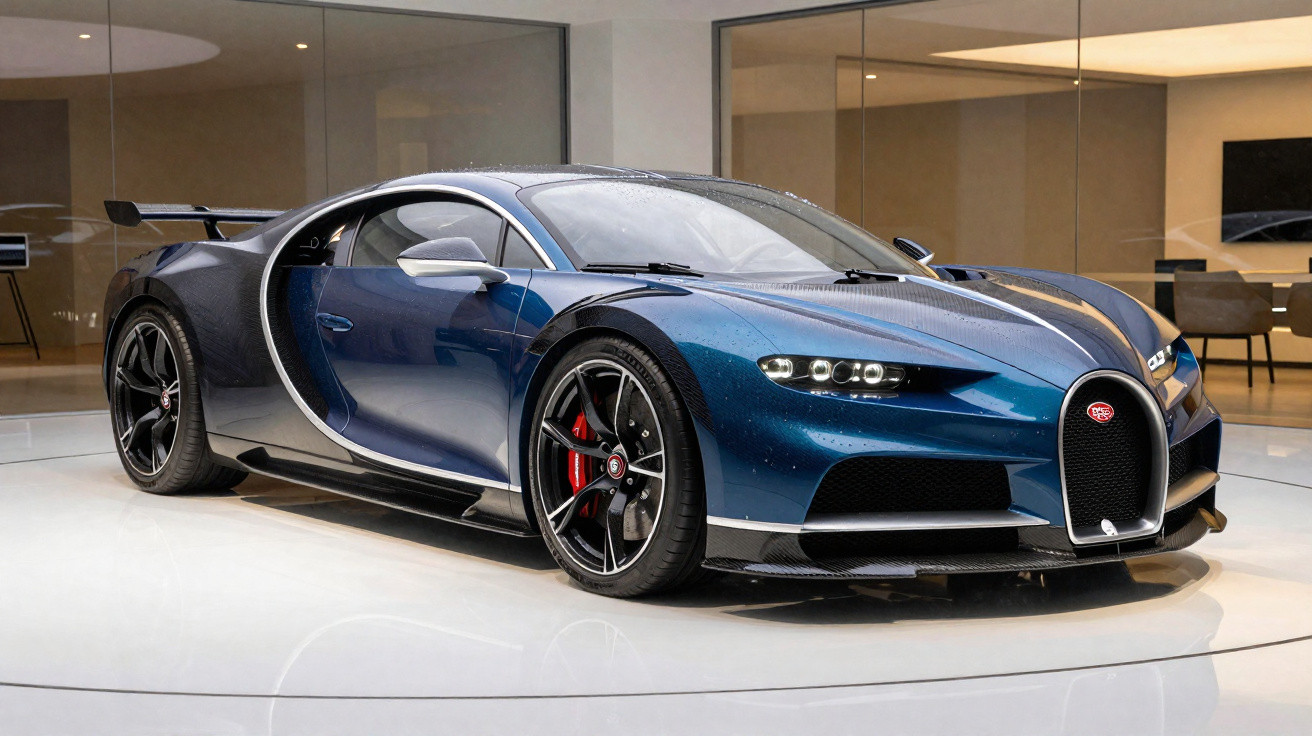
The Bugatti Bolide is Molsheim’s latest weapon, built to take on any circuit worthy of the name. It is not approved for road use, so every component has been engineered solely to deliver the greatest possible track performance.
Its brakes deserve particular attention, especially with a colossal 8.0-litre quad-turbo W16 producing 1600 hp mounted behind the driver. With this in mind, Bugatti partnered with Brembo, which equipped the Bolide with the largest carbon-carbon brake discs ever made.
You are probably more familiar with carbon-ceramic brake-disc technology, which is more widely used in road cars. Carbon-carbon technology is reserved for motorsport, particularly Formula 1, thanks to its lower weight, limited thermal expansion and ability to withstand extreme temperatures while retaining a very high coefficient of friction.
Given those qualities, it is hardly surprising that Bugatti says the Bolide’s braking performance is on a level with Formula 1 technology.
Bugatti Bolide carbon-carbon brake discs
Development of the Bugatti Bolide’s carbon-carbon discs took two years, resulting in units measuring 390 mm in diameter and 37.5 mm thick at the front wheels. In other words, they are the largest discs ever produced from this material.
The front monobloc calipers are another key feature of the Bugatti Bolide braking system. Made from aluminium alloy with a nickel coating, they use eight pistons and four high-performance 25 mm pads.
At the rear axle, there are also two monobloc calipers, although these feature six pistons. As at the front, four high-performance pads are fitted, but they are smaller at 24.5 mm. The discs retain their 390 mm diameter, while their thickness is reduced to 34 mm.
The Bugatti Bolide brakes also feature bespoke master cylinders and even system fluid with a dedicated formulation, intended to enhance the performance of this hypercar.
Lower weight and improved cooling
When developing a new braking system for a machine as extreme as the Bugatti Bolide, Brembo’s engineering team focused on achieving the lowest possible weight alongside the most effective cooling.
Despite the very generous dimensions of each carbon-carbon disc, each one weighs just 3.175 kg.
“The entire system had to be redesigned to cope with the Bolide’s extraordinary and demanding characteristics and power. The front caliper, for example, is, in my opinion, a true engineering masterpiece, and the largest we have ever fitted to a racing car.”
Mario Almondo, Chief Operating Officer of Brembo Performance
For cooling, Brembo’s engineers made a major contribution to defining the shape of the Bugatti Bolide’s front air ducts.
Brembo cooling and Wet mode calibration
Following several track-testing sessions, optimisation of the ducts now directs around 85–90% of the airflow towards the discs and pads, with only a small proportion reaching the calipers.
The partnership between Bugatti and Brembo also produced a new calibration for the Bolide’s “Wet” driving mode, intended for wet circuits or low-grip surfaces. After all, the torque delivered by the W16 engine to all four wheels is substantial, placing far greater demands on the traction control system and, consequently, the braking system.









Comments
No comments yet. Be the first to comment!
Leave a Comment