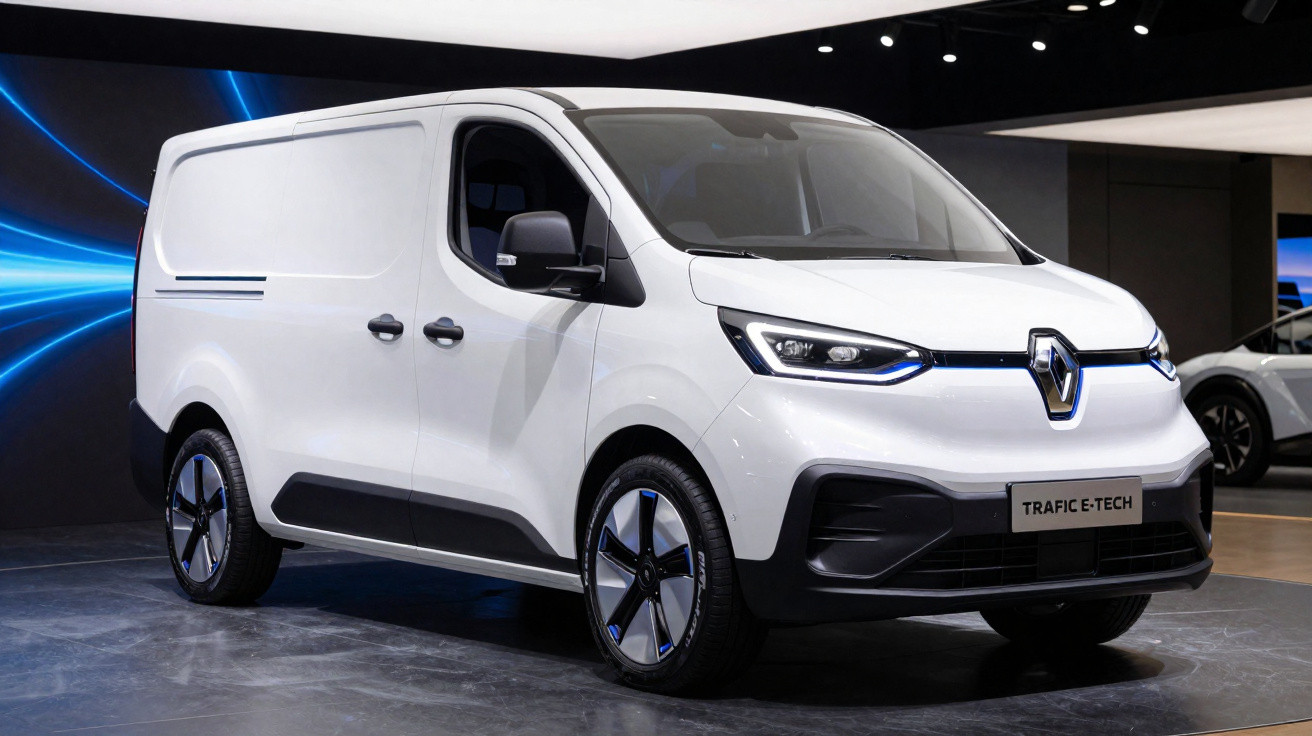
As promised, and as announced at the start of the year, Renault Group has unveiled the Trafic Van E-Tech electric at IAA Transportation in Hannover.
Built at the Sandouville plant in France, the new electric Trafic will initially be offered as a panel van, with its market launch scheduled for the end of this year. The line-up will expand in 2027 with chassis-cab and crew-cab variants.
The new vehicle is the first of five new light commercial vehicles the company plans to introduce by 2028 as part of its FutuREady plan.
What has changed with the Trafic Van E-Tech electric?
In effect, the Trafic Van name is the only thing that remains. The new model now features an 81 kWh battery, providing a range of more than 470 km (WLTP) on a single charge - a figure still undergoing homologation. In urban driving, this could rise to 690 km.
Range is not the only area set to make a difference. Its 800 V electrical architecture allows the new Trafic to regain up to 280 km of range in just 20 minutes using direct-current (DC) charging.
Renault also estimates that its total cost of ownership could be up to 10% lower than that of an equivalent van fitted with a combustion engine.
The new model brings another first: according to Renault, it is the brand’s first vehicle - and Europe’s first light commercial vehicle - to use a Software-Defined Vehicle (SDV) architecture. This replaces up to 80 electronic control units with a centralised structure based on high-performance computers.
The entire system runs through CAR OS, an Android-based operating system developed in partnership with Google. The aim is for the Trafic Van E-Tech Electric to receive updates and new features throughout its working life.
This architecture also enables predictive maintenance and allows certain functions to be tailored to the needs of each business. In other words, the Trafic can gain new capabilities without having to wait for a new generation.
Still built for work
Despite its significant technological focus, the new Trafic Van provides up to 5.8 m³ of load volume and a maximum payload of 1.3 tonnes. Towing capacity reaches 2 tonnes, while there is room for three Euro pallets. Loading height is 53 cm, and the distance between the wheel arches is up to 1.30 metres.
With a 10.3-metre turning circle, Renault says the new Trafic is as easy to manoeuvre as a Clio, while its 1.89 m height means it can access most underground car parks.
The brand also promises comfort approaching that of a passenger car, aided by elements including the multi-link rear suspension, the driving position and the quiet operation of the electric system.
Designed for different professions
The new generation has also been engineered from the outset to simplify conversions. Its flat floor and available space make it possible to adapt the van for a range of professional applications.
The new Trafic Van E-Tech Electric also includes Vehicle-to-Load (V2L) technology, enabling electrical equipment to be powered from the vehicle battery. In the future, it will be possible to add an ePTO function to supply more demanding conversion equipment, such as refrigeration systems or ambulance equipment.
When will it arrive?
The European launch is planned for the end of this year. Prices for Portugal have not yet been announced.



Comments
No comments yet. Be the first to comment!
Leave a Comment