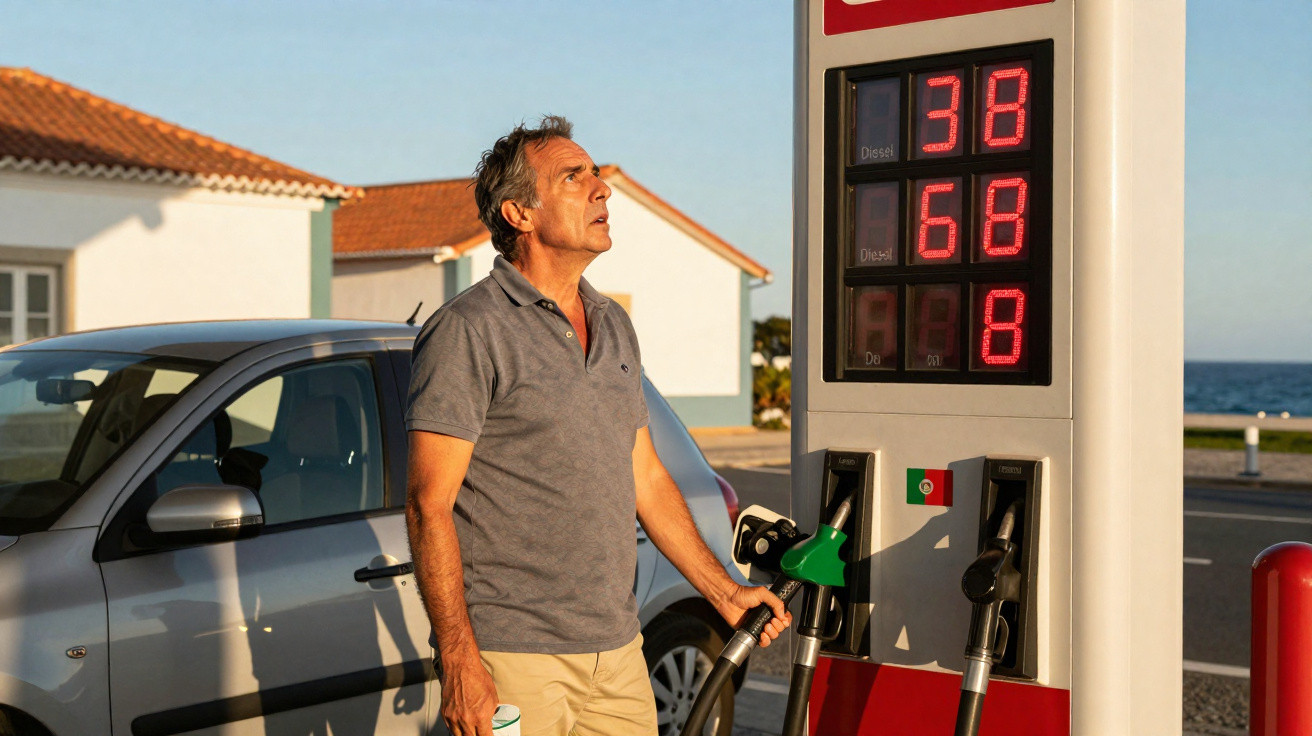
Diesel price reaches a record high
The average price of standard diesel reached a fresh all-time high on Monday, 14 September, climbing to €2.152 per litre and overtaking the €2.145 recorded on 9 April this year. But how much has it actually risen since the start of the United States of America’s war against Iran?
To put the scale of the increase into perspective, it is necessary to go back to 6 March. At that point, the average price of standard diesel in Portugal stood at €1.635 per litre. It has since risen by 51.7 cents per litre, representing an increase of 31.6%.
The figures come from the Directorate-General for Energy and Geology (DGEG) and factor in the discounts currently available, including those introduced by the Government through ISP and those offered by fuel retailers themselves.
Although the conflict with Iran began on 28 February, fuel prices did not begin to reflect changes in the market until the following week. For that reason, the average price on Friday, 6 March, is used as the benchmark for measuring the change since the start of the conflict in the Middle East.
And petrol?
The average price of standard 95 petrol also hit a new high since the start of the conflict in the Middle East on Monday. It reached €2.072 per litre, although it remains below the all-time peak of €2.188 recorded on 8 June 2022, following Russia’s invasion of Ukraine.
On 6 March, the average price of standard petrol was €1.705 per litre. Since then, it has increased by 36.7 cents per litre, equivalent to a rise of 21.5%.
In other words, while both fuels have seen substantial increases, the figures show that diesel has been much more heavily affected since the conflict began, both in absolute terms and as a percentage.
Tax relief and the impact on pump prices
Without the Government’s exceptional ISP (Tax on Petroleum and Energy Products) discount - worth 9.758 cents per litre for diesel and 6.592 cents for petrol - prices would be even higher: about €2.25 per litre for diesel and €2.14 per litre for petrol.
This support is in addition to the tax reduction introduced in 2022 after the conflict between Russia and Ukraine began. It remains in place and has been progressively adjusted in line with market developments.
What is driving the increase?
The rise in fuel prices in Portugal and across Europe is directly linked to the escalating conflict in the Middle East and disruptions to oil supplies, particularly in the Strait of Hormuz.
This is one of the world’s main oil shipping routes, and reduced traffic through the area has heightened concerns over global supply. Under normal, pre-conflict conditions, around one fifth of the world’s oil passed through it.
The impact was also swiftly felt in the oil market. Brent crude, Europe’s benchmark, was trading at around $72 a barrel before the conflict started, but moved above $100 as supply disruptions intensified.
On Monday, 14 September, Brent even exceeded $108 a barrel before closing at $105.68.












Comments
No comments yet. Be the first to comment!
Leave a Comment