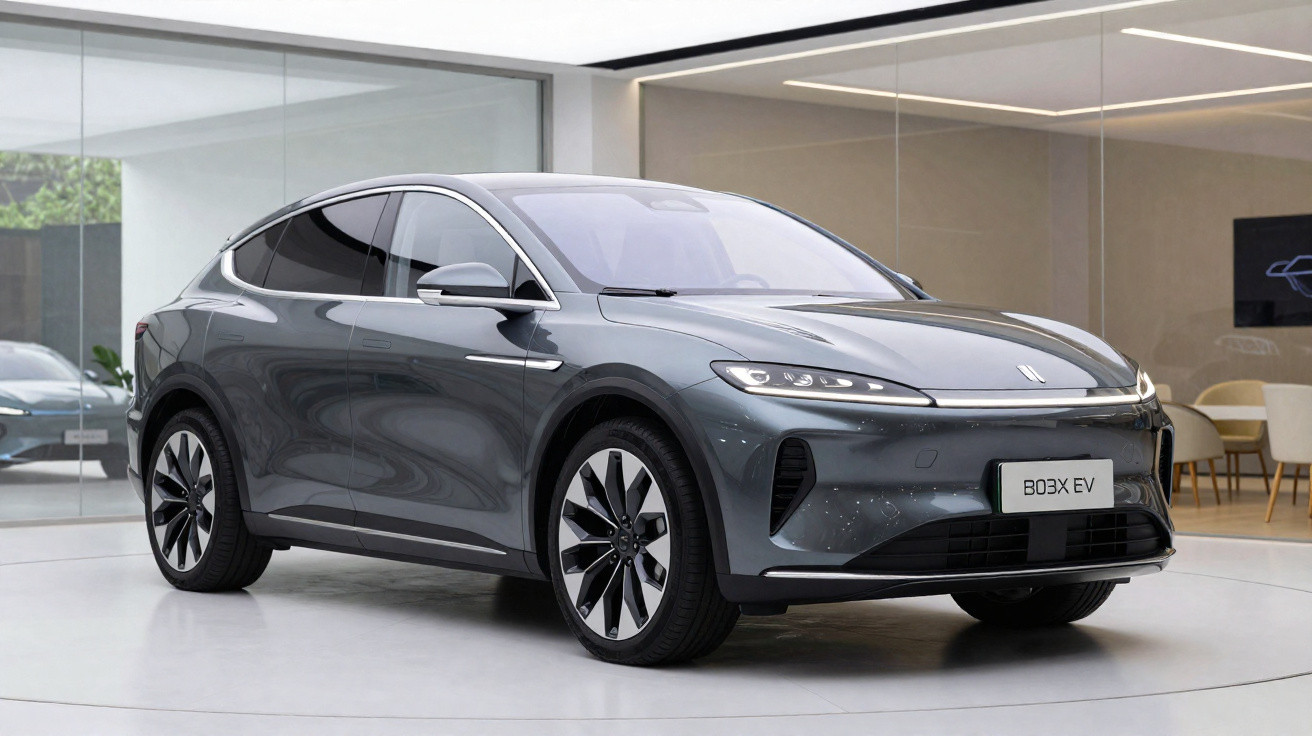
The Leapmotor B03X’s aggressive price is one of its strongest selling points, although it falls noticeably short in several areas.
At €24,285, the Leapmotor B03X arrives on the Portuguese market as the cheapest electric SUV available. It delivers 130 kW (177 hp), close to 300 km of range and roominess worthy of a proper family car.
That was not, however, the version I drove at the B03X’s international launch. Instead, I tested the range-topping Design Pro Max, which raises output to 145 kW (197 hp) and range to 382 km. Priced at €28,285, it still offers a price, space and equipment combination that is difficult to match among European rivals.
It is an especially striking price given that Leapmotor is affected by European tariffs on electric cars manufactured in China. In its home market, it is called the A10, but the name had to be changed because Audi had already registered that designation.
The B03X is a square-shaped SUV with softened edges, and its proportions brought the FIAT 500L to mind. As I discovered, that shape has clear benefits when it comes to making the most of the available space.
More spacious inside than it looks
Its generous exterior dimensions help deliver a sizeable boot. Beneath the boot floor sits a huge underfloor compartment, taking total luggage capacity up to 510 litres - a figure more commonly found in cars from two segments above.
The boot floor can be set at two levels. In its higher position, folding the rear seats creates an almost flat loading surface. There is a rigid parcel shelf, lighting and a 12 V socket, although some of the plastics are of mediocre quality.
There is also an unusual arrangement that allows the rear seat bases to fold into a vertical position, recalling Honda’s “Magic Seats”. This creates a vast amount of vertical load space.
The long wheelbase, meanwhile, improves accommodation in the second row. At 1.80 m tall, I had plenty of room, particularly for my legs: without reaching for a tape measure, I could fit all 10 fingers between my knees and the back of the driver’s seat, which had been adjusted to suit my height, with space still remaining.
Three adults will feel more cramped across the rear, as is usual in this class, but the middle passenger benefits from a completely flat floor. The theatre-style seating effect created by the raised rear seats also gives occupants a better view out.
The dashboard has less personality. It could easily belong in a Leapmotor, a BYD or almost any other Chinese brand. In front of the driver is a small, narrow 8.8-inch digital instrument display, while the centre of the cabin is dominated by a 14.6-inch screen with excellent resolution.
The software translation is improved compared with other Leapmotor models, although the voice assistant still neither speaks nor understands Portuguese and, in English, sounds as though it is in its first week of primary school.
More frustrating is the fact that almost everything must be operated through the central display or the touch-sensitive surfaces on the steering wheel.
On the other hand, the synthetic leather covering much of the dashboard and door trims gives an impression of quality that is unusual at this price point. It is absent from European competitors and matched only by the occasional Chinese rival.
Leapmotor B03X driving impressions are unconvincing at first
There are two versions available. The entry-level model pairs a 39.8 kWh LFP battery with 130 kW (177 hp) and a 292 km combined WLTP range. The version I drove also uses LFP chemistry, but increases capacity to 53 kWh, range to 382 km and power to 145 kW (197 hp). It is also 100 kg heavier, with this B03X weighing 1625 kg.
Both versions support AC charging at up to 11 kW, while their DC charging capabilities differ. The smaller battery can accept 100 kW, whereas the larger one reaches 133 kW.
Initial driving impressions are not particularly positive. As is typical with Leapmotor models, you must place the NFC card on the central tray between the front seats before setting off, which is not especially convenient.
The steering is then extremely light, “plastic” in feel and offers very little feedback. Although its ratio is correct, requiring three turns from lock to lock, the Comfort and Standard modes - neither of which I would recommend - make it feel almost disconnected from the wheels. Sport mode adds some weight, but never delivers genuine feel.
The 145 kW (197 hp) is more convincing. It provides prompt responses in town and strong overtaking acceleration beyond it. The various driving modes change accelerator response, but with the pedal fully pressed, maximum available power remains the same.
The suspension also does an adequate job. It is not excessively firm and keeps body movements reasonably well controlled, provided the chassis is not pushed too hard. Increase the pace and its limits become apparent, particularly through traction loss under stronger acceleration, which is even more evident on wet surfaces.
Braking performs better. The Leapmotor B03X integrates several components - ABS, traction control and stability control - into a “one-box” system, helping to give the brake pedal a consistently linear and reasonably prompt response. There are three regeneration settings - Weak, Medium and Strong - plus a “one-pedal” mode, although these require a search through the central screen. There is no “coasting” mode, however.
The cabin also showed solid assembly quality and matching finishes. There are no unwanted noises over speed bumps or uneven surfaces, but sound insulation was less impressive: there is too much tyre noise and external traffic noise entering the cabin.
Efficiency is a real strength
I saved the best aspect until last. It would not be an exaggeration to say that, for the first time during an initial drive of an electric car, I completed the route with an average consumption lower than its official certified figure. And this was without making any attempt to drive economically.
I finished with an average of 14.7 kWh/100 km across urban driving, winding mountain roads and built-up areas, below the official 15.7 kWh/100 km rating. In other words, the official 382 km range could realistically be closer to 400 km.
How much does the Leapmotor B03X cost?
The Leapmotor B03X starts at €24,265 in Life Pro specification with the 39.8 kWh battery. The 53 kWh Design Pro Max version I drove rises to €28,285.
There is currently no electric SUV cheaper than this one. The FIAT 600e, Ford Puma, Peugeot e-2008 and Opel Mokka all cost more than €30,000, as does its fellow Chinese model, the BYD Atto 2.
The Citroën ë-C3 Aircross is ultimately the only model that comes close to the B03X on price, but it does not offer the performance, equipment or perceived quality of the Chinese model.
Alongside its price, these are the B03X’s greatest strengths. It is not the best B-SUV to drive on the market, and some ergonomic decisions are irritating. Yet it delivers a great deal of car for only a little more than many superminis.



Comments
No comments yet. Be the first to comment!
Leave a Comment