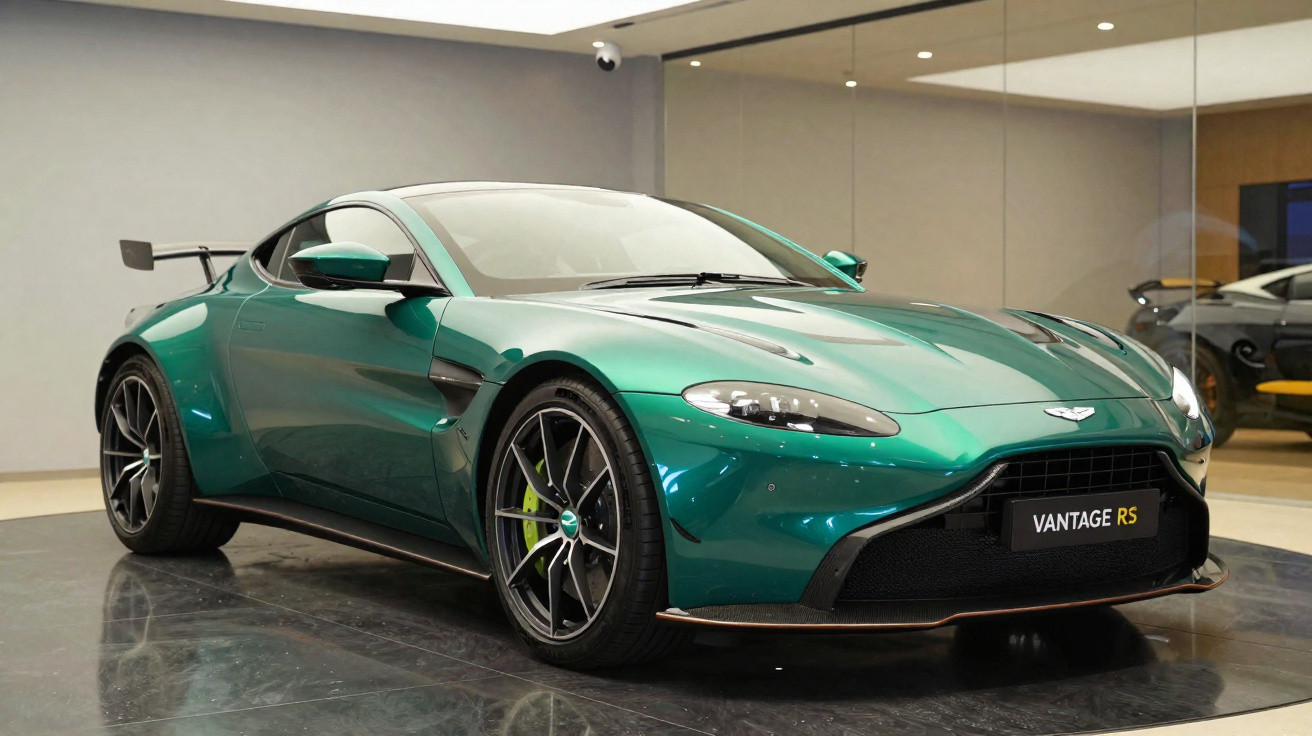
Electrification is making its presence felt across an ever-growing number of industry segments, including the supercar market. Fortunately, there are still exceptions, and the Aston Martin Vantage is one of them.
Now in its second generation, the British sports car is preparing to set its sights on the Porsche 911 GT3 with a version more firmly geared towards track use.
This will not simply be a more powerful variant, either. The prototypes we have spotted point to a more extensive overhaul, including substantial aerodynamic and chassis changes.
More radical, more aerodynamic Aston Martin Vantage
There is clear evidence that the Gaydon manufacturer is not merely planning a power increase. The transformation is immediately apparent at the front, where the Vantage RS - the name suggested by current rumours - gains a more aggressive grille, new and larger air intakes, and a bigger splitter.
The changes continue along the sides, with the front wings receiving fresh upper air vents. These may be intended to reduce the turbulence usually created by air building up in the wheel arches and, in turn, cut front-end lift.
It is at the rear, however, that it becomes obvious this is not just another Aston Martin Vantage. Despite the camouflage, the centrally positioned quad exhaust outlets, the huge air diffuser and the prominent rear wing stand out straight away.
As expected of a model of this kind, the rear wing and diffuser serve more than an aesthetic purpose. They are there to create greater downforce and keep the Vantage as “glued” to the tarmac as possible.
That task will be especially important in a model whose power is expected to make a top speed beyond 300 km/h possible.
Closer to 700 hp
Under the bonnet, every indication suggests that this Aston Martin Vantage RS - assuming that is its eventual name - will continue to use the AMG-sourced 4.0-litre twin-turbo engine. However, while the Vantage and Vantage S produce 656 hp and 665 hp respectively, rumours point to a modest power increase for what should become the most powerful version of the British coupé.
Reaching around 700 hp is therefore not entirely implausible. Even so, Aston Martin has yet to confirm final figures, so we must wait to see how far it takes the V8.
In any case, additional power is unlikely to be this version’s main selling point. With a more aggressive aerodynamic package and chassis revisions, the apparent aim is to make the Vantage more capable in what will be its natural habitat: the track.
Coupé or roadster?
The Vantage RS should not be limited to a coupé body style, either. Alongside these prototypes, we have also had the chance to spot what could be the future Vantage Roadster RS.
As its name suggests, the key difference will be the absence of a fixed roof. On one hand, this solution is likely to add weight and compromise the model’s torsional rigidity. On the other, it will make it possible to enjoy the same mechanical and aerodynamic package in the open air.
It is still unknown when these more extreme Aston Martin Vantage versions will be unveiled, but the prototypes already appear to be nearing production specification, suggesting their reveal should not be far away.






Comments
No comments yet. Be the first to comment!
Leave a Comment