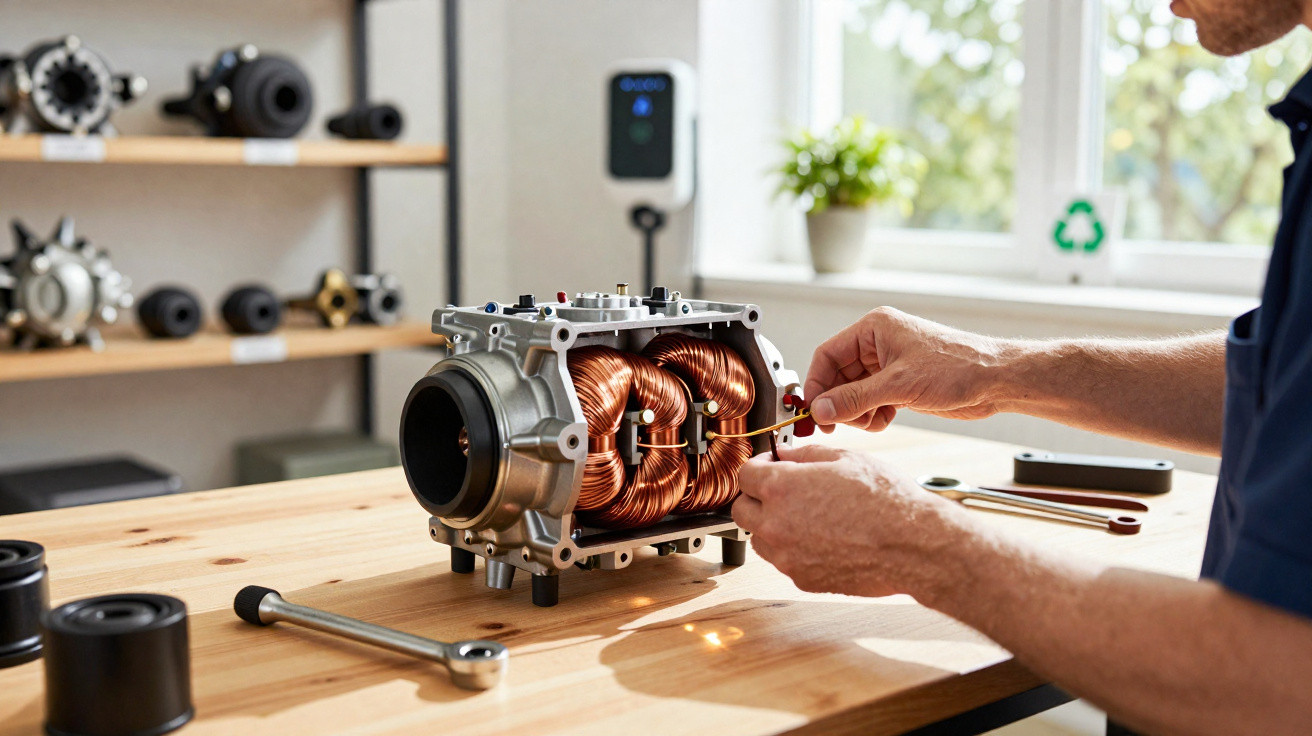
What happens to electric car motors when they are replaced? At Renault, some will be given a second life, with performance comparable to a new unit and a full warranty.
An electric motor replaced after a fault does not necessarily have to reach the end of the road. Renault now has a way to restore certain units, cutting repair costs while also reducing their environmental impact.
The new programme was unveiled at Automechanika 2026 in Frankfurt by The Remakers, an automotive component remanufacturing specialist and subsidiary of The Future is NEUTRAL - a joint venture between Renault Group and SUEZ.
Renault remanufactured electric motors
The new remanufacturing line covers the 6AM electric motor fitted to the Renault Mégane E-Tech, Master E-Tech and Scenic E-Tech.
Renault says these remanufactured motors deliver performance and reliability equivalent to a new power unit, while being covered by a full warranty.
The key distinction is the price. On average, the cost is around 30% lower than that of a new unit, making it possible to restore the component rather than fit a brand-new replacement once it reaches the end of its service life.
The principle is fairly straightforward: rather than replacing a component with a new unit and sending the original for recycling or end-of-life processing, remanufacturing recovers a large proportion of its parts and returns them to the market.
This could become particularly important as more electric vehicles build up years and mileage and begin to leave their warranty period. For these vehicles, the expense of a full replacement can have considerable bearing on the decision to repair or replace the vehicle.
Lower environmental impact
At Automechanika 2026, The Remakers also presented the findings of a Life Cycle Assessment (LCA), carried out by consultancy Quantis in accordance with ISO standards and independently externally reviewed.
According to the study, remanufactured electric motors reduce environmental impact by at least 67% across the five indicators assessed: climate change, mineral and metal resource use, acidification, freshwater eutrophication and photochemical ozone formation.
For remanufactured power electronics, the reduction is at least 47%.
Renault states that the results are especially significant for components intended for electric vehicles, because of the high level of reuse of materials with a substantial environmental impact, including copper and electronic components.
Not only for electric vehicles?
Remanufacturing is not limited to electric vehicle components. The study also identified lower environmental impacts for internal-combustion engines, as well as manual and hybrid transmissions.
For The Remakers, the remanufactured electric motor range sits alongside other available solutions, including the 5A motor used in models such as the Renault Zoe and Kangoo E-Tech.
However, the company is not the only part of this model. The Future is NEUTRAL also brings together other circular economy activities, including battery repair, material recycling and the recovery of end-of-life vehicles.





Comments
No comments yet. Be the first to comment!
Leave a Comment