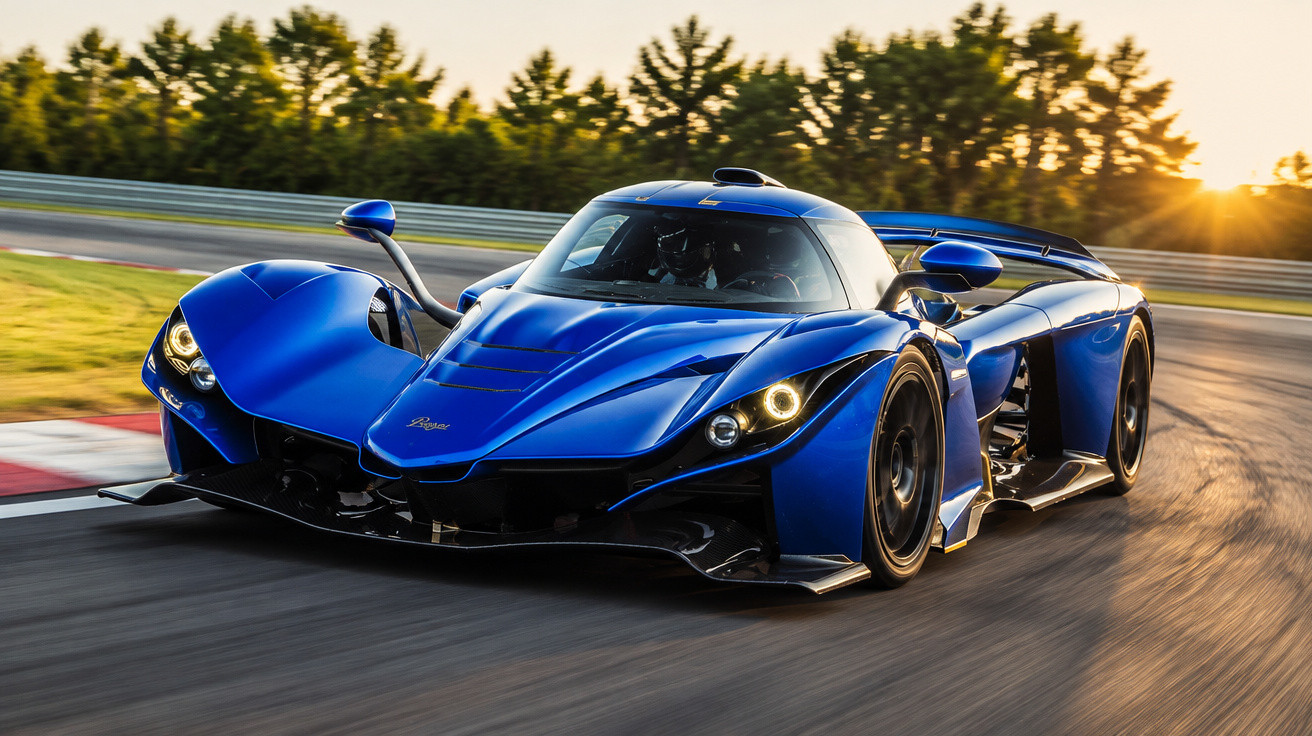
The Praga Bohema does not simply take corners; it stalks them. Like prey. Yet it has neither a four-figure horsepower output, hybrid assistance nor a barrage of software designed to flatter your driving talent. Instead, it is shaped by absence. Above all, it lacks weight. And cupholders. It recalls the sensation of actually driving a car rather than operating one, leaving you wired with adrenaline and able to communicate only in rhythmic swear words. This is a road-legal ‘track focused hypercar’ living right on the boundary of what seems acceptable.
The Praga Bohema is terrifyingly magnificent. It is also not an especially capable city car. That is because the ideal machine for both road and circuit use does not exist. Compromise will always pummel you, while regulations will always dictate the result. You will inevitably look unhinged in an Asda car park with a 5ft rear wing and canards, or creep through a rainstorm at 25mph on the latest near-slick semi-slick tyres. Still, manufacturers keep attempting it. It must be about bragging rights and ego.
One look at the Bohema tells you that it makes little attempt to disguise this imperfect compromise. Its roofline sits somewhere around knee height, while the ‘doors’ are closer to flaps unfolding from either side of the narrow passenger compartment. Its proportions and styling have a clear Le Mans Prototype influence, expertly blended with insect-like character and aerodynamic elegance. It is not conventionally beautiful. But, good God, it attracts attention.
Photography: Mark Riccioni
Praga Bohema: entering a road-legal track car
It attracts just as much attention when you are attempting to climb into it in central Prague, in front of the inevitable audience. You perch on the sidepod, thread your legs inside and lower yourself into a cabin that sits just on the snug side of claustrophobic. Then you climb back out after remembering that the steering yoke needs removing, offering the spectators an awkward smile. Back in you go. Fasten the five-point harness and prepare for departure. Then discover the key is still in your pocket, unfasten the harness, put the key into its holder on the left of the carbon tub and strap yourself in again.
Next comes the ignition button in the roof, followed by the starter. Behind your head, a 700bhp VR38DETT - the twin-turbo V6 from a Nissan R35 GT-R, tuned by UK firm Litchfield - fires immediately into life. It sounds absolutely nothing like an R35 GT-R. Somewhere around hip level, a Hewland six-speed sequential gearbox, using a single throttle-actuated clutch - or a behind-wheel hand clutch in more aggressive modes - shudders, trembles and pulses. Select first with the right-hand paddle and it feels as though somebody has slammed a door directly behind your skull. Rearward vision is non-existent, while your eyeline is approximately level with a Transit van’s wheelnuts. Road car, my arse.
Once moving, though, it is not actually too bad. Forward visibility is unexpectedly strong, and the rear-view mirrors sit far enough out on aerodynamic stalks to help you avoid hitting things while changing lanes. The seat base can be raised, the pedals and steering wheel adjusted, and the air conditioning blows cold. Its inboard pushrod suspension uses twin springs to separate its characteristics, while Öhlins dampers provide the cushioning. With a ride height fit for a snake’s belly, Prague’s medieval cobbles do not make it especially pleasant at low speeds. You must balance the clutch with the throttle; it feels more like a device for getting under way than anything resembling an automatic, and gearchanges need to happen at 3,500rpm or higher. But it is manageable.
To examine Praga’s claim that the Bohema is both a ‘practical’ road car and an effective circuit machine, I am driving it several hundred miles across the Czech Republic to three separate racetracks, then seeing whether it can establish a lap record at each one. It sounds... ambitious.
Prague is the obvious starting point because it is home to Czech company Praga. From there, we are heading to Autodrom Most, an entertaining compact circuit around an hour away, easily reached via back roads and a brief motorway blast. The Bohema feels taut, ultra-direct and committed, but never hostile or obnoxious. One point is immediately obvious, though: this thing feels as if it has been built from cobwebs and happy thoughts. In standard form, it weighs less than a tonne (982kg), celebrating lightweight construction, a carbon tub and woven bodywork. That grumpy Hewland transmission is around 70kg lighter than a dual-clutch unit, while every nut, bolt and concept has been thoroughly pared back.
The first time you give it everything, you will bark out a surprised laugh. Rather than battering the laws of physics, it seems to slide around them, slicing through air with enough venom to draw blood. I had forgotten this: the effect mass has on every aspect of a car, and how more power is no substitute for anaesthetising that pain. Most arrives quickly, in something of a haze. There is much to absorb, chiefly that the Bohema is not actually a desperate road car despite first impressions. But that is not the point. The circuit is the point. Once unleashed at Most, those early impressions become sharper than wit.
Praga Bohema at Autodrom Most
The unfamiliar element is not acceleration, although that is enough to make you cough. It is the moment between braking and turn-in. Modern drivers are accustomed either to managing a heavy car around a bend or relying on digital sorcery through torque vectoring and traction control. We forget the pure pleasure of attacking a corner using tyre grip and human senses alone. Bypass the algorithms, then use fingertips, inner ear and backside to identify the divide between a clean corner exit and an Armco impact. Keep your eyes raised and focused where you intend to go, throw the Bohema into a turn and make one precise steering input. Feed in power, find that mid-range surge of boost, and you can tighten or lengthen the car’s exit line according to your needs. It makes you laugh even while overwhelming you with sensation.
It excels in long, high-speed bends, conducting the orchestra of forces at work. Suddenly, the gearbox makes complete sense, hammering through upshifts and stripping away ratios deep under braking as though it has a grievance. The engine is raspy and guttural. It sheds speed as if operating in a video game. As a driving experience, this is Mötörhead at stadium volume.
Those extended corners are also where the aerodynamics begin to matter. Plenty of cars claim hundreds of kilograms of invisible aerodynamic load, but they usually summon these unicorn forces only at speeds you are unlikely to reach, even on track. At 155mph, the Bohema produces a greater proportion of its kerb weight in downforce (950kg). That is not actually a huge speed. The Bohema proves easy to drive extremely quickly, but extracting everything from it - squeezing out every last fraction - requires a serious improvement in your skills. It suits someone who wants their challenges unfiltered, yet sympathetic.
With a car that apparently matches GT3 and Cup machinery for lap times, I need assistance. So I hand the Bohema to Praga test driver Aleš Jirásek to find out whether he can take a record. We lower the ride height slightly - something you can genuinely do yourself with a pair of spanners and a ruler in around half an hour - remove the numberplates, which use quick-release fittings and small magnetic chargers to keep the lights operating, and we are ready. The benchmark for a road-legal car is 1:39.91, achieved by the inevitable Porsche GT3 RS.
One warm-up lap, two flying laps and a cool-down lap produce a brutal result. The Bohema records 1:35.12 at Most. That is around four seconds faster than the RS on the same Michelin Cup 2 R tyres. It has not merely edged ahead; it is on an entirely different part of the map. Jirásek believes there is more time available - seconds more - but he has not visited Most for some time, and the car has not been specially set up for this circuit. It has received only a quick-and-dirty lowering job from an engineering-incompetent journalist.
But this is merely the beginning. We lift the ride height again, and I head out on proper roads towards Brno circuit on the same tyres, which are barely scuffed, for the next record attempt. The following day, we encounter the 1000 Czechoslovak Miles rally and share the road with countless carefully curated classics, including venerable Pragas. The atmosphere is immaculate. Yet Brno awaits, and it is a complex prospect. The circuit itself is vast and broad - locals call it ‘The Highway’ - with dramatic elevation changes and corners demanding real commitment. I circulate hopelessly off-line, only finding courage on the straights, while the Praga gives me the sort of mechanical side-eye capable of stripping paint.
22 minutes 14 seconds
We repeat the previous circuit preparation procedure, adjusting the height and removing the numberplates, before sending Aleš out for hot laps. The outcome is equally eye-widening. Once again, a road-going GT3 RS holds the previous lap record, this time with 2:08.70. The Bohema completes Brno in 2:01.67. That demonstrates exactly how monstrous this machine is. That makes two.
Road miles and the Slovakia Ring record attempt
Slovakia Ring is third, requiring more road miles and another overnight stop. Still on the same set of tyres, one fact becomes painfully apparent: this is a deliberate, entirely self-aware car. Praga knows the Bohema is not for everybody, so it is less a race car adapted for the road than a race car capable of travelling on it. I drove through towns, villages and McDonald’s car parks, over cobbles and unfinished roads. It required care, and its turning circle is that of a suburb, but it was not utterly painful. The ride is firm, yet the suspension still offers distinct mercy despite limited spring and damper travel.
You gradually become accustomed to climbing in and out, acquiring a little elegance through familiarity. Put the key in its recess within the tub before getting in and both hands remain available. Once seated, drop your phone into the holder on top of the central column - very Dacia Duster - then connect it to the USB port hidden behind. That gives you navigation which stays current and weighs only grammes. A wallet pocket sits beside your left thigh, the mirrors are easily adjusted, and there is a bottle or flask holder behind your head in the central spine; it can also accommodate a Bose Bluetooth speaker. Yes, you would hear it. This is not a car so loud that ear protection becomes necessary, even at full chat. It is noisy and vibratory, certainly, but not uncomfortable.
Praga chose to mount the engine on its own bushings, ensuring that the motor - if it served as a stressed member - could not turn the carbon cabin into a subwoofer and attempt to invert occupants’ ears. It works, making the car usable on public roads. The Hewland is admittedly a truculent piece of engineering at low speed, but that is what thoroughbreds do when asked to join pony club. Still, this car does not need a team of engineers to start it, has no 45-second fire-up process, does not exhaust you with basic theatre and carries a pair of luggage bags of around 50 litres in the sidepods. You simply get in and leave. Then try to kick the bejeezus out of it.
This may be carbon fibre and mathematics wrapped around a compact package of explosions, but its character is anti-digital. Living with it feels more like blood, bone and brass than code and computers cleverer than you: old-school power-to-weight with new-school sensibilities. In a way, it becomes a badge of honour. You must learn how to drive a Bohema properly, from balancing the throttle at low speeds and reversing it, to extracting a hard-core lap time. When hypercars are as straightforward to drive as your gran’s hatchback, having to acquire skills is deeply satisfying.
It’s a committed track killer that is usable on the road, not contorted by excess faff, or joy killing discomfort
Naturally, it is not flawless. On the road, it is... a lot. It fidgets and refuses compromise. The gearbox can hold onto downshifts if you are off the throttle, and its immediacy denies you any respite unless the road is billiard-table smooth. Under heavy braking over bumps, it can become skittish, while steering response is so instant that one decent sneeze could leave you upside down and on fire. On track it is immense, yet offers no pause there either. Initially, you feel less as though you drive this car than survive it. Later comes satisfaction. Which is rather the point.
One final challenge remains: the formidable Slovakia Ring. For transparency, this is Praga’s test circuit, so everyone expected a record because the Bohema already held it with a 2:03.60. The next quickest car - another GT3 RS - had recorded a low 2:10s time. Confidence was high. Until it was not. Time was tight, cameras needed setting up and everyone was rushing; somebody failed to close the rear clamshell properly. Aleš’s helmet obscured the warning light, and during the 175mph warm-up lap, the rear bonnet sprang open with the force of a small explosion, casually tearing the back from the car. Controlled panic followed.
Additional track time was booked, a rear clamshell was forced into the back of a van and dispatched, then came five hours of waiting and wondering. Once the unpainted carbon spare had been bolted on, the car was ready for another attempt: bruised, battered and war-torn, but usable. After one warm-up lap, Aleš became uncompromising racing driver, setting 2:03.45 and beating his own record. The relieved exhalations drained most of the oxygen from the pit lane, while the cheers forced it back in.
The lesson is that the Bohema succeeds not by attempting to be everything for everyone, but by very clearly refusing to do so. It is a dedicated circuit destroyer that remains usable on the road, unwarped by needless faff or comfort-destroying hardship. On road tyres, it will beat anything on track short of a race car on slicks - and we used the same Michelin Cup 2 Rs throughout the journey, supporting the idea that low weight is an all-encompassing advantage. They looked somewhat battered by the end, but the results are indisputable.
The Bohema is niche, costly and deliriously enjoyable. Yet despite its appearance and price, it genuinely has a role. A road-legal racing car does exist, because the Praga Bohema is not a myth. In fact, it is rapidly becoming a legend.


Comments
No comments yet. Be the first to comment!
Leave a Comment