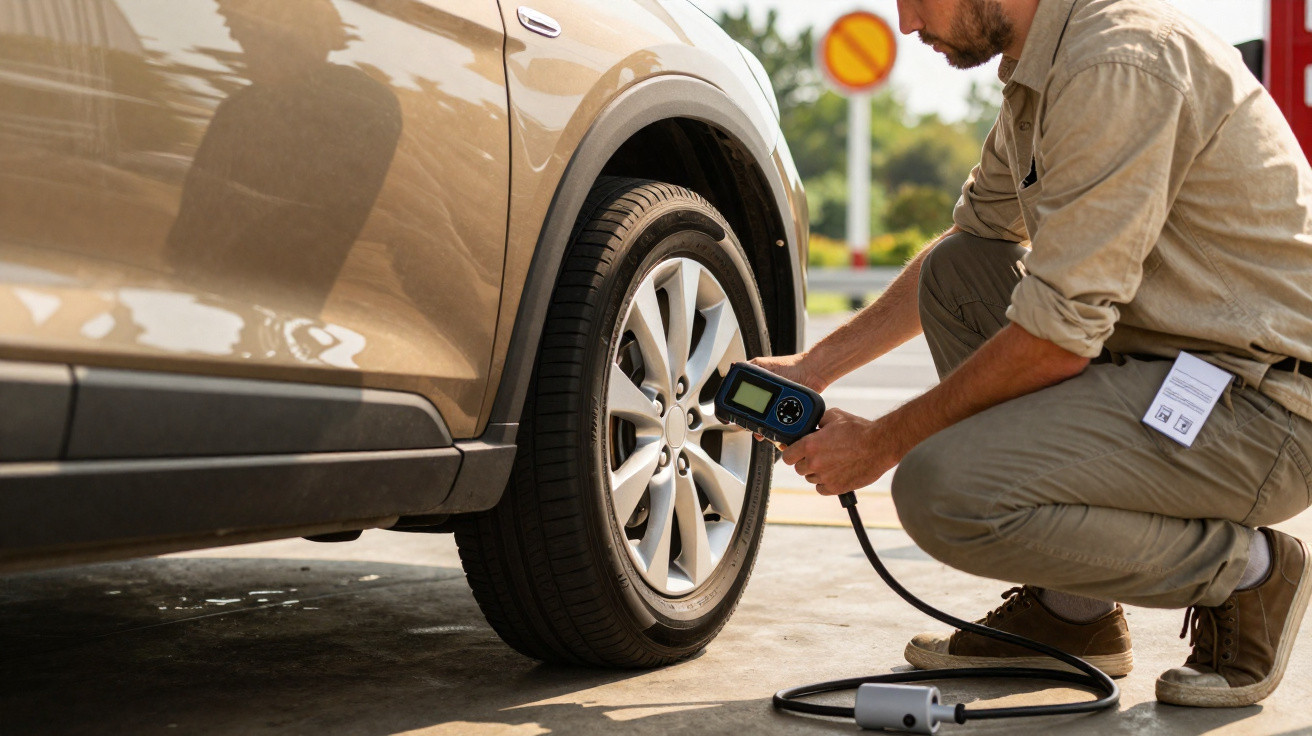
The commute is unchanged, as is the supermarket shop and the school run. But the figures on the fuel pump continue to rise, while the car feels slightly weightier through the steering and a touch sluggish out of roundabouts. You put it down to congestion, rising costs or an ageing vehicle. Then, on a wet Sunday morning at a forecourt near the A40, you crouch beside the tyres and spot it: the front-left tyre is clearly drooping. It is not flat or obviously unsafe. It simply looks worn out. Soft. Neglected.
Five minutes after putting coins into a spluttering air machine, the car feels immediately more responsive, lighter and almost grateful on the way home. The fuel computer, normally ignored, discreetly shows a slightly improved figure. It makes you question how long money, grip and braking distance have been lost through tyres that nobody inspects unless they appear visibly damaged.
The reality is that most tyres do not shout when something is wrong. They murmur.
Why tyre pressure quietly costs you fuel and safety
Outside a retail park on a clear Tuesday, stand near the air pump and you will see the pattern. Drivers get out, inspect their tyres from a respectful distance, shrug, and climb back in. Front tyres carry children, groceries, laptops and lives, yet tyre pressure is often treated as a dull optional job, somewhere alongside cleaning the boot.
The problem is that underinflation seldom appears striking. A tyre may be 15% below pressure and still seem “fine” at a quick glance. Inside it, however, the rubber flexes more, the sidewalls work far harder, and its contact patch with the road no longer matches the engineers’ design. In that unseen space between “looks okay” and genuinely okay, both safety and efficiency gradually disappear.
The figures make the point more seriously. The RAC estimates that tyres 15 psi below their correct pressure can increase fuel use by up to 6%. For a typical family hatchback covering 10,000 miles annually, that is a meaningful cost. Across several years, hundreds of pounds can quite literally be burned through increased rolling resistance. Braking matters too: safety-agency testing shows severely underinflated tyres can add several car lengths to wet-weather stopping distances, precisely when grip matters most.
There are less obvious costs as well. Tyres repeatedly run at low pressure wear unevenly along their shoulders, so they need replacing thousands of miles sooner than necessary. That means more expense, more discarded rubber, more energy wasted and more waste overall. All because the air within the tyre has been quietly incorrect week after week.
From a mechanical perspective, the effect is logical. A tyre is engineered to retain a particular form while carrying a load. As pressure falls, more rubber is pressed into the road and creates additional friction. Your engine must overcome that friction with every metre travelled. Increased sidewall flex generates heat and accelerates ageing. Steering becomes soft and imprecise, the car rolls more through corners, and modern aids such as ABS and stability control have more difficulty because the tyre is not operating as intended.
Overinflation creates the reverse problem. With too much air, the car runs on a narrower strip of central rubber, potentially reducing grip and making it unsettled over wet or damaged tarmac. Fuel economy may improve by a very small amount, but comfort and control are sacrificed. The recommended figures on the door pillar or fuel flap exist for a reason: they are not merely advice, but a discreet promise of balance.
Make tyre pressure checks a five-minute habit
The easiest approach is also the one drivers most often miss: a relaxed five-minute inspection using a reasonably good pressure gauge. Do not rely on the one that has spent three years rolling beneath the passenger seat and collecting crumbs. Use one with a clear display that does not leak around the edges. Store it in the glovebox or a door pocket rather than beneath a folded pushchair and football in the boot.
Check when tyres are “cold”, which broadly means the vehicle has travelled no more than a couple of miles. Park on level ground, apply the handbrake and walk slowly around the car. Inspect visually first: bulges, cracks or anything shiny embedded in the tread are immediate warning signs. Next, measure each tyre and compare the reading with the values on the driver’s door sticker or in the handbook. Front and rear pressures may be different, particularly with a full load.
Let’s be honest: nobody genuinely does this every day.
A more effective option is to connect tyre checks with something already in your routine. For plenty of motorists, that means refuelling. On every second or third visit to fill up, pull into the air station while the engine remains off and the tyres are still close to cold. You may have to wait behind someone struggling to recall their settings, but that is simply forecourt life when it is busy.
Choose the target pressure on the machine, take off the valve cap, attach the nozzle and wait for the beep. It is neither glamorous nor Instagrammable, but it subtly improves the way the car behaves for the next several hundred miles. If paying for air is irritating, a compact plug-in compressor powered by the 12V socket at home can be surprisingly satisfying. Park on the drive, make a cup of tea, then inflate each tyre while it cools.
Everyone has been the driver who spots an issue only when a dashboard warning appears. Modern TPMS systems are helpful, but they are not clairvoyant. They alert you to steep pressure losses, rather than the gentle loss of a couple of psi each month caused by temperature shifts and time. That gradual decline is what quietly drains fuel and confidence without any drama.
“If you treat tyre pressure like brushing your teeth – quick, regular, boring – you’ll barely think about it. If you ignore it, the problems show up far more dramatically and at the worst possible moment,” says a London-based MOT tester who’s lost count of how many nearly-flat cars he sees each week.
A straightforward way to avoid forgetting is to build pressure checks into a small routine:
- Every payday weekend: inspect all four tyres and the spare.
- Before lengthy journeys or holidays: carry out a quick top-up and visual inspection.
- When autumn’s first cold spell arrives: check again, because pressure falls as temperatures drop.
The emotional benefit can matter more than the mechanical one. It is quietly reassuring to know that the tyres holding the road on a wet motorway in the dark have been checked by you, rather than merely presumed to be “fine”. That feeling of control comes from small, repeatable actions that take less time than scrolling on your phone beside the pump.
How tyre pressure readings can change your driving
After you begin checking pressures consistently, your perception of the car changes in subtle ways. The faint resistance once blamed on wind becomes recognisable as a low rear tyre. The imprecise steering noticed on a gusty day now has an identifiable cause and a simple remedy. It is a quiet form of confidence built through one basic routine and a £10 gauge.
Fuel economy can sound like a dry subject, but it conceals a broader question. How much daily driving happens on autopilot, with the assumption that everything underneath the car “just works”? How many children are taken to school on tyres only a breath away from legal limits? How many late journeys home take place on rubber that has not been inspected since the previous MOT?
This is not about assigning blame; it is about paying attention. Checking tyre pressure is one of the few aspects of modern motoring completely within your control. No app can handle it for you, and no subscription can quietly solve it in the background. Despite all the technology in current cars, four small areas of rubber and air still determine how you brake, corner and stay on the road. Ignoring them does not remove the risk; it only conceals it behind a hectic week and a long list of jobs.
| Key point | Detail | Benefit for the reader |
|---|---|---|
| Correct pressure | Follow the values shown on the door pillar or in the handbook, with tyres “cold” | Lowers fuel consumption and maintains predictable road holding |
| Regularity | Carry out a quick check every 3–4 weeks and before long journeys | Prevents premature wear and reduces unwelcome motorway surprises |
| Practical habit | Link the check to filling up or a particular weekend | Turns a chore into a simple reflex that protects both budget and safety |












Comments
No comments yet. Be the first to comment!
Leave a Comment