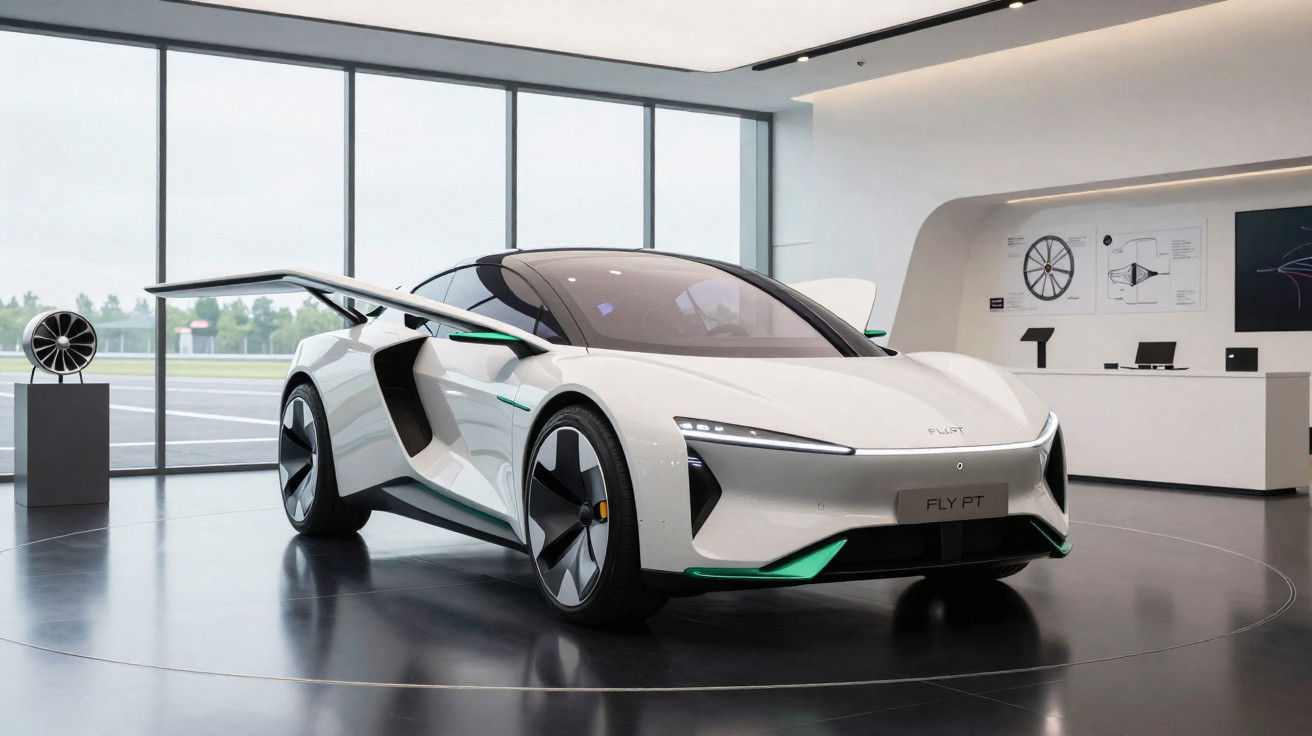
If the science-fiction films of our childhood or youth were to be believed, by 2024 our skies should already have been filled with flying cars. That has not happened, yet several ongoing projects are working to turn the concept into reality, with continued progress being made.
Among these initiatives are projects from car makers including Hyundai and China’s XPeng. Portugal is also exploring a future in which the “flying car” becomes a reality, as demonstrated by the FLY.PT project.
FLY.PT brings together a consortium of companies and research centres, representing an investment of eight million euros. Its aim is to help “revolutionise national air transport.”
FLY.PT: taking to the road and the skies
FLY.PT involves creating “a personal air transport system” that is autonomous and electric. It stands out not only because it can fly, but also because it can travel on roads in the manner of a conventional car.
This is made possible by its modular design, which gives it vertical aerial mobility as well as horizontal ground mobility.
The system comprises three modules: a cabin capable of carrying up to two people, which can then be connected to either of two further modules. One is an autonomous drone-shaped flying unit with a 30-minute range, while the other is a skateboard-type chassis incorporating the electric propulsion unit.
The cabin module can be attached either to the drone or to the car chassis. Whichever configuration is used, the FLY.PT project vehicle will remain fully electric and completely autonomous.
The team tested and developed “propulsion elements, energy storage, range, coupling and integration, industrial design and usage concepts”. It was also tested by ISQ, which contributed to the prototype’s development through mechanical and ballistic testing.
Could FLY.PT become a real-world vehicle?
So-called flying cars may well become a feature of megacities in the near future. They may not necessarily be private vehicles, but they could create a range of opportunities across different business areas, including transporting passengers or small goods.
That is part of the FLY.PT project’s ambition, which “aims to develop products and services in an integrated manner and with a single global vision” by combining the cabin with autonomous vehicles, both aerial and land-based.
For now, further developments are awaited.



Comments
No comments yet. Be the first to comment!
Leave a Comment