In the world of Very Fast Cars, progress tends to move s-l-o-w-l-y. Last month, Top Gear gave you a world-exclusive drive of the Lotus Evija. Although it was unveiled in 2019, the world’s most powerful road car was not ready for either customer until mid-2025. If that seems later than a Northern rail service, consider the Aston Martin Valkyrie. The V12 F1 moonshot eventually appeared at TG’s 2024 Speed Week eight years - and two CEOs - after its announcement. And those are the cars that have actually escaped the primordial ooze of hopeful renderings to become carbon-clad reality. Anyone who placed a deposit on an Arash AF10 (2016), Dendrobium D-1 (2017) or, heaven forbid, the second-generation Tesla Roadster (2017) has an investment about as secure as $hawktuah coin.
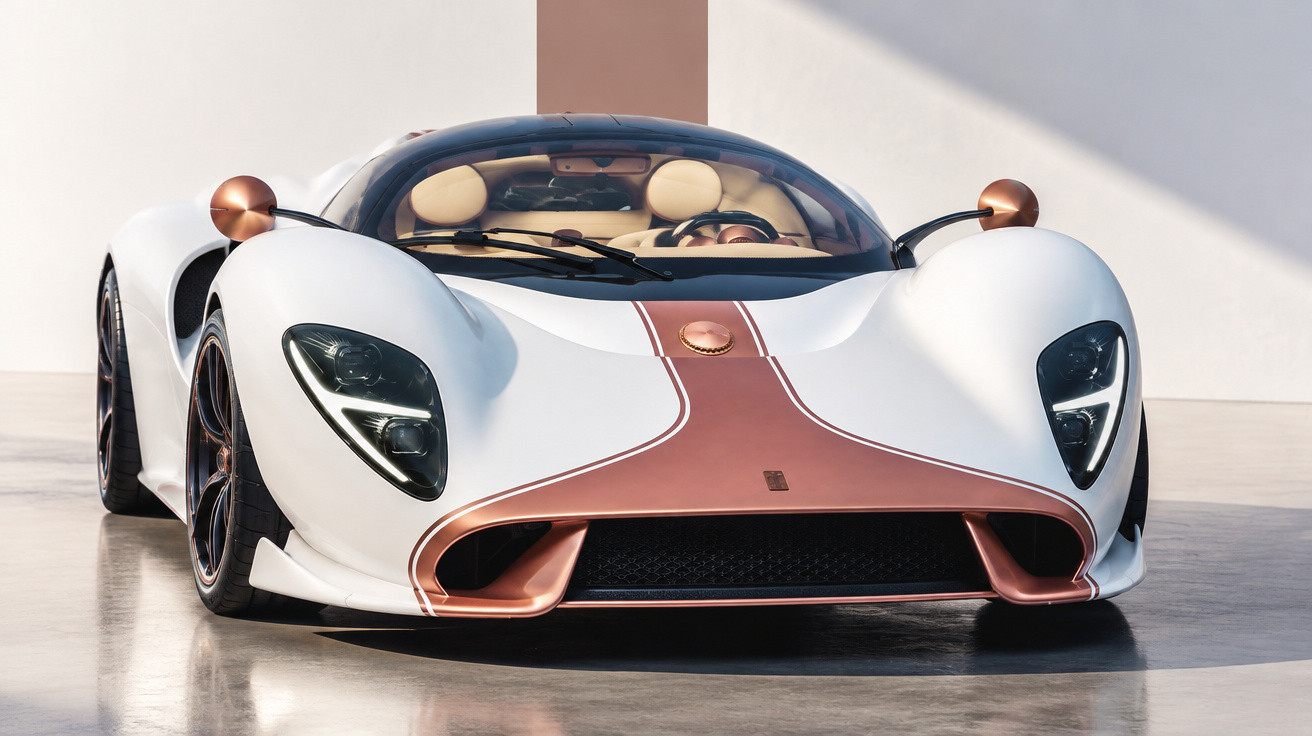
That is why, despite the sensational response it received in the pre-saucepan-bashing days of 2019, you probably did not expect to hear about the De Tomaso P72 again. When this rouge-hued beauty was revealed at that summer’s Goodwood Festival of Speed, the company had neither a factory nor a confirmed engine supplier. It had all the hallmarks of classic vapourware.
Then there was the curse of badge baggage. De Tomaso enjoyed its peak in the 1970s, struggled through the 2000s and was acquired in 2014 by Hong Kong financier Norman Choi. Take a look through the ranks of dormant sports-car marques that new money has valiantly, and unsuccessfully, attempted to revive: Brabham, Bristol, Delage, Marcos, Veritas and TVR. Even before Covid-19 and tariffs arrived, the P72 appeared less likely to survive than a spirited Premier League team freshly promoted from the Championship.
Photography: Mark Riccioni
De Tomaso P72 deliveries finally begin
Yet, knock me over with a peacock feather: it is finished. The first deliveries will reach 72 extraordinarily patient owners in time for Christmas. Or 71 original owners, to be precise: one elderly American deposit holder died during the wait. De Tomaso’s backers were not concerned, though, because the waiting list exceeds production volume by a factor of 20.
I meet the company chief and his labour of love at an anonymous studio on Stuttgart’s outskirts. Customers are arriving for a ‘ta-dah, thanks for holding’ exercise in building anticipation while they pore over material swatches. A few days after I am permitted to sit inside - on a chamois leather, lest my jeans mark the untouched seats - the car will be sent to the United States to meet further clients. In this case, seeing really is believing.
Let us run through the specification before examining what has changed since 2019. The carbon-fibre body originally penned by former McLaren designer Jowyn Wong remains completely intact. Thank goodness: it is a breathtaking form that makes no concession to generating downforce. Instead, it looks as though it was shaped from windblown silk before being frozen in liquid nitrogen. The sole visual alteration is a less angular diffuser that conceals two radiators for cooling the transmission.
Its voluptuous rear haunches and bubble canopy are loaded with references to the Ferrari P3/4 and Lola T70 MkIII, with a dash of the original Porsche 917K. De Tomaso cites only the one-off P70 prototype racing car as the true inspiration for the design. I am not entirely convinced: the P70 featured a fixed rear wing and faired wheels, and it was destined to race just once after project leader Carroll Shelby was lured away by Ford in 1965 to oversee something called the GT40.
Ford V8 power and a six-speed manual
Ironically, the powertrain comes from Ford. As with the Pantera and Mangusta in De Tomaso’s heyday, the P72 is propelled by a large American V8: the 5.0-litre Coyote unit more commonly found in a Mustang. Its origins may be humble, but that is intentional. Choi says he wanted to continue the marque’s tradition of Detroit muscle and create a ‘timepiece’ - an heirloom to be passed down through generations. Something less troublesome to maintain than a hybrid-boost quint-turbo V17.
In reality, it remains rather specialised for tomorrow’s enthusiastic amateur mechanics. The pistons are forged, as is the crankshaft. Norman requested a supercharger only on condition that its pulley whine would be exceptionally discreet, allowing the car to sound naturally aspirated. Its 700bhp output looks modest beside modern supercar figures, but it has only 1,400kg to move. Norman is unconcerned that he has waited six years for a power-to-weight ratio inferior to that of a McLaren 750S costing one-sixth as much. “For me it’s not just about pure speed, it’s about engagement. When you drive this car it’s moving theatre. Sometimes in life it’s nice to not be in the fast lane – to enjoy the moment.”
That thinking also explains why the P72 follows the latest boutique-supercar fashion by offering a manual gearbox. The prototype had a sequential shifter, but the production version delivers on its promise with an H-pattern six-speed. Its exposed linkage creates a Pagani-esque focal point in an absolutely exquisite interior. Climbing aboard is now easier, too, as a section has been removed from the carbon monocoque’s sill. The structure itself is built to Le Mans prototype crash standards. Meanwhile, the formerly slim, quilted bucket seats have been sculpted directly into the tub.
For comfort, the steering wheel has plenty of adjustment and the pedal box moves along sprung runners, as in the Ford GT and LaFerrari. The designers maintain that the P72 is more grand tourer than its mysterious track-only relative, the Apollo Intensa Emozione, but the driving position is unequivocally motorsport-derived. You sit cradled forwards, with your backside low and heels raised, peering at the nose through mountainous front wings. It is not a spacious cockpit, although the glass upper sections of the doors pour in light to reduce the intimidation - and, frankly, encourage every passer-by to stare inside.
A cabin built as timeless jewellery
The P72’s interior contains 179 individual aluminium fittings. That matters because the new Bugatti Tourbillon cabin has only 160 pieces, despite using the same supplier for its brightwork. If rose gold is not to your taste, you can specify any colour you wish, while three finishes are available: hand-brushed, hand-polished or ‘blasted’ matte. The rev counter reaches IX - yes, its markings are engraved in Roman numerals. Physical instruments were non-negotiable. Even so, in 2025 that presents a challenge because of the number of warning lights now legally required within the driver’s eyeline.
It is odd how legislation is intruding even on limited-run unobtainium. The P72 is, in fact, too low to satisfy future roof-height regulations. Its exhaust is also strangled by a feeble 63dB noise limit. At least the silencers receive an expensive ceramic coating. With a wink, chief designer Jakub Jodlowski suggests that a fruitier exhaust will be available for customers who also happen to own their local constabulary.
16 minutes 56 seconds
Knurled controls descend from the ceiling to operate the heating and electric windows. Naturally. What is absent is a volume dial, USB port or any infotainment system whatsoever. Once again, the reasoning is longevity: touchscreens age like milk, whereas engraved jewellery does not. The only digital concession is the optional rear-view mirror, which is actually a display for the reversing camera. It was accepted at the insistence of serial supercar owner Norman, who regularly complains about slit-windowed exotica when navigating tight Hong Kong parking garages. Save the violins.
There are no driving modes. Nor is there active aero. An ESC-off button indicates one modern driver-assistance provision, but Jakub explains that the car is designed around low drag - hence its longtail and minimal panel gaps - and that his team took handling inspiration from the Goodwood Revival rather than the British Grand Prix. The intention is mechanical grip rather than the invisible cheat code of downforce, with an emphasis on steering the car using the throttle. Really? In an airbag-free, mid-engined unicorn costing £1.4m plus taxes? If you say so.
If it proves to be a timeless tonic for the ages, a piffling six year supercar gestation won’t feel like a long time
Whenever an engineer sincerely tells me that a supercar has been painstakingly honed for excitement, I picture the hundreds of examples sadly sleeping in tailored pyjamas, buried in humidity-controlled bunkers. They quietly gain value while yearning for their owner to hit a financial iceberg and be forced into a quick sale to the next collector. Choi says his 72 chosen customers were selected because they will drive their cars. It would be tragic if they did not.
Norman is considerably greyer than at our last meeting, and admits that the delays have been gruelling. Covid and his own perfectionism both exacted a price. There was uncertainty over the production location: Italy first, then America, and now finally race team HWA, in AMG’s Affalterbach backyard. Then there were legal disputes and the sale of his previous hypercar revival project, Apollo.
Later this year, we will find out whether the driving experience has justified all that upheaval. The new De Tomaso has taken a very long time to arrive. But if it turns out to be a timeless tonic for the ages, a piffling six year supercar gestation will not seem long at all.



Comments
No comments yet. Be the first to comment!
Leave a Comment