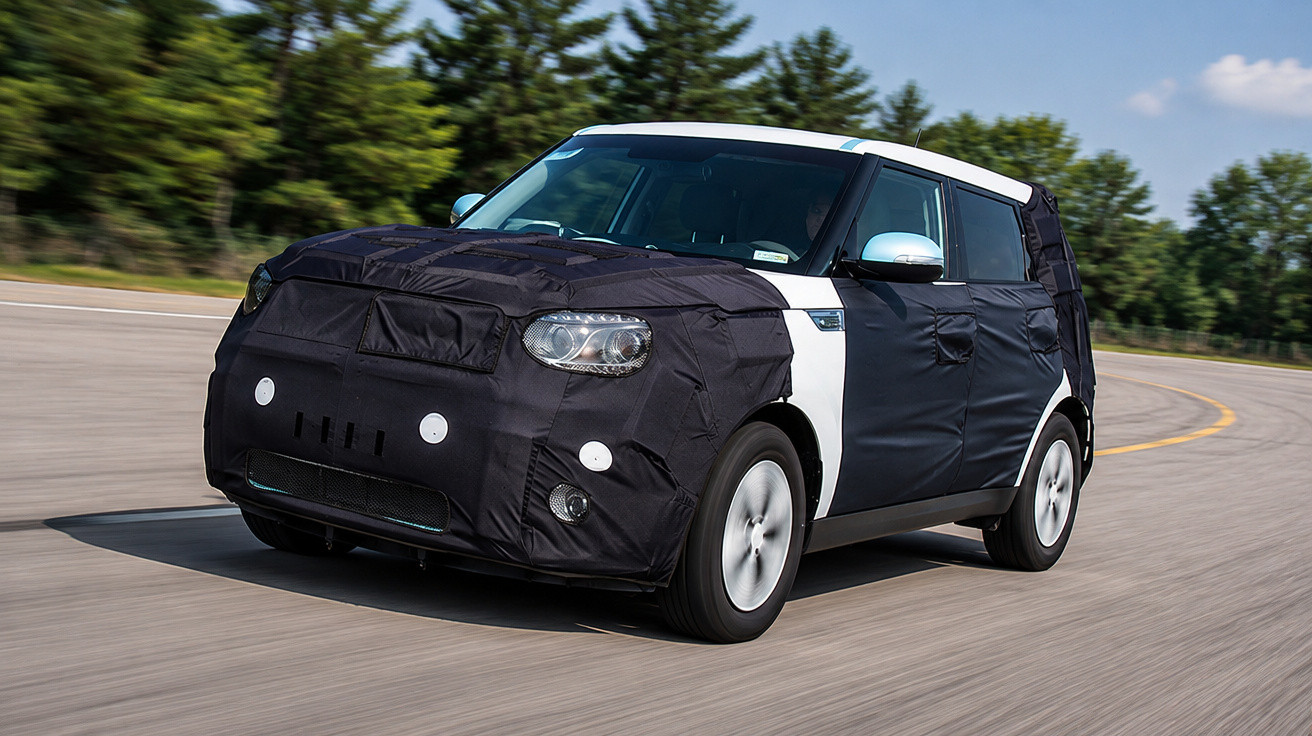
What exactly is it?
It is the Soul EV: as you may already have worked out, an entirely electric take on Kia’s mini-MPV.
I’m positively fizzing with anticipation.
We suspected as much. Following the compact Kia Ray - a boxy, Nissan Cube-esque model that has quietly helped build enthusiasm for electric cars in South Korea for a little more than three years - this will be Kia’s first mass-produced electric vehicle to be sold globally.
It uses the regular front-wheel-drive Soul architecture, which was designed to accommodate a battery pack without greatly compromising cabin space. That underpinnings are also shared with the new Cee’d, providing a respectable starting point.
Kia Soul EV powertrain and charging
The battery pack is positioned beneath the Soul’s floor, helping to bring down its centre of gravity. It produces just under 110bhp (82kW) and 201lb ft (273Nm) of torque, delivers a 0–100km/h (0–62mph) time of less than 12 seconds, and reaches a heady maximum of 145km/h (90mph).
How long does charging take?
Plug it into a 240V supply and the battery can be fully replenished in five hours. Use a 100kW rapid charger instead, and the process takes 25 minutes.
The EV does, however, weigh around 300kg more than a conventional Soul. Kia is still working through the battery and motor technology, and has not yet selected a supplier.
What range can it manage?
Kia predicts it will travel more than 200km (124 miles) on a charge when it arrives next year. That is encouraging.
Kia Soul EV on the road
What is it like to drive?
Refined and hushed. During our test route, the Soul felt settled, smooth and pleasantly relaxing around town. On dual carriageways, though, there was a suggestion of body roll and a softly sprung chassis; pin the accelerator from a standstill and the immediate torque makes the Soul pitch backwards on its springs and dampers.
That torque is the real appeal. Electric motors produce plenty of twist seemingly from nowhere, resulting in respectable 0–50km/h (0–30mph) acceleration, useful overtaking response and even an appealing little ‘bullet-train’ hum from the motor.
How far did you travel?
Over the first section of our drive, we covered just more than 26km (16 miles), while the indicated range fell from 166km (103 miles) to 126km (78 miles). On the second run, the range decreased from 124km (77 miles) to 108km (67 miles), despite travelling 21km (13 miles). Those figures came from a mixture of considered stop-start driving and, ahem, more enthusiastic use of the accelerator.
Should you buy the Kia Soul EV?
Should I buy one?
We would hold off for now. The final technical specification remains to be confirmed and, based on this initial prototype drive, the Soul EV is not especially engaging. Still, the price may be decisive: if Kia can sell a city EV for a figure close to that of its petrol-powered Soul, it could have a winner on its hands...



Comments
No comments yet. Be the first to comment!
Leave a Comment