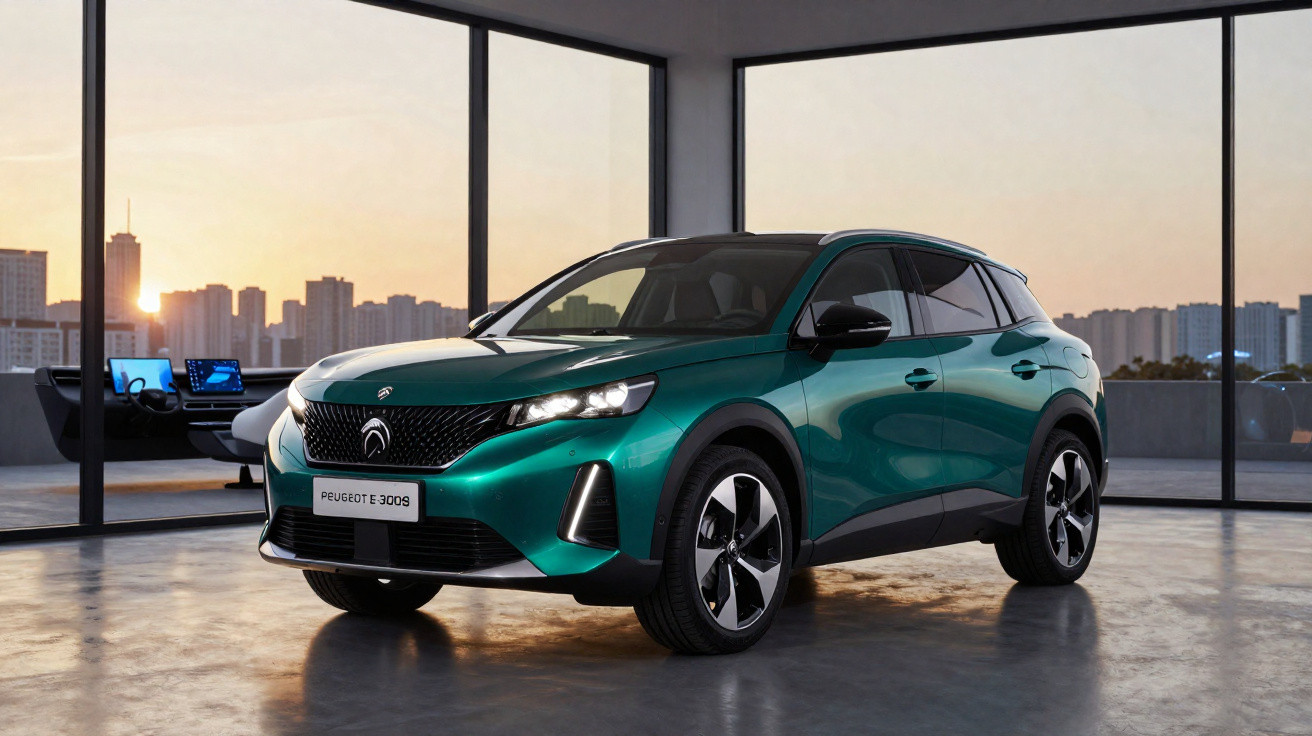
The new Peugeot E-3008 demonstrates the French brand’s courage. Everything has changed in this new generation.
There is no other way to describe it. Peugeot has completely reinvented the 3008, changing virtually everything that could be changed, particularly on the outside. Can we be slightly dramatic? Parked next to this new 3008, its predecessor looks considerably older - even though it is not.
I know design will always be somewhat subjective, but the approving looks it received as we drove past during the days I spent with this Peugeot E-3008 seem a good indication.
As well as the new liftback-style rear end, there are sharper angles and more pronounced creases, which together lend this Peugeot a more sophisticated appearance. The familiar lighting signatures intended to evoke a “lion’s claw” are also present. We do not think Peugeot knows how to design them any other way…
On the test car, all of this is even more striking thanks to the GT trim - the most comprehensive, sportiest and most expensive specification.
This trim brings 20-inch alloy wheels with an equally distinctive design, while the upper half of the bodywork is finished in black, creating greater contrast with the main exterior colour.
Boldness continues inside the Peugeot E-3008
Once inside, the sophisticated impression established by the exterior continues. That is down to the equally distinctive seat design and the highly elaborate styling of the door cards, centre console and dashboard. The latter is home to the new Panoramic i-Cockpit, introduced with this generation of the Peugeot 3008.
The build quality deserves particular praise. Every surface feels impressively solid. It is not merely a detail, but a strong overall impression throughout this model. In this respect, it may be Peugeot’s best car ever.
In terms of materials, this version also has a particularly eye-catching specification, combining TEP- and Alcantara-trimmed seats with fabric sections on the dashboard and door panels. There is no doubt that it is very pleasing visually.
The driver still gets a steering wheel that is far more compact than usual and distinctly non-circular in shape. As with all recent Peugeot models, it takes some getting used to. It is a divisive solution: some people love it, while others really do not.
Even so, it cannot be said that we felt uncomfortable behind it. The familiar multifunction stalks sit behind the wheel, although they now have a more modern design.
Perhaps less ergonomic is the location of the gear selector, mounted on the dashboard immediately beside the start/stop button and within easy reach. So far, so good. The issue arises during manoeuvres, for example, because you always have to look at the selector - both to find it and to make sure the desired gear has actually been selected.
More - and fewer - screens
In front of the driver, Peugeot has replaced the now-familiar layout of two horizontal 12-inch displays with one 21-inch screen. It sits much more directly in front of the driver, though it is further away from the front passenger, who will have to stretch further to reach it.
It does, however, offer good resolution and a user interface with new animations that will delight fans of technology and gadgets. Its integration into a curved panel makes it easy to read, at least for the person behind the wheel.
What is more, the entire assembly has been positioned to appear as though it is floating above the dashboard, giving the ambient lighting even greater prominence. One of the upper dashboard screens has admittedly been removed, but there is now another, smaller display on the centre console. This is reserved for the i-Toggles, Peugeot’s name for a series of shortcuts to the infotainment functions used most often. And yes, they can be personalised to suit your preferences.
Versatility and space
There are no space issues in either the front or rear seats, and certainly not in the boot, which has a capacity of 520 litres. Although the roofline slopes down, passengers in the second row still have sufficient headroom because it only drops away properly behind the rear seats.
Younger passengers will also love the countless storage areas available for “losing” a large number of toys and other belongings. There is also a centre console with USB-C ports and air vents. All of this comes alongside a standard of finish very close to that found in the front seats.
More functional, less emotional
The Peugeot E-3008’s dynamic performance was not among the aspects that impressed us most. It is obvious that this SUV was engineered around compromises. What compromises are those? Providing occupant comfort while retaining a degree of dynamic precision.
There are more comfortable models in the segment - its Citroën C5 Aircross “cousin”, for instance - and more dynamic alternatives, with the SEAT Ateca serving as a benchmark, but it disappoints in neither area. One thing is certain: managing 2200 kg was no easy task for the brand’s engineers.
Among the less positive points is steering that could offer more feedback. It is not a major problem; there are simply rivals that do this better.
The gearbox no longer includes a “B” mode with maximum regeneration. Instead, there are now two paddles behind the steering wheel that allow the driver to switch between three levels of regenerative braking. Even so, a minimum level is always active, and it never coasts freely.
To balance the equation, however, the battery’s positioning beneath the passenger compartment and between the two axles deserves highlighting.
This architecture not only lowers the centre of gravity, but also helps the E-3008 feel more firmly planted through corners, without excessive body movement. A new multi-link rear suspension also contributes here.
Only one Peugeot E-3008 powertrain option
For now, the only powertrain offered for the Peugeot E-3008 is the configuration fitted to the car we tested: a single electric motor driving the front wheels. Maximum output is 157 kW (213 hp), while torque stands at 345 Nm.
In performance terms, Peugeot claims 8.8 seconds for the 0–100 km/h sprint and an electronically limited top speed of 170 km/h. Power comes from a 73 kWh usable battery, allowing Peugeot to quote a maximum range of 527 km.
Is it possible to achieve that figure? In real-world use, do not count on it. Unless you drive exclusively in town and mostly with the air conditioning switched off, you will never get close to that figure.
Does that mean this model’s consumption and range are poor? Quite the opposite, so let us look at the facts.
Using the manufacturer’s stated combined consumption average of 16.9 kWh/100 km, maximum range should be around 432 km. That is much closer to reality.
It is a figure that is not at all difficult to achieve, even with the intermediate driving mode selected and the air conditioning always running. I recorded an average of 17.4 kWh/100 km by the end of the test, meaning it would take a substantial 420 km to fully drain the battery.
Did I occasionally use too much accelerator? Of course I did. So, in everyday use, you can genuinely expect those 420 km. But let us break down consumption across the different types of use.
In urban driving, the Peugeot E-3008 was happy to use less than 15 kWh/100 km on most journeys. At a modest and relaxed 90 km/h, the trip computer even settled at 14.1 kWh/100 km, which is no longer so common in a fully electric car.
At 120 km/h, however… Well, at 120 km/h, we cannot say the same, because at this pace the E-3008 reminds us why electric cars are not the biggest fans of motorway journeys. Guilherme Costa, who also spent time with this model, recorded average consumption of 20.9 kWh/100 km during a 200 km motorway trip, with driving that was not always restrained.
On that basis, expect 350 km of motorway range.
Simplified choice
With the new E-3008, Peugeot has also chosen to simplify the configuration process. As well as there being only one powertrain for now, there are just two available trim levels: Allure and GT.
The test car was a GT, the most comprehensive trim, with a starting price of €52,150. Combined with the metallic paint (€650) and the “360° Vision & Drive Assist Plus Pack” (€1,450) fitted to this car, the price rises to €54,250.
As standard, the Peugeot E-3008 comes in the bright Obsession Blue body colour seen across the French brand’s various communications. There are five alternatives, all priced at €650: black, white, grey and two shades of blue, one lighter and one darker. The darker option is Ingaro, the same colour as the E-3008 shown in the pictures.

Comments
No comments yet. Be the first to comment!
Leave a Comment