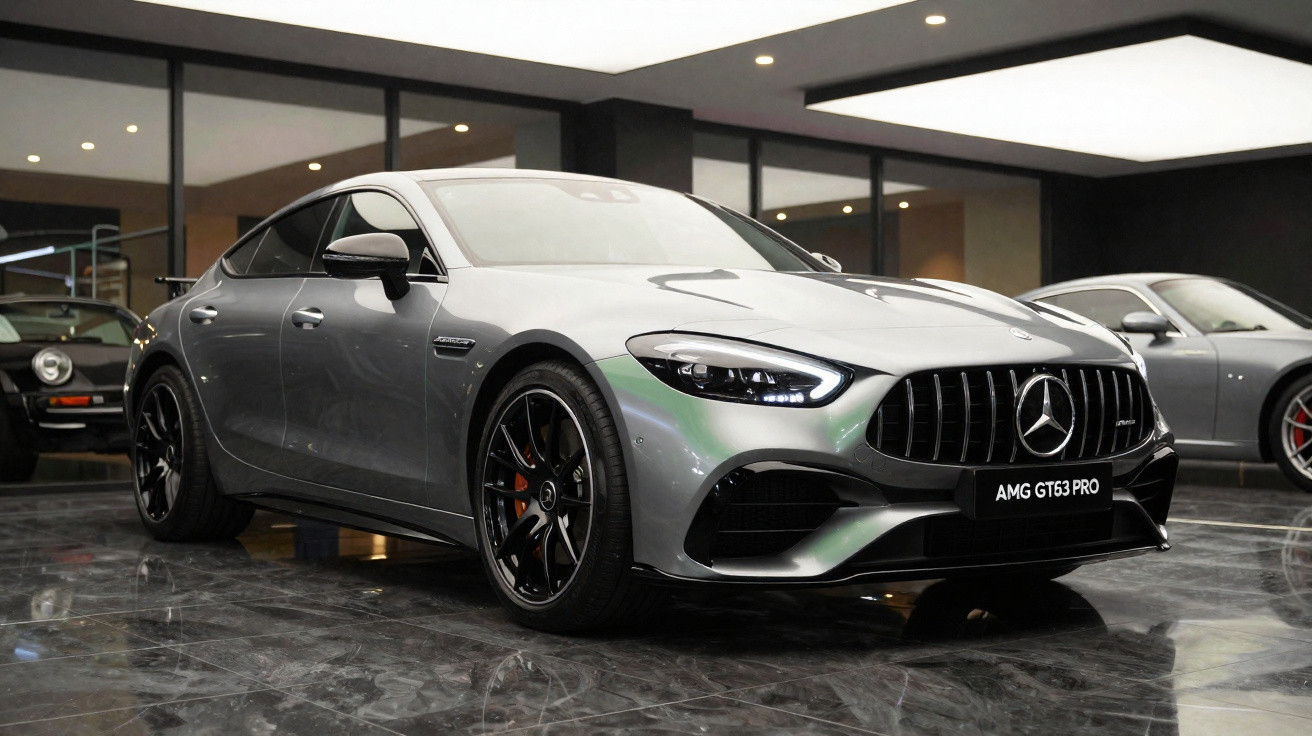
On paper, the Mercedes-AMG GT 63 Pro appears to be a direct Porsche 911 rival: two doors, 2+2 seating and brutal performance figures. Yet the real contest takes place elsewhere, within AMG’s own ecosystem. Buyers choosing the GT 63 usually are not arriving from Zuffenhausen; they are moving up from another model in the same stable.
A sports car like the 911 – yet fundamentally different
From a purely technical perspective, it seems obvious: Mercedes-AMG GT 63 Pro versus Porsche 911, a classic clash between German sports-car heavyweights. However, Affalterbach rejects that interpretation surprisingly firmly.
“The typical GT 63 Pro buyer does not compare the car with the 911, but with their current AMG – and simply upgrades.”
Mercedes-AMG says that many GT 63 Pro customers come from vehicles such as the G63 and E63: substantial performance SUVs and powerful saloons. They are now looking for something more extreme, a genuine sports coupé. For this audience, the 911 is not the natural next step but more of a parallel universe.
Fundamental differences in character
The technical layouts quickly explain why these two cars deliver such contrasting experiences:
- Porsche 911: a traditional rear-engined sports car, with its engine positioned far back
- Mercedes-AMG GT 63 Pro: front engine with a transaxle layout, meaning the engine sits at the front and the gearbox is mounted towards the rear axle
- Both: a 2+2 seating arrangement, coupé profile and potent road-focused sports cars with everyday usability
Above all, the engine placed behind the rear axle gives the 911 its distinctive personality: immense traction, an unusual balance and a driving sensation all of its own. With its front-mounted engine, the AMG sits on the road differently, feeling more like a long-bonnet grand tourer trained into a track machine.
This is precisely the essence of Mercedes-AMG’s argument: the two cars appeal to different kinds of enthusiast. Some are devoted to the 911 formula, while others favour the raw presence of a powerful front-engined V8.
A 4.0-litre V8 with nothing to prove
To retain customers within the brand, Mercedes-AMG brings serious firepower to the GT 63 Pro. Beneath the bonnet is the familiar 4.0-litre twin-turbo V8, an engine AMG has consistently developed over many years.
“610 PS, 850 Newton metres, 0–100 km/h in 3.1 seconds – the GT 63 Pro clearly reaches supercar territory with those figures.”
Compared with the already formidable GT 63, the Pro raises the output again, by 26 PS and 50 Newton metres. Its power is sent to all four wheels through a nine-speed automatic gearbox, controlled by AMG Performance 4Matic+ all-wheel-drive technology. This allows the performance to be deployed cleanly on the tarmac even when grip is poor.
The bare numbers look as though they have been calculated to fit between two 911 variants. On one side sits the 911 GTS T-Hybrid with 535 PS and 609 Nm; on the other is the 911 Turbo S with 711 PS and 800 Nm. The AMG slots almost exactly into the gap between them.
Comparable performance, not the same philosophy
In terms of output and acceleration, the GT 63 Pro can comfortably keep pace with the leading 911 versions. Its 317 km/h top speed is more than sufficient for the fast lane or any race circuit. That underlines AMG’s intention: the GT 63 Pro is not conceived as a tourer, but clearly as a serious sports car.
Its personality nevertheless remains different. The AMG feels wider, more muscular, louder and perhaps slightly more provocative. The V8 soundtrack creates a completely different spectacle from the flat-six boxer engine of the Porsche 911. Both soundtracks have cult status, simply in different ways.
AMG builds for loyal customers – not against Porsche
The strategy behind it is particularly interesting. The GT 63 Pro is not intended to poach 911 buyers, but to give existing AMG owners a higher rung on the ladder. Those who have previously driven a G63 or E63 already know the controls, styling and characteristic AMG manner. Moving into the GT 63 Pro therefore feels less like changing brands and more like a logical progression.
Many of these customers already own several cars. In that case, the GT 63 Pro joins the garage as an addition rather than a replacement. Alongside the family SUV and fast saloon, there is then a proper coupé for Sunday-morning drives or track days.
“For many of these buyers, the question ‘Porsche or AMG?’ does not arise at all – they simply remain loyal to the brand.”
There is also another factor that should not be underestimated: status. In some circles, a large, imposing Mercedes bearing an AMG badge is seen as a stronger statement than a comparatively compact sports car from Zuffenhausen. Brand image often has a more emotional effect than vehicle-dynamics charts.
Why loyal buyers matter so much to AMG
In the premium segment, established customers count for more than short-term conquest sales. Once buyers have entered the AMG universe, they often remain there across several generations of vehicles. That is due to several factors:
- Familiar control systems and infotainment structure
- Recognisable design cues, including the Panamericana grille and signature lighting
- Confidence in servicing, the workshop network and resale values
- An emotional connection: “My first AMG” becomes an experience that stays with many owners
With the GT 63 Pro, AMG expands its range upwards without diluting its DNA. It offers another interpretation of the same formula: maximum performance, clear everyday usefulness and an unmistakable brand identity.
Who the GT 63 Pro really suits
Beyond the engineering alone, the question is who actually needs a car like this. The answer often lies in the intended use. Typical scenarios include:
- Business people who cover high mileages, frequently drive quickly on motorways and want a distinctive coupé
- Sports-car fans for whom a pure 911 feels too uncompromising because they often travel as a pair with luggage
- AMG enthusiasts who already own a performance-badged G-Class or E-Class and now want a more emotional weekend car
The GT 63 Pro combines strong everyday practicality – four seats, a degree of luggage capacity and all-wheel drive – with performance that comes very close to true supercars. This blend is exactly what makes it more appealing to many buyers than a more purist sports car.
Terms, concepts and a look at the risks
One term frequently used in this context is “2+2 seating”. It means two proper seats at the front and two occasional rear seats, generally more suitable for children or short journeys. The aim is to bridge the gap between a strict two-seater and a conventional four-seater.
Another key term is “twin-turbo”. Here, two turbochargers operate in parallel or in a coordinated sequence to provide the V8 with boost across a broad rev range. The result is torque available very early and power delivery that almost resembles a large naturally aspirated engine from earlier times, only much stronger.
Anyone considering such a car should also recognise the trade-offs: high running costs, expensive tyres, depreciation that can be sensitive to the wrong specification, and increasingly strict regulation in city centres. A 610-PS coupé does not fit every daily routine, even if it is theoretically usable every day.
For genuine AMG fans, however, the attraction still outweighs these factors. The GT 63 Pro supplies exactly what they expect: enormous power, a bold presence, a familiar brand and a driving experience clearly distinct from that of a Porsche 911. Once someone consciously chooses this philosophy, they rarely look enviously at the neighbour in their 911. Both worlds can coexist without competing for each other’s customers.

Comments
No comments yet. Be the first to comment!
Leave a Comment