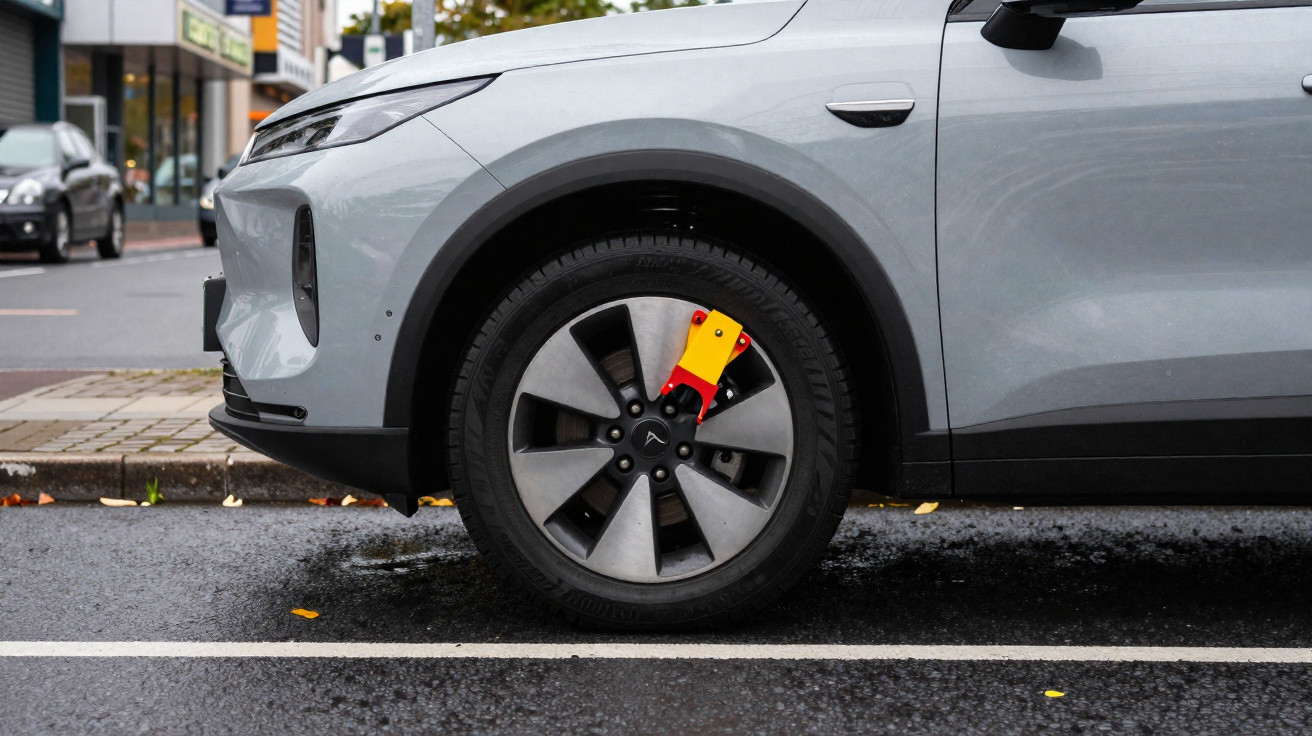
Footage apparently showing a BYD Fang Cheng Bao Bao 8 travelling with one front wheel raised and a wheel clamp still attached has prompted understandable concern. The striking part is not simply the vehicle’s suspension capability, but the apparent attempt to use it on a public road around other traffic and pedestrians.
Modern hydraulic body-control systems can raise or level a vehicle in carefully defined conditions. That does not make a three-wheel stance, a clamped wheel or a suspension fault safe to drive with. If a car is damaged, restrained or sitting abnormally, the sensible answer is recovery - not trying to use a clever feature to continue the journey.
What the footage appears to show
The clip circulating online appears to show a Bao 8 moving along a public street with its front-left wheel lifted clear of the road. A yellow-and-red wheel clamp seems to remain fitted to that wheel, while the SUV rolls on its other three tyres.
The surroundings appear to include parked vehicles, shops, pedestrians and passing traffic. That is a crucial distinction from a closed demonstration area, where surfaces, speed, space and access can all be controlled.
Footage alone cannot reliably establish:
- who was driving and why;
- whether the vehicle was being tested, recovered or moved a short distance;
- its precise speed;
- whether the clamp was fully engaged or already damaged;
- whether the local authorities or the clamp operator became involved.
A vehicle may be capable of an unusual manoeuvre without that manoeuvre being suitable on a public road.
The technology behind the raised-wheel display
The Bao 8 has been associated with BYD’s DiSus-P hydraulic body-control technology. Systems of this type can adjust the height and attitude of a vehicle body, sometimes at individual corners, rather than relying only on conventional springs and dampers.
That can be useful in limited circumstances. A vehicle may be able to raise itself for extra ground clearance, compensate for uneven surfaces or assist with an approved maintenance procedure. The important qualification is that the feature must be used exactly as the manufacturer intends.
A hydraulic suspension system is not a replacement for proper lifting equipment, a safe jacking point or a recovery vehicle. Nor should the ability to raise a wheel be treated as permission to drive with a tyre, wheel, clamp or suspension component in an abnormal condition.
Features and specifications can also vary by market, trim level and model year. UK motorists should not assume that a function demonstrated on a vehicle sold in China will be available on a future UK version, or that it would operate in the same way.
When individual wheel lift can have a legitimate use
Lifting a corner of a vehicle is not automatically a gimmick. Used on stable ground and in line with the handbook, adjustable suspension can be helpful.
Possible controlled uses
Access for approved maintenance
Some systems may make it easier to position a vehicle for inspection or wheel-changing work. The handbook must specifically permit this, and the car still needs correct support before anyone works beneath it.Levelling on uneven ground
Controlled body-height adjustment may help a vehicle sit more evenly on suitable terrain, for example when parked off-road.Improving clearance at very low speed
Raising the body can help avoid contact with an obstacle on private land or rough ground, provided the surface and manoeuvre are appropriate.Workshop positioning
A service mode can help technicians prepare a vehicle for lifting or inspection. It does not replace a ramp, lift or axle stands.
The common thread is control: level ground, clear surroundings, no passengers at risk and strict adherence to the vehicle manufacturer’s instructions.
Why a wheel clamp makes this especially risky
A wheel clamp is a restraint device designed to prevent a vehicle being moved. Driving with one attached can damage the tyre, wheel, brakes, wheel arch, suspension and bodywork. It may also damage the clamp itself.
Raising the clamped wheel may appear to avoid the immediate problem of the clamp scraping along the road. In practice, it introduces different hazards. The clamp adds mass around the wheel and could interfere with suspension movement, steering components or bodywork as the vehicle moves. It may strike the ground if the raised corner drops over a pothole, dip or kerb.
Travelling on three wheels also changes the way a vehicle reacts. Risks include:
- less predictable steering, particularly when turning;
- altered braking balance and tyre loading;
- reduced stability on cambers or uneven surfaces;
- a sudden change in vehicle attitude if the raised wheel drops;
- danger to pedestrians, cyclists and nearby drivers who cannot anticipate the movement.
Wet tarmac, drain covers, painted markings, fallen leaves and broken road surfaces are routine autumn hazards in the UK. A vehicle already sitting at an unusual angle has less margin for error when it encounters any of them.
Public street versus a controlled demonstration
A proving ground can be closed to the public and checked before a vehicle demonstration begins. Engineers can set limits, monitor the system and stop the exercise if anything looks wrong.
A public road has none of those safeguards. Someone can step from between parked cars, a vehicle door can open into the road, or an approaching driver can misjudge the situation. Even at walking pace, an unstable or damaged vehicle can cause injury or further damage.
In the UK, vehicles used on the road should be in a safe and roadworthy condition. Whether a particular situation breaches road traffic law depends on the facts and the condition of the vehicle. The practical point is simpler: if a wheel, tyre, suspension component or restraint device gives cause for concern, stop safely and arrange assistance.
Adjustable suspension can create clearance, but it cannot make an unsafe vehicle safe to drive.
If your car has a wheel clamp or suspension problem
Do not try to defeat a wheel clamp by driving, lifting that corner of the vehicle or attempting an improvised repair. Contact the organisation identified on the clamp and use its stated release process.
If your vehicle has suffered a suspension fault, has become stuck at an unusual height or has wheel damage, take these steps instead.
What to do
Stop somewhere as safe as possible
Use hazard warning lights if appropriate. If stopping in a live lane creates an immediate danger, move only as far as necessary to reach a safer location, if the vehicle can be moved safely.Keep clear of the underside
Keep passengers and bystanders away from the raised or damaged corner. Never put any part of your body beneath a vehicle supported only by its suspension or a roadside jack.Consult the handbook
Check for suspension service modes, jacking points, towing instructions and any warnings for hybrid or electric versions.Call suitable recovery assistance
Contact your breakdown provider, manufacturer roadside assistance or a competent recovery operator. Explain that the vehicle has adjustable suspension, is sitting unevenly or has a wheel restraint attached.Do not override safety systems casually
Some cars have transport or workshop modes. These should be used only as described in the handbook or under guidance from a trained technician.
For any authorised work, use equipment rated for the vehicle and proper axle stands on firm, level ground. Never rely on a hydraulic system alone to support a car.
Common mistakes to avoid
Advanced vehicle technology can make risky ideas look easier than they are. Avoid these common errors:
- Treating a viral clip as an instruction. Short videos rarely show the preparation, limits or damage that may follow.
- Confusing capability with approval. A system may lift a wheel, but that does not mean it is approved for driving on three wheels.
- Using suspension height instead of safe support. Follow the handbook’s jacking and lifting guidance.
- Driving with a clamp, flat tyre or loose part. A short journey can turn a manageable issue into a costly repair.
- Attempting a lift on soft or sloping ground. Grass, gravel, mud and angled tarmac can all make a vehicle unstable.
- Ignoring model-specific recovery instructions. Electric and hybrid vehicles may need particular handling, isolation or transport procedures.
The sensible lesson from the Bao 8 clip
The footage is an eye-catching example of what modern hydraulic body control can do. Individual wheel lift and adjustable ride height may have worthwhile uses in carefully managed situations.
But the responsible use of such technology is much less dramatic. Follow the handbook, use a suitable surface and treat a wheel clamp, tyre issue or suspension warning as a reason to stop and get help. Clever suspension may assist with access or levelling; it is not a workaround for a vehicle that should not be driven.
If your own vehicle is not securely back on all four wheels, in a condition you understand and safe to use, recovery is normally the best next move.













Comments
No comments yet. Be the first to comment!
Leave a Comment