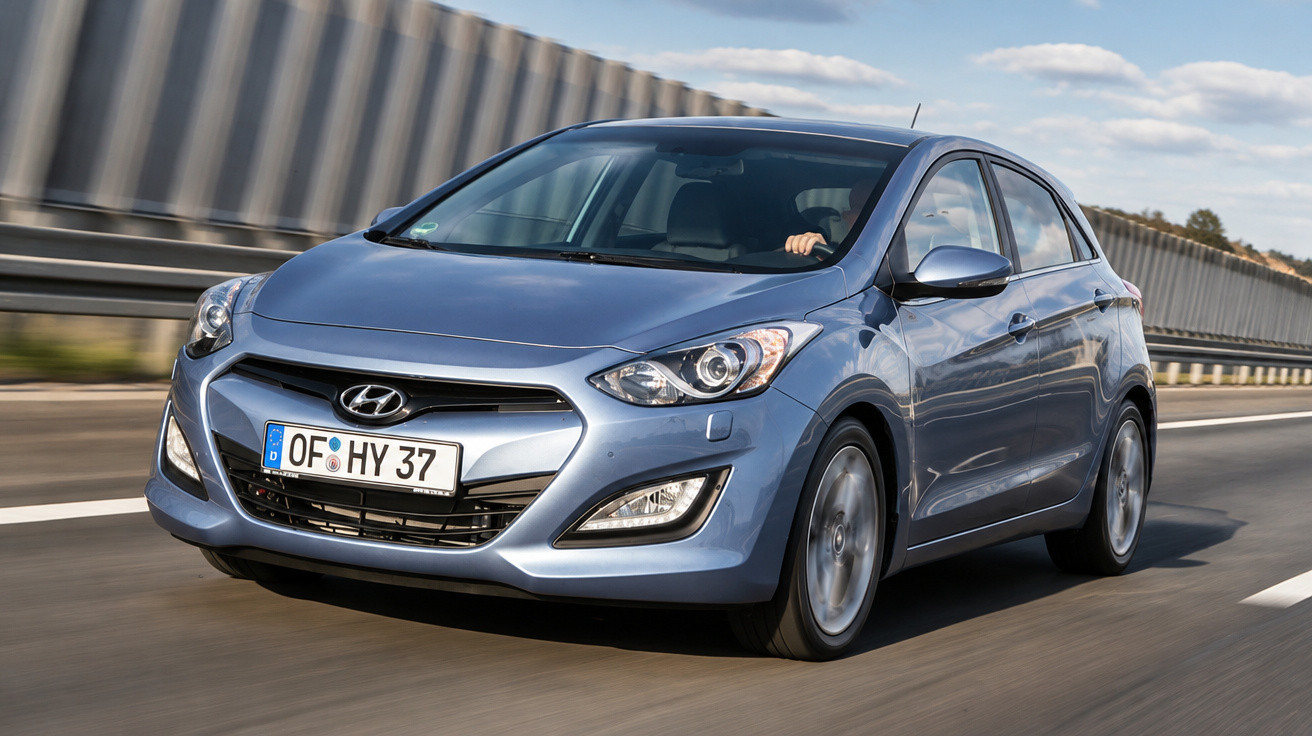
This is still a prototype, so I am not about to make any sweeping claims. Even so, after an initial drive, I would say the new Hyundai i30 looks set to be more competitive than the i40, a car we have already said we rather like.
Hyundai i30 targets the family hatchback class
The i30 is aimed squarely at the heart of the Ford Focus market – although it could just as easily be seen as a rival to the Honda Civic. Hyundai remains exceptionally good at keeping owners happy through its reliability and warranty. More recently, buyers have also been delighted by how their Hyundais look and drive, helping the brand achieve truly stellar scores in customer-satisfaction surveys – the rankings once dominated by Japanese manufacturers.
Owners who were pleased with their previous i30s are likely to be seriously impressed by this new one.
Of course, that is not the whole story. Improving on the appearance and driving manners of the old Hyundai i30 is one thing; the important test is whether it can edge towards the genuine class leaders.
Hyundai i30 diesel engine, steering and comfort
There is a quiet, eager 128bhp diesel engine that comes in below the 100g/km CO2 threshold. It delivers miserly fuel economy while still providing entirely adequate performance. The gearshift is accurate, as is the steering, which has the appropriate degree of weighting and progression. You can alter the steering weight, although there seems little reason to do so because each setting feels much the same. That said, the steering wheel does not communicate much about available grip.
The ergonomics are excellent. This is the sort of car you simply get into and drive: the seats go almost unnoticed because they are positioned correctly and shaped just right. They are neither overly soft nor too firm. In many rival cars, I find myself constantly adjusting the seat controls in pursuit of a comfortable driving position that never quite materialises. The i30 has all the fundamentals covered.
A refined early Hyundai i30 prototype
It also offers some appealing details beyond those essentials, including neatly creased bodywork and a dashboard that is both carefully finished and effectively illuminated. Ride quality is quiet, although I had four people on board for most of the time, and that tends to settle any car’s ride at lower speeds. The Hyundai i30 was also composed on motorways, particularly considering mine was an early vehicle, which would normally be expected to generate plenty of wind noise. It was a busy day, however, so I never found enough clear road to exceed 80mph.
So, this was hardly the most comprehensive road-test assessment of a new car. It was an early outing in a near-production prototype, with no tyre-squealing cornering and no full-throttle acceleration runs. Instead, it was driven normally, as most people drive every day. In those conditions, it was ruddy difficult to find fault with it.
The one uncertainty is pricing. It has not been announced because, at the time of writing, the car is still four months from launch. We hear Hyundai staff discussing the possibility of taking an aggressive approach. They should be cautious: a Hyundai that feels unexpectedly expensive is a poor idea. Hyundai ought to be about pleasant surprises.

Comments
No comments yet. Be the first to comment!
Leave a Comment