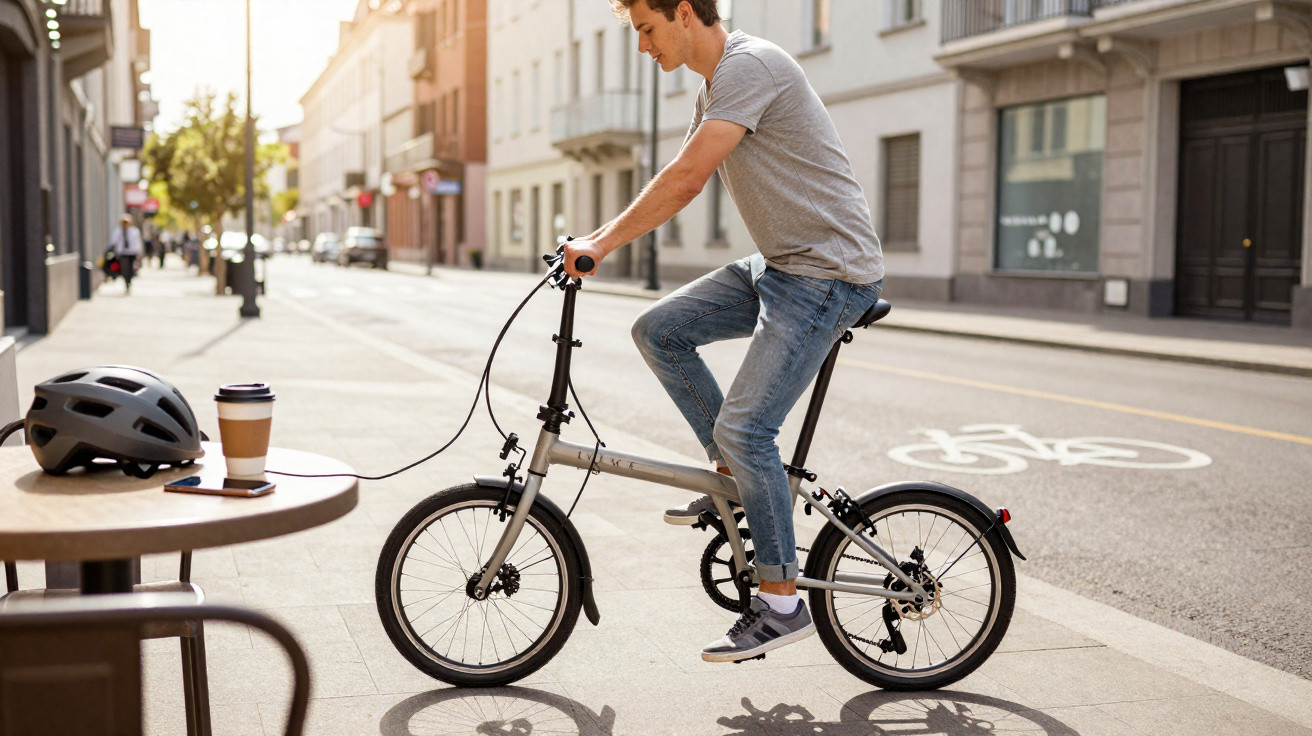
The ENGWE ZIP is an electric bike that folds in three seconds, weighs 16.9 kg and occupies no more space than cabin luggage: that is the promise behind the Chinese manufacturer’s latest urban model. I spent several weeks carrying it around Paris and the surrounding area. The aim? To find out whether the brand’s marketing claims had become excessively optimistic. Here is my review.
Remarkable compactness and USB-C charging
The ZIP stands apart from the other e-bikes I test as soon as it arrives: its box is remarkably compact, only slightly larger than a suitcase. Better still, it comes 95% assembled. The instructions simply ask you to fit the handlebar stem and seat post into their respective slots, click the pedals into place, then screw on the rear rack. Barely 15 minutes passed between the box arriving and the ZIP being ready to use. Almost, anyway: the battery first needed charging.
The battery sits in the bag at the front of the bike, which can also carry accessories or a few items of shopping © Marc Mitrani for Presse-citron
It is a black rectangular unit concealed inside the black bag positioned at the front. It can be charged while installed, or removed from the bike and taken indoors. I particularly like the fact that it can be replenished using the standard 100 Watt GaN USB-C charger supplied in the box.
In other words, the ZIP’s charger is the same type used by a MacBook Pro or a premium smartphone. Gone is the huge, weighty proprietary power brick that works only with the bike. When travelling, a single charger covers everything. That is a luxury almost never seen on an electric bike at this price point, with most rivals still relying on proprietary, 2010s-style connectors.
There is one caveat: a third-party charger must supply 100 Watts. A 60 Watt charger can also be used, but charging will take longer. Even with the supplied power adapter, reaching 80% takes 2 h 45, while a full charge requires 4 h.
One of the ZIP’s strengths is how easily it folds. The process takes under a minute and leaves the bike genuinely compact. The magnetic mechanism that holds it securely when folded is welcome, as is the storage point for the removable pedals. Two small wheels beneath the frame keep the folded ZIP pleasantly stable and make it easy to move around.
Built for short journeys
Riding a bike with 16-inch wheels requires a small adjustment: it does not behave like a 26- or 28-inch model. The steering feels more responsive, road imperfections are transmitted more directly, and it takes a few kilometres to get used to it. That said, the ZIP surprised me with its stability. Its 1.95-inch tyres, around 5 cm wide, partly offset the harshness usually expected from wheels this small. The suspension seat post handles Parisian cobbles and poorly repaired stretches of tarmac effectively. It has been designed for riders between 1.55 m and 1.90 m tall.
The 250 Watt motor housed in the rear hub produces 40 Nm of torque. It is not exceptionally powerful, even in this class, as some competitors approach 60 Nm, but that is not the key point here. The emphasis is on the torque sensor, which I found surprisingly capable. Assistance is smooth and responds in proportion to pedalling effort, without unpleasant surges. At Paris traffic lights, the ZIP pulls away without bogging down.
Its three assistance levels cover the essentials. The first suits riders who want to put in some effort, the second is ideal for commuting, while the third turns the ZIP into a miniature rocket - up to 25 km/h, naturally. The conventional 7-speed Shimano drivetrain does its job without making grand claims. It is not at the top end of the range, but it fits the bike’s urban positioning well. Braking comes from two hydraulic disc brakes with very respectable bite, even in the rain.
Decent range
ENGWE claims a range of between 60 and 120 km, depending on the selected assistance level. Those figures are achieved with a light rider in ideal conditions. Unfortunately, I am neither light nor “ideal”. Fully equipped, I weigh 110 kg, roughly 30 kg more than the standard rider used for testing. The effect is significant: in mixed use, with some level 2 and plenty of level 3, expect around 45–50 km. That is enough for three to four days of daily journeys without reaching for the charger. Do not expect to cross France on it, but that is not its purpose in any case. A lighter rider will inevitably travel further, although still not as far as ENGWE’s stated figures suggest - 65–70 km for a 75 kg rider, for example.
Connected bike features
The ZIP includes a 3.2-inch colour LCD display and Bluetooth connectivity for the manufacturer’s companion app, available on iOS and Android. It remains readable in direct sunlight and presents the key information: current speed, battery level, assistance mode, mileage and front-light status. The app offers the basics, which seems entirely appropriate given the bike’s positioning. It lets users track journey statistics, alter certain settings and receive any available updates. It is a welcome extra that remains very rare on bikes sold at this price.
Could the ZIP be the perfect folding bike for city use? To a large extent, yes, although it still has a few drawbacks, as the manufacturer had to make choices to keep the price under control. From that perspective, using a steel frame instead of aluminium is unfortunately understandable. An aluminium frame could have saved one or two kilograms, but would also have increased the price.
Ultimately, 40 Nm of torque is still 40 Nm of torque. On flat streets and gentle urban inclines, it is sufficient. Around the Plateau de Gravelle or on Montmartre’s climbing cobbles, however, you need to select the lower cassette gears and accept that you will have to pedal harder. If your daily route includes substantial elevation changes, a more powerful and more expensive model is likely to be a better investment. This warning applies even more to heavier riders such as myself, who place greater demands on the motor uphill.
My verdict on the ENGWE ZIP
The ZIP is not a universal electric bike suited to everyone. It is best viewed as a specialist product designed for a very specific customer. It is aimed at city dwellers who combine several forms of transport each day, live in a flat where every square metre matters, and need a highly compact bike that can slide beneath a desk or into a cupboard.
There are plenty of thoughtful details from its designers: quick folding, a controlled weight, hydraulic brakes and an effective torque sensor. The USB-C charging deserves special praise for removing the need for a proprietary mains adapter: clearly, the brand has observed urban habits in 2026 rather than repeating the usual formula.
Priced at €999 at launch (€1,099 afterwards), its value for money is hard to beat among compact urban folding bikes. If you live in a large city and switch between the Underground, bike, tram or regional train, the ZIP deserves serious consideration, especially if theft worries you. Conversely, if you want a bike for Sunday rides, look elsewhere: you are likely to be disappointed.
ENGWE ZIP
€999
9
| Category | Score |
|---|---|
| ### Design & ergonomics | 9.0/10 |
| ### Ease of use | 9.0/10 |
| ### Range | 8.5/10 |
| ### Performance / price ratio | 9.5/10 |
What we like
- Compact when folded
- Standard USB-C charging
- Effective hydraulic brakes
- High-performing torque sensor
What we like less
- Steel frame choice
- Struggles on steep climbs
Buy the ENGWE ZIP

Comments
No comments yet. Be the first to comment!
Leave a Comment