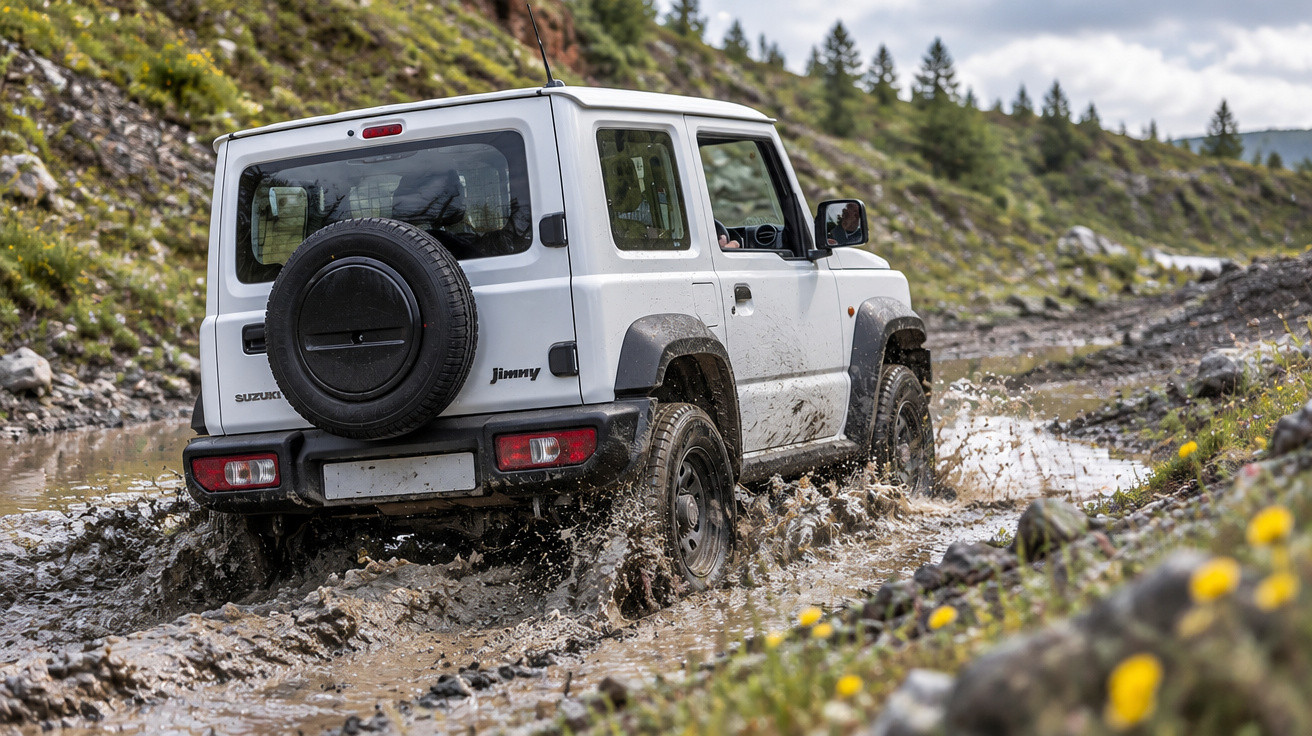
Hang on, wasn’t the Suzuki Jimny discontinued?
Yes, it was. After being absent for roughly a year, however, it has returned with a caveat: it is now sold solely as an LCV, or light commercial vehicle - a van, in everyday terms. Suzuki says it will reach the UK in ‘very limited numbers’, meaning 480 examples during its first year on sale, equating to about three per retailer. Securing one may well be trickier than getting hold of a GT3 Touring.
Seriously?
Suzuki reckons it could sell ten times that volume and is already having to turn prospective buyers away. Older four-seat Jimnys still command more than £25,000 on the used market, despite getting older and accumulating more miles. With the Jimny LCV costing £16,796 before VAT - or an appealing £19,999 for private buyers once tax is added - expect some purchasers to buy one purely to speculate.
What does that price include?
Only one trim level is offered, and it is charmingly no-frills. You will not find satellite navigation or climate control, although it does come with digital radio and conventional air conditioning. The cabin is, at least, packed with physical buttons.
Several exterior colours are available, including a two-tone finish like that worn by our former long-term Jimny. The smart steel wheels pictured here, though, are the only option. That is no bad thing when you are relentlessly thumping along rough country lanes with a rural dog-grooming business based in the rear.
How much fur detangler can the Suzuki Jimny LCV carry?
The Jimny LCV, unsurprisingly, loses its rear seats - ours were almost always folded anyway. Their removal creates a pleasingly square 863-litre load area, with a protective bulkhead ahead of it to prevent cargo flying towards you and your passenger when an off-road excursion becomes lively. It is only 33 litres larger than a normal Jimny’s boot with its seats folded, but the floor is now entirely level. Payload is a rather modest 150kg, and it is worth noting that the rear windows remain uncovered.
Remind me how it performs.
Power comes from a proudly unsophisticated 1.5-litre petrol engine, without any modern turbocharging, paired with a five-speed manual gearbox. It produces a lofty 100bhp and 95lb ft, which is ‘good’ for 0-62mph in… well, Suzuki has not published a figure. Allow around 12 seconds with a following wind. Top speed is 90mph, while its less-than-green figures stand at 36.7mpg and 173g/km of CO2. If any of that concerns you, though, you are looking at the wrong vehicle: this is designed for uncompromising utility above everything else.
So it excels off road…
Without doubt, that is where it is at its best. On tarmac, a Jimny can feel cheerful when you are in the appropriate frame of mind, yet nervous and unsettled when you are not - particularly in poor weather. Take one out in a strong gale and the experience will stay with you for weeks. Venture off road, however, and it becomes brilliant: it will scamper up and down improbably steep inclines without complaint, while its tiny overhangs eliminate any real worry. The transmission lets you select rear- or four-wheel drive, with high- and low-range settings for the latter.
It is then that Suzuki’s determination to retain this engine starts to make sense, even though its emissions unceremoniously forced the Jimny out of European showrooms. It tolerates punishment, buzzing as though pistons are about to burst through the bonnet, yet seemingly always ready for more.
The engine works every bit as hard as the suspension. The entire car - sorry, van - feels completely at home bouncing through woodland, quarries, or whatever other absurd location you have reached by blindly following satellite navigation set to ‘shortest route’. You are more likely to stray into the centre of a classified firing range than to defeat the mechanical components beneath you.
Is there a downside?
Its broader talents are probably as restricted as its supply. A vehicle this uncompromising is unusual today, but that has always been central to the Jimny’s appeal. Converting it into a van objectively improves it, too: the rear seats were always cramped, while the boot was even smaller when they were upright, and a vehicle so proudly functional only benefits from more carrying capacity. The alarming prices of used Jimnys also make spending around £17k on a new one appear good value, even if the Dacia Duster Commercial starts at £11,995 and offers three times the payload.
This spirited little 4x4 rises above simple rationality, and the fact that Suzuki worked so hard to return it to sale while the rest of its car range is hybridised - complete with matching marketing messages - shows how important it is to have a ‘character’ in the line-up. Whatever shortcomings that character brings.

Comments
No comments yet. Be the first to comment!
Leave a Comment