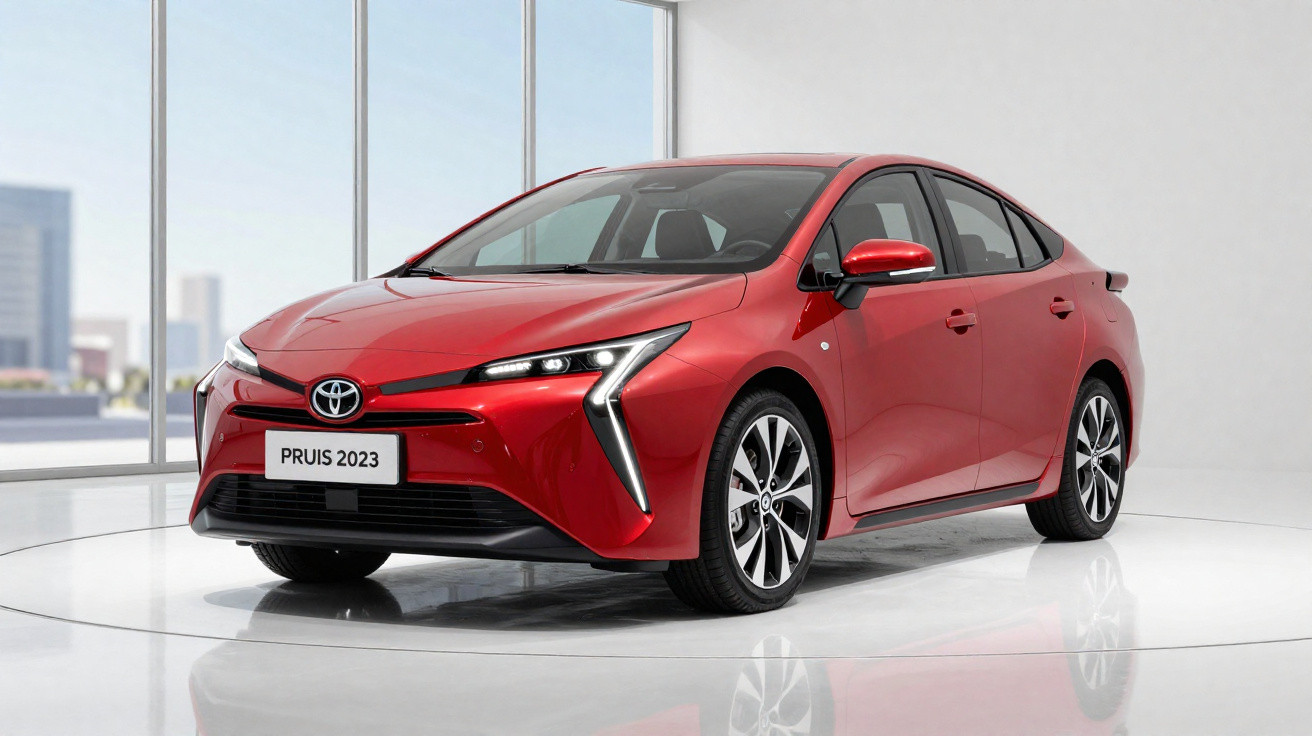
The Prius rejects its past and injects a refreshing dose of performance and excitement.
More than 25 years have passed since the first Toyota Prius was introduced in the US and Japan, with the aim of cutting fuel consumption by 50% compared with other cars in its segment.
The second-generation Prius (2003) and third-generation model (2009) remained highly rational propositions thanks to their low consumption, cementing an image that was rather more dull than exciting.
However, Akio Toyoda, the Japanese giant’s boss, decreed that Toyota would no longer make boring cars, and things began to change with the fourth-generation Prius in 2016. It was the first model to use the GA-C platform, which created a more “intimate” connection between driver, car and road, though the exterior design was still fairly inhibiting and the powertrain/transmission retained room for improvement.
No more taxis!
More than five million units after the original Prius, the fifth generation will undoubtedly transform perceptions of one of the world’s best-known cars. The project’s chief engineer, Satoki Oya, tells me with a restrained smile:
“I was asked to create a Prius that broke away from its taxi image and made people sigh when they saw it in the street.”
Satoki Oya, chief engineer of the Toyota Prius
That ambition now takes shape in the 2023 Toyota Prius, which in Europe is available exclusively as a plug-in hybrid, recharged externally. It is a strategic decision, as registrations of the two hybrid propulsion systems had already reached parity in the previous generation across the “old continent”, although other markets will continue to receive the self-charging hybrid (HEV) version as well.
Oya-san also explains the choice by pointing to Toyota’s extensive hybrid line-up in Europe’s C-segment: the Corolla, Corolla Cross and C-HR.
Shorter, lower and wider
The new Prius’s very appealing appearance is the result not only of its cleaner lines, but above all of its revised proportions. It is 5 cm lower, 2.2 cm wider and 4.5 cm shorter, while its wheelbase has grown by 5 cm, promising improved interior space. With the wheels pushed closer to the body’s extremities, the silhouette is now far more dynamic, even sporting.
The most striking feature of that profile - an almost unbroken line from the leading edge of the bonnet to the end of the roof - is the relocation of the body’s highest point. It has moved from above the first row of seats to the roof area over the second row.
Sporty exterior design affects the interior
After getting into the car carefully enough to avoid striking their heads on the lower roof - the price paid for the new Prius’s sporty line - rear passengers benefit from more legroom. Since the rear bench sits higher than the front seats, they also enjoy a good view thanks to an amphitheatre-like effect, which is useful given the narrow side window area.
The raised section in the middle of the rear floor is of medium size, allowing a reasonable degree of freedom and space, especially for the middle-seat occupant.
Headroom is not outstanding, but the loss is less than expected because the body has been lowered more at the front than at the rear. Anyone up to 1.80 m tall should not have to worry about inadvertently touching the roof.
The rear window is also very narrow and, together with the extremely broad rear pillars that would not look out of place on a coupé, seriously compromises rearward visibility for the driver. For that reason, the new Toyota Prius has a digital camera at the back of the car, whose images are displayed in the interior rear-view mirror as an alternative to the restricted conventional mirror view.
Improved infotainment
We “entered” the new Toyota Prius through its rear doors, but have now reached the front row, where there is both good and bad news. Starting with the positives, there is a large, horizontal 12.3-inch central infotainment screen with excellent resolution and brightness, plus graphics that are considerably more sophisticated than those Toyota offered until recently. Android Auto and Apple CarPlay connectivity are also included.
The build quality is reassuring too, even if soft-touch surfaces do not dominate the cabin, and their greater presence would improve the overall perceived quality. Also on the positive side, the climate controls are physical. The front windows use double glazing, a feature normally associated with cars from higher classes, helping to keep the cabin quiet, as we shall see later.
Areas for improvement
On the downside, Toyota again uses the dashboard layout first introduced in the bZ4X electric car. It suffers from an excess of hard plastics but, above all, it forces the driver to focus and refocus their eyes too often on every journey because of the arrangement of the displays and their distance from one another and from the driver. The instrument panel also deserves criticism:
Much more powerful and capable of travelling further in “zero emissions” mode
This third generation of Toyota’s plug-in hybrid system is based on the fifth generation of the hybrid system. The previous 1.8-litre petrol engine has been enlarged to 2.0 litres, with output rising from 98 hp and 142 Nm to 152 hp and 190 Nm. The electric motor is far more powerful as well, producing 120 kW (163 hp) rather than 53 kW (71 hp) - with an additional 23 kW (31 hp) from the generator - which explains the increase in overall system output from 122 hp to 223 hp.
One significant change is the removal of the clutch between the two electric motors, the main unit and the generator, which allowed both to contribute to moving the vehicle in the predecessor. The new main electric motor no longer needs that “help” because it is much more powerful.
More important still is the adoption of a larger 13.6 kWh battery, replacing the previous 8.8 kWh unit. This is decisive in increasing electric range from 45 km to 69 km, a provisional and not yet homologated figure, although Toyota believes it could be greater still.
Thanks to more sophisticated chemistry, identical to that used in the RAV4 PHEV battery, this battery delivers 50% more capacity with 30% fewer cells: 72 rather than 96. It has a higher energy density, occupies the same space and weighs roughly the same as the smaller battery it replaces.
Oya-san does not disclose the precise chemistry of the lithium-ion battery - the Japanese are always very guarded when providing technical details… - but does tell me that “the electrolytes are denser than in the previous battery”. The only drawback of the higher capacity is that charging will take longer, but there are no miracles here.
Engaging dynamics
My first dynamic encounter with the new Toyota Prius took place around Athens, Greece, mostly on coastal secondary roads and inland routes with plenty of bends.
The new Prius’s improved stability is immediately apparent. This comes from it being lower and wider, but also from the greater structural rigidity - there is a new crossmember at the now-independent rear axle, which uses a multi-link layout. This latter factor has made it possible to retain a degree of comfort in the dampers.
However, with the 19-inch wheels - the previous generation went no larger than 15 inches - and 195/50 tyres fitted to my test car, travelling over some of the more pronounced imperfections along the way resulted in sharper impacts for occupants. Choosing tyres with a slightly taller sidewall and wheels one size smaller - 195/60 tyres on 17-inch rims - might be a sensible idea.
The small steering wheel, positioned below the instruments and offering a semi-head-up display-style arrangement familiar from Peugeot models, helps the driver feel more involved. Yet it is the exceptionally easy and effective turn-in, the extremely well-controlled body roll and the powertrain’s very strong response that would make anyone doubt they were at the wheel of a Prius.
6.8 s from 0 to 100 km/h… A Prius?
The extremely positive shock of driving the new Prius, and seeing how distinctly it differs from its predecessor, is nowhere clearer than in its performance - after all, it has around 100 hp more than before.
The new Prius cuts more than four seconds (!) from the traditional 0-100 km/h sprint - 6.8s versus 11.1s - while top speed, still limited, has increased by 15 km/h to 177 km/h.
Acceleration and in-gear response also benefit from a much better - and now genuinely acceptable - relationship between the noise made by the petrol engine and the car’s acceleration response, even though a continuously variable transmission remains as the “intermediary”.
Naturally, the petrol engine is less audible as a result of the improved cabin soundproofing, but chiefly because it is much more powerful and needs to work far less hard under stronger acceleration. The much more powerful and ever-present electric motor also plays its part.
It is true: the new Toyota Prius rejects its past, and after driving this new generation it is simply impossible for anyone to call it a “taxi” or a “grandad car” again.
When does it arrive and how much will it cost?
I was almost about to leave without mentioning consumption, which until now has been the principal argument that convinced almost all of the five million customers who bought one. As with electric range, average consumption is still undergoing homologation.
The car is 50 kg heavier than its predecessor and has a similar aerodynamic coefficient - its Cx is worse, but its frontal area is smaller. The compensation comes from the larger engine capacity and higher output, which enable lower throttle loads, together with the more powerful electric propulsion and extended electric range.
Toyota therefore anticipates consumption in the region of 0.8 litres for the first 100 kilometres, while there is still “charge”, of course. In our case, we recorded 3.9 l/100 km, but the test route was not only somewhat longer, it also required pushing the plug-in hybrid system a little harder to assess its response.
The estimated price for Portugal is expected to be around €46,500, with confirmation only coming later, and its arrival is scheduled for the beginning of summer.

Comments
No comments yet. Be the first to comment!
Leave a Comment