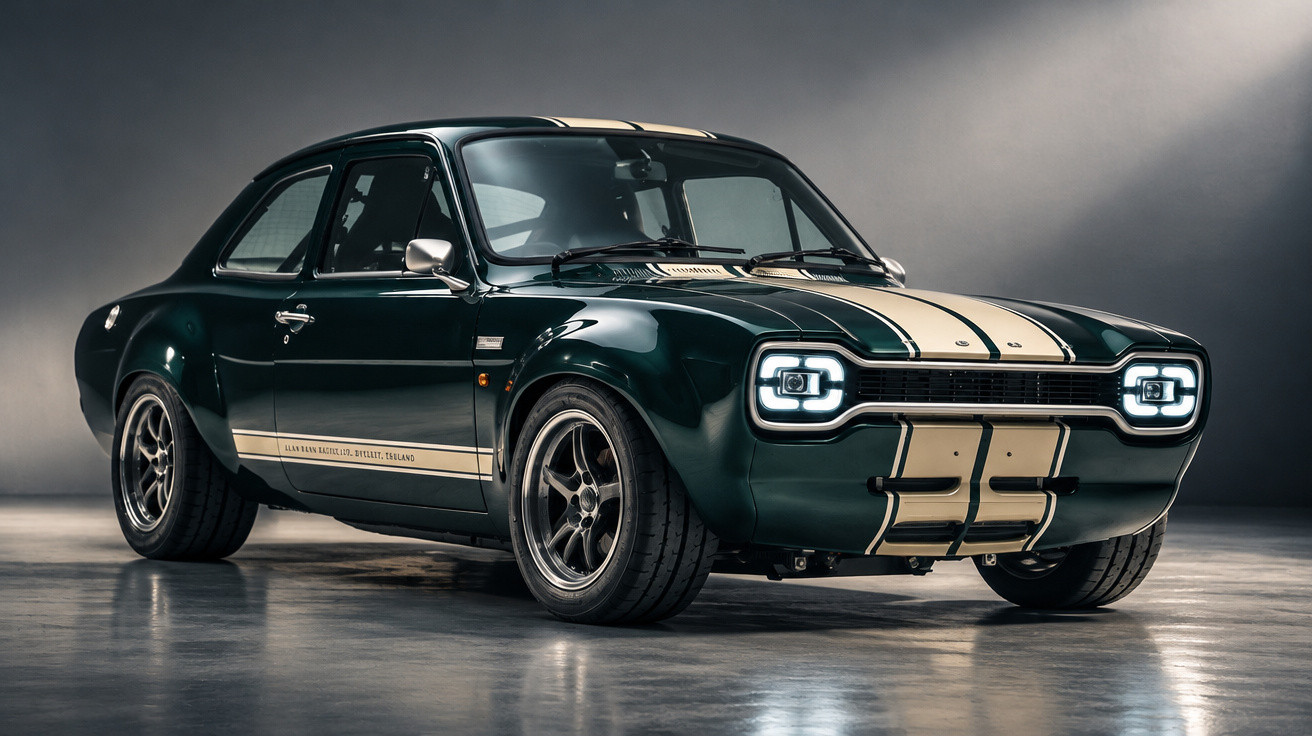
The Ford Escort has returned, albeit in a dramatically altered form. It boasts a superior power-to-weight ratio to a Porsche 911 GT3, an engine with greater specific output than the Aston Martin Valkyrie, and dampers made by the company that also supplies the GMA T.50. This is plainly no longer a working-class hero.
Yet it is neither a restomod nor a continuation model. Officially approved by Ford, the Ford Escort Mk1 RS by Boreham Motorworks is a freshly engineered, modified retro-futurist interpretation of the race-bred original Escort.
Trying to categorise it too precisely is likely to become needlessly complicated. Better simply to appreciate it as a handsome, sub-900kg, rear-wheel-drive, naturally aspirated little Ford with a manual gearbox, an enormous character and a 10,000rpm redline.
It may conceivably be one of the finest driving machines ever created. It is unquestionably the most exotically engineered Escort yet made.
Naturally, such ambition brings a substantial bill. The starting price is £354,000 including VAT but excluding options, among them the 10k engine, which is properly known as the TEN-K.
Ford Escort Mk1 RS: race-car inspiration and new engineering
First revealed 18 months ago, the completed car differs considerably from a standard original Escort. Its key inspiration is the Group 5 Alan Mann Racing Escort that won the 1968 saloon car championship.
Last year, I drove Boreham’s nut-and-bolt faithful reproduction of that competition car: a track-only machine with a period-correct Twin Cam engine and four-speed gearbox. This new Ford Escort Mk1 RS begins there, then introduces contemporary engineering and technology.
Its front subframe is completely new, moving the front wheels forwards and extending the wheelbase by 30mm. Chassis stiffening raises rigidity by 50 per cent, while the rear axle weighs half as much as the original item, which was close to 100kg. Boreham achieved this by replacing the iron construction with an aluminium centre casting and titanium axle tubes. Most body panels remain steel, although the bonnet and boot lid are carbon fibre. Nobody has yet commissioned an all-carbon body, though it seems inevitable that somebody will.
The standard powertrain is the same as that used in the Alan Mann car: an 1,845cc Twin Cam producing 182bhp and 133lb ft (180Nm), with an 8,500rpm redline. Considering how extensively the rest of the car has been transformed, however, the TEN-K is the engine to have - and every buyer so far has specified it. Boreham has not yet disclosed either its development partner or the extra cost over the 1.8, but it is an exceptionally sophisticated piece of engineering.
Built from scratch, the engine uses a 3D-printed mould to minimise material use, helping keep total mass to only 85kg. It is a belt-driven inline four with 16 valves, “Formula One inspired port and valve geometry”, individual throttle bodies, and billet components including the crankshaft, dry sump and cam cover.
The output figures are remarkable. Boreham originally aimed for 300bhp, but has ultimately achieved 325bhp. From only 2,152cc, that gives it a place among the world’s most power-dense naturally aspirated production engines. It produces 155bhp per litre, against 133bhp/litre for a Ferrari 458 Speciale and 153bhp/litre for an Aston Martin Valkyrie.
With production limited to 150 examples, Boreham’s engine avoids the most demanding emissions-testing requirements. That should not diminish the achievement, though. Peak torque arrives at 6,500rpm before the curve levels out, while the original Ford BD - or belt-drive - engines have informed the car’s huge induction sound through its carbon airbox. It looks superb beneath the bonnet, too.
A more luxurious Ford Escort cabin and body
Viewed from afar, the headlamps are the only obvious clue that this is not an original Escort. Whether their styling appeals is a personal matter, but the LEDs will undoubtedly illuminate the road in a way ageing halogen lamps could never manage.
The Escort has always been beautifully proportioned, and its bubble arches provide a purposeful stance. At first, the silhouette merely appears cleaner and its panel gaps more precise; closer inspection reveals the craftsmanship involved. Almost all exterior metalwork is machined aluminium. The door handles and mirror housings have a depth and texture that represent a vast improvement over the quality of an original Ford.
The same approach carries into the cabin. It has been comprehensively redesigned and retrimmed, with supple leather, carbon door cards, a bespoke instrument panel and bespoke switchgear. Equipment ranges from phone connectivity to a carbon-fibre roll cage.
It remains a very small car, a fact underlined whenever you see how large the modern seats appear within it. Alternative seating will be offered. These are the comfort seats, fitted with reclining backrests to make reaching the helmet holders behind them easier. Those who want fixed, slimline carbon bucket seats will also be catered for by Boreham.
This is undeniably a Ford Escort unlike any before it. It has the appearance and feel of an expensive machine, but it raises the question of whether the Ford Escort really required such an extensive makeover. Applying this degree of design and engineering to a modest everyday car feels extravagant in every sense.
Boreham is establishing its reputation through precisely this level of detail - it was also behind the Evoluto 355 we drove recently - and finding 150 affluent customers should not prove difficult. However, elevating the Escort so far upmarket separates it from its roots, making it exclusive and perhaps overly precious. It also faces competition from MST, which produces excellent rally-inspired Escorts for less than half this car’s price.
By taking it so far upmarket it distances the Escort from its origins, making it exclusive and too precious
Ford Escort Mk1 RS performance and driving hardware
The decisive test will come on the road, where it has every chance of being a complete success. Its two-way-adjustable R53 dampers, also used by Gordon Murray for the T.50, ought to be outstanding. The gearshift is equally promising: its long lever sits only a short distance from the steering wheel and feels exceptionally tight and accurate. The five-speed Holinger manual gearbox has a dogleg first gear and short, forceful bespoke ratios.
Even the power steering has received this level of care. Assistance is present at low speed, then progressively reduced as velocity rises to preserve maximum feedback. “Peak analogue” is the strapline and the intended experience.
Performance, meanwhile, will be emphatically modern. With 325bhp moving just 895kg, the car delivers 363bhp per tonne, compared with 355bhp per tonne for a 911 GT3. It will therefore be more than quick enough on the road, and it is backed by a 2yr/20,000 mile (32,000km) warranty.
If Boreham gets it right, the car could enter the giant-killer hall of fame beside the Alfaholics GTA-R, while potentially launching a revival for historic Fords. After all, Boreham Motorworks holds Ford’s contract for further projects. We already know the next will be a mid-engined, 4WD, Group B-inspired RS200.
For now, though, the Mk1 Escort deserves to be celebrated. Yes, £350,000 is absurd money for an Escort, especially when an educated guess suggests a fully specified example will probably exceed £400,000. That is mad. Rather than viewing it as an overpriced Escort, consider it the ultimate B-road car. We will soon discover whether it fulfils that promise.





Comments
No comments yet. Be the first to comment!
Leave a Comment