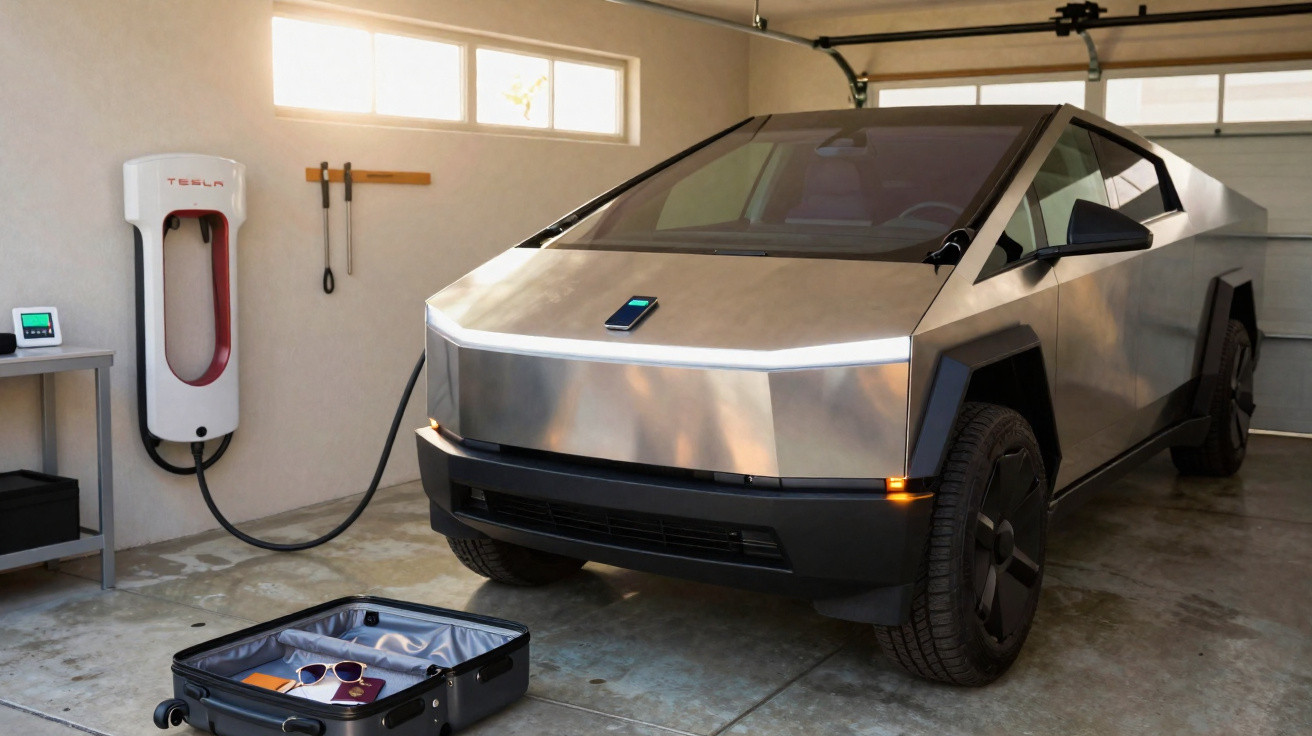
Two peaceful weeks away, an all-electric truck left at home, and an unpleasant shock waiting in the garage upon the owner’s return.
The owner of a Tesla Cybertruck believed he had taken all the right steps before leaving for a summer holiday. The pickup remained plugged in, its battery charge appeared sufficient, and the app displayed no alerts. But after two weeks, the truck would not start, prompting uncomfortable questions about how these enormous EVs handle genuine heat, extended periods parked up and the occasional hardware fault.
When a plugged-in Cybertruck stays silent
Reports published in August 2025 said the driver lived in Arizona, where summer heat regularly exceeds 40 °C. Before going away, he left his Cybertruck in the garage, plugged it into his home charger and allowed it to manage its energy use itself, in line with Tesla’s usual advice for longer absences.
When he returned from holiday two weeks later, he opened the Tesla app intending to cool the cabin before arriving home. Instead, he found that the app had ceased communicating with the truck around eleven days earlier. There was no recent information, no live connection and only a static status screen suggesting a problem more serious than an ordinary low battery.
He then entered the garage, attempted to use the door handles and tried to power up the truck, but received nothing in response. There was no start-up, no familiar chime and no indication that the traction system would come online.
Despite staying plugged into the wall, the Cybertruck refused to start after two weeks, with the app showing no updates for 11 days.
For plenty of EV owners, leaving a vehicle connected to mains power while away is a routine safeguard. The vehicle can replenish its charge gradually, offset “vampire” drain and condition its battery where necessary. In this case, that well-known precaution suddenly appeared less dependable.
Heat, advanced hardware and a delicate balance
Arizona brings an extra complication to an already sophisticated vehicle. Under severe heat, the battery, inverters and onboard charger all operate in tougher conditions. Cooling systems must work more frequently, while electronic components can remain heat-soaked for hours, particularly in enclosed garages with little ventilation.
That does not mean a vehicle is inevitably destined to fail. Tesla engineers its battery packs and power electronics for use in such environments. Even so, every part has operating tolerances, and extreme temperatures can reduce the room for error, especially on newer platforms with limited long-term real-world data.
After describing the incident in a Facebook group for Tesla pickup owners, the driver sparked an unexpectedly detailed technical discussion. Group members compared:
- Preferred longer-term charging levels, commonly 50–60 %
- Charging routines, including overnight charging versus charging during peak daytime heat
- Garage arrangements, such as insulated garages, ventilated spaces or open carports
- How carefully they monitor app connectivity before and throughout trips
For many Cybertruck owners, the episode became a useful case study. They attempted to distinguish an unusual fault from poor practice, and isolated personal experiences from signs of a wider weakness.
What Tesla’s diagnosis revealed
After the owner contacted Tesla service, the company arranged for the truck to be taken to a service centre. Technicians carried out electrical inspections, checked the communication modules and assessed the battery’s condition. They soon excluded a depleted high-voltage battery as the cause. Its state of charge was healthy, and the truck had remained plugged into the home charger.
The actual issue was within the power electronics. Following additional testing, Tesla identified a fault in part of the power converter, the hardware that receives direct current from the battery and adjusts it for the drivetrain.
A failed element in the power converter prevented the traction system from waking up, so the Cybertruck locked itself down for safety.
When a component of that kind develops a fault, the vehicle’s control software generally takes the cautious approach. It detects conflicting signals, records a fault condition and prevents drive commands from being accepted. To the driver, the truck simply appears dead, despite the battery still being capable of retaining charge.
Tesla changed the defective component and paid for the work under warranty. Reports said technicians described the case as an isolated hardware defect rather than proof of a structural problem affecting the wider Cybertruck range. Nevertheless, technology publications covered the incident, increasing its visibility and reigniting reliability discussions on Tesla forums and in comment sections.
What this means for Cybertruck charging habits
Recommended charge levels before a long absence
The Cybertruck owner’s manual reflects broader EV advice: when a vehicle will be unused for an extended period, its battery should ideally remain around the middle of its available range. Many specialists regard 50–60 % as a sensible target. Compared with keeping the battery continuously at 100 % or allowing it to approach empty, this can reduce chemical stress on the cells.
Leaving a battery at a high state of charge for days or weeks in hot weather can speed up battery ageing. Equally, a deep discharge that allows the vehicle to reach 0 % and remain there can harm cells and activate protection measures that make recovery more difficult. Drivers therefore generally aim to maintain a buffer at both ends of the range.
| Storage duration | Suggested charge range | Extra precautions |
|---|---|---|
| A few days | 40–70 % | Basic monitoring via app |
| 1–3 weeks | 50–60 % | Limit charging to cooler hours |
| Over a month | ~50 % with periodic top-ups | Check connectivity and garage temperature |
Remaining plugged in will usually help maintain that range. Owners can set a charge limit in the app; the vehicle stops charging at the selected level, while the charger starts again only once the battery has dropped slightly. In normal circumstances, this should be a gentle process requiring little attention.
Heat, garages and smart scheduling
Thermal management is central to this incident, even though it may not have caused the failure itself. In the Arizona case, the owner normally charged overnight and tried to keep the garage ventilated, but this approach was not followed before the trip. The Cybertruck remained plugged in without carefully timed charging in a region where concrete can retain heat well into the evening.
For EVs left at home in hot climates, garage airflow and night-time charging can matter almost as much as the chosen charge limit.
Charging during the coolest hours puts less thermal strain on both the battery and the onboard charger. A basic timer on a home wallbox, or scheduling through the Tesla app, can arrange top-ups for after midnight, when demand on the grid is lower and outside temperatures have fallen.
Even a small fan or a partially open garage door may reduce the heat around the vehicle. In desert states, owners are increasingly viewing ventilation as an essential part of EV ownership, alongside kW ratings and cable lengths.
How to spot the signs before a failure
The most unusual element of this case was the app’s silence. The Cybertruck stopped transmitting current information long before the owner attempted to drive it, indicating that it may have shut down or lost some of its communication capability days earlier.
That interruption points to several practical guidelines for EV drivers preparing to travel:
- Check the app the day before leaving and make sure it is updating in real time.
- If information remains frozen for more than a day, try to wake the vehicle with a remote climate or lock command.
- Monitor repeated communication faults and take screenshots before speaking to support.
- If the app cannot be reached, ask a neighbour to inspect the vehicle visually.
Connected functions have two sides: they make remote checks straightforward, yet they also expose problems that may have occurred hours or days before the owner becomes aware of them. Treating an unresponsive app as an early alert rather than a small inconvenience can make the return home less surprising.
What this says about maturing electric pickups
The Cybertruck remains part of an emerging vehicle category: exceptionally heavy electric pickups used in hot and demanding conditions. Numerous components, including its stainless-steel body panels, power electronics and suspension systems, work at the limits of modern engineering practice.
As a result, occasional hardware faults that appear dramatic online are likely to emerge, even if they are statistically uncommon. Owners must balance sensible confidence in the technology with several traditional habits: checking their vehicle, documenting unusual behaviour and using cautious charging and temperature settings when leaving it parked for long periods.
From an engineering viewpoint, incidents like this also provide feedback. Thermal stress affecting inverters and converters, regional patterns of similar faults and the speed of service-network responses can all inform revised designs, firmware adjustments and future component decisions.
For anyone considering a Cybertruck or comparable electric pickup in a hot climate, this account offers a straightforward checklist before closing the garage and leaving for the airport: choose a mid-range charge limit, arrange night-time charging, provide some garage ventilation and check the app once or twice during the trip. The truck may still be a computer on wheels, but a few human routines can help ensure that computer is awake when you return.














Comments
No comments yet. Be the first to comment!
Leave a Comment