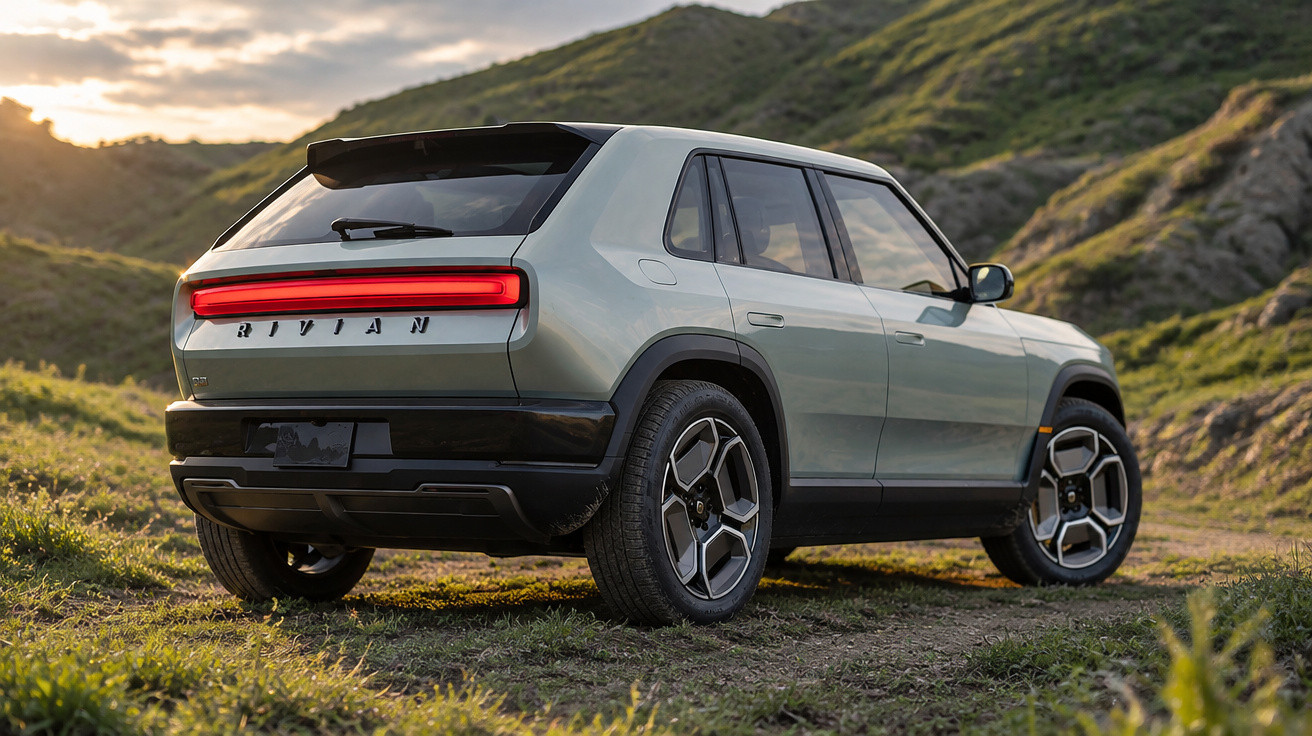
Volkswagen is investing $5.8bn in Rivian because it considers the US carmaker’s e-hardware to be “the most advanced” currently available anywhere in the world.
Last year, the companies revealed a joint venture under which Rivian will collaborate with VW on ‘next-generation electrical architecture and best-in class software technology’. In return, a great many Benjamins will make their way into Rivian’s coffers.
Volkswagen and Rivian’s electrical architecture partnership
When TG asked about the arrangement, VW brand chief Thomas Schäfer said the technology would extend across “the body systems, the drivetrains, the infotainment… all electronics in the vehicle”. Porsche and Audi are set to be the first beneficiaries, while the new US marque Scout Motors is also included.
Schäfer maintains that Volkswagen was not seeking a Get Out of Jail Free card for the rather patchy infotainment systems it has produced in recent years. He argues that the latest setup, fitted to the ID.3, ID.4, ID.7 and other group models, is “perfect” and “state of the art”. Mind you, it does now have temperature controls that work in the dark.
There will be no platform sharing, either. Unlike Ford, which has based the Explorer and Capri on VW’s MEB skateboard, future Rivians - most immediately the R2 and R3 - will not be rebadged Volkswagens, nor will the reverse be true.
Why Volkswagen wants Rivian’s e-hardware
Instead, VW’s concern lies beneath the surface. “Our vehicles at the moment are multi control unit electronic architectures,” Schäfer explains. “Every part of the car – whether the seat or the window wiper – has [an] individual intelligent control unit that speaks all sorts of languages. So to keep it together in the vehicle is very complex.
“The future is a central unit. And you have sort of dumb units around that the central computer organises. So you have a much easier updatable architecture.
“We needed to anyway go in that direction, and we decided to do that in the joint venture together into a very functional, very competitive, state-of-the-art software architecture. We find that [Rivian] probably have the most advanced in the market.”
The approach resembles BMW’s plans for its forthcoming Neue Klasse EV generation. Earlier this month, BMW made ambitious claims about sharper handling and dynamics, enabled by a single control unit managing the powertrain, brakes, regenerative braking and steering rather than multiple systems competing with one another.
TG suggested to Schäfer that BMW had completed this development internally without breaking open its piggy bank. “Well, how big is BMW?” he replies. “We could also do stuff in-house. It's a question of ‘Can you do it at the right speed and cost?’ It's always a debate, is it right?
“Also the complexity in our group, it has to work for at least 10 brands. It's not simple. So we decided the best way to do it is this way.”
It is a journalistic sin to finish a news story with ‘time will tell’, but…


Comments
No comments yet. Be the first to comment!
Leave a Comment