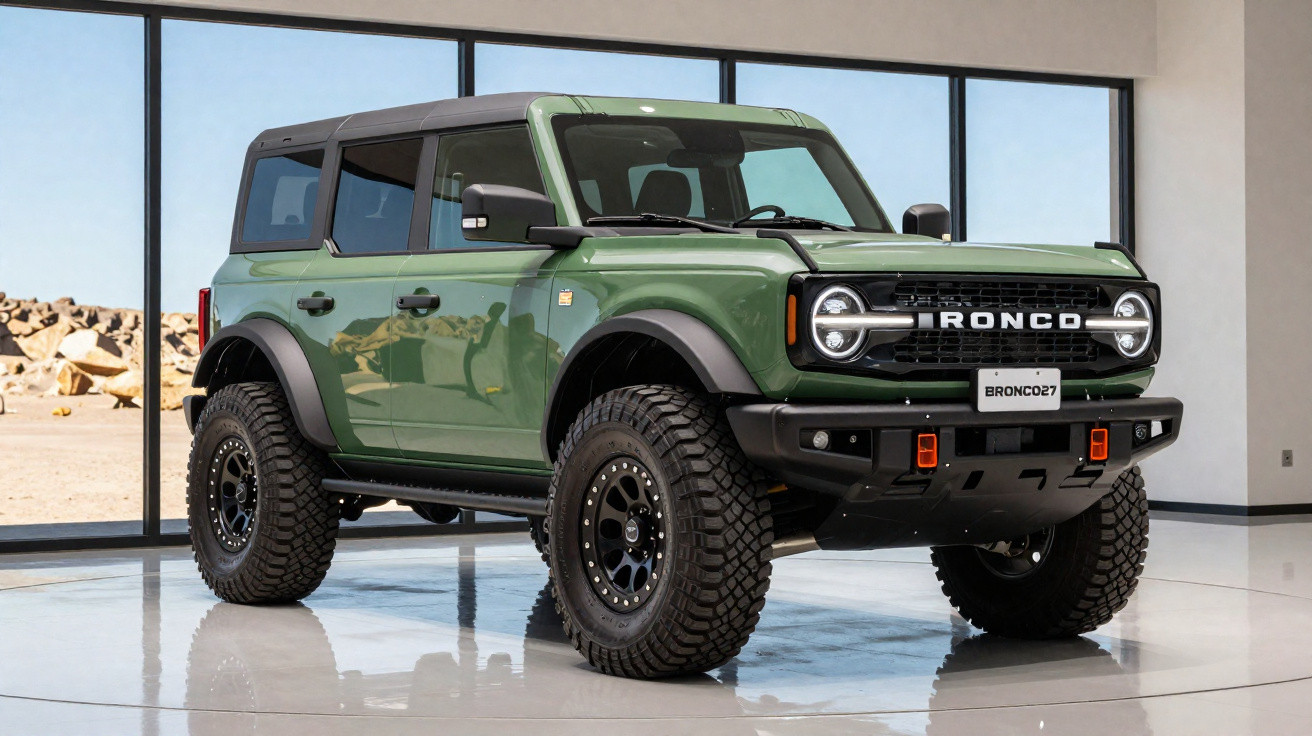
Ford is a mainstream marque across the globe, yet it has almost a handful of models that rank among the most highly regarded in their respective classes.
From the legendary yet attainable Mustang sports car, through the indestructible F-150 pick-up - one of the world’s best-selling vehicles - to the fast, purist GT and now the Bronco, 55 years after the original model arrived and 25 years after production ended: a proper off-roader built to go “to infinity and beyond”.
The engineers behind this sixth-generation model had a very clear brief: combine the Mustang’s genes with those of the F-150 and make it the benchmark for buyers who still want, or genuinely need, a real 4×4 rather than a civilised urban SUV that becomes nervous when faced with a small mound of sand.
Tradition… but more modern and technical
The Ford Bronco uses a new architecture that combines solutions commonly found in passenger cars - including an independent front axle with aluminium control arms derived from the Ford Ranger - with features typical of hardcore Jeeps and pick-ups, such as a rigid rear axle and low-range gearing.
Like the Jeep Wrangler, its original rival, which it now meets again, it has a body-on-frame construction with the cabin mounted on top. This differs from the new Land Rover Defender, another adversary but now positioned further upmarket, which has adopted a monocoque structure.
A rigid axle remains at the rear, while numerous features contribute to the GOAT capabilities - Go Over Any Terrain - that Ford says are part of the Bronco’s DNA. The GOAT acronym appears on the rotary controller for the driving modes and low-range activation, located between the front seats beside the gear selector.
As for transmissions, the 2.3 EcoBoost four-cylinder engine, producing 274 cv and 420 Nm, can be paired with a seven-speed gearbox. The 2.7-litre V6 EcoBoost, developing 335 cv and 563 Nm, is available exclusively with a 10-speed automatic.
There are seven driving modes to select from: Normal, Eco, Sport, Slippery, Sand, Baja, Mud/Ruts and Rock Crawl. The final three are available only on versions designed more specifically for off-road use.
Two 4×4 systems are also offered: one with a conventional transfer case and another with an automatic system, both managing power delivery between the two axles. Differential-locking systems can optionally be fitted to either, maximising traction and, unlike in the Jeep Wrangler, allowing the locks to be engaged independently.
The optional Trail Toolbox is another aid for demanding terrain. This off-road ‘toolbox’ comprises three systems: Trail Control, Trail Turn and Trail One Pedal Drive.
Trail Control is effectively cruise control for low-range 4×4 driving. Trail Turn reduces the turning circle through torque vectoring. It does the job, though its intervention proved slightly abrupt because it essentially holds one inside wheel while the other three rotate around it.
Finally, Trail One Pedal Drive, offered only with the V6, works much like the system in electric cars: the accelerator alone is used to control speed over rocks and deeper ruts, with the brakes applied automatically.
Ford Bronco equipment for serious off-roading
Packages are available to turn the Ford Bronco into a genuine wilderness machine. The Sasquatch package equips it with 35-inch tyres and enables it to ford water up to 850 mm deep. It also provides 29 cm of ground clearance and more generous approach, breakover and departure angles: 43.2º, 29.9º and 37.2º respectively, compared with 35.5º, 21.1º and 29.8º in the standard versions.
Alongside beadlock wheels, in which the tyres are bolted to the rims, it brings a shorter final-drive ratio and Bilstein-branded dampers. The latter use upper valves to increase stiffness and control off road. Metal underbody protection is also fitted to vulnerable, impact-prone areas including the engine, transmission, transfer case and fuel tank.
The Bronco Sasquatch also gains a semi-active anti-roll bar that can be disconnected in 4×4 mode to maximise axle articulation and the approach angle. It should be reconnected for sharper steering response and more stable behaviour on tarmac.
Unlike the comparable system Jeep uses in the Wrangler Rubicon, this anti-roll bar can be disconnected midway through negotiating an obstacle. The resulting extra wheel articulation allows progress to continue, without having to reverse onto level ground, disconnect the anti-roll bar and attempt the obstacle again.
The American dream
To drive the Bronco, you need to cross the Atlantic, as there are none on this side and none are expected in the near future. Official Ford sales have not yet started, while even in the United States there are waiting lists lasting months.
Of the family’s three body styles, we drove the two-door. There is also a four-door version with a longer wheelbase and, later, a more urban Bronco Sport. The latter does not share the same technical basis: it does not use a body-on-frame chassis, instead sitting on a derivative of the C2 platform also used by the Focus and Kuga.
The two-door we drove is probably the version that makes the strongest impression on Americans. And what an impression it makes. Two men in their fifties, relaxing while fishing near Newport Beach south of Los Angeles, were thrilled to spot this gleaming red Bronco in the car park. Being direct and unfiltered, one could not resist saying: “finally it’s on sale… I wanted to order one, but the salesman doesn’t even know when that will be possible…”.
His fishing companion quickly pulled out his phone to take pictures and better remember the special encounter, before joking beneath his baseball cap: “if I give you 100,000 dollars now, can I have it?”.
That is the level of enthusiasm generated by this square-cut Jeep. Its retro styling immediately links it to its predecessor, while repeated launch delays only made the wait more painful. Smiles appear in every town, from San Diego to Palm Springs, confirming the enthusiastic welcome the vehicle has received. More than 125,000 orders have already almost exhausted the production available for the first year of the Bronco’s revival.
Jeep Wrangler remains the only rival
Setting emotions aside, targeting the relatively affordable hardcore 4×4 segment makes perfect sense. In the United States, it can be bought from the equivalent of €26,000, with top versions reaching twice that figure. Former competitors such as the Mercedes-Benz G-Class, Toyota Land Cruiser and Land Rover Defender have acquired premium refinements - and matching prices - leaving only its public enemy number one, the Jeep Wrangler, descendant of the venerable Willys, to fight on the same ground. Just as it was in the 1960s.
In this two-door version, the hard top can be split into sections and the doors can be removed by one person simply releasing the catches from inside. Refitting them requires more hands and some practice, not least to avoid scratching the paintwork.
The four-door comes with a fabric roof as standard and an optional hard top with four removable sections. On both body styles, the frameless door panels can be stored in the luggage compartment inside dedicated protective bags.
The cabin, which accommodates four people in the short-wheelbase body and five in the long-wheelbase version, consequently becomes airy and bright, inviting journeys in direct contact with the elements. This is helped by the lack of any crossbar in the middle of the roof.
Another advantage is the sizeable doors, which make entry to and exit from the two rear seats easier. Two adults fit comfortably there thanks to the 2.55 m wheelbase, although that remains 40 cm shorter than in the four-door Bronco.
Tough and uncompromising inside too
The dashboard is very upright and monolithic, seeming like a wall in front of the front occupants, but it also creates a direct connection with the Bronco’s past.
Every plastic surface is hard, which normally makes such interiors more susceptible to squeaks and rattles over the years, especially in vehicles expected to tackle off-road tracks. The upside is easier cleaning, as is the case with the floor if the washable option with water-drain holes is selected.
Overall, the instruments are appealing, with two drawbacks: the digital rev counter is not especially easy to read, while the selected driving mode is shown by a small, poorly positioned indicator.
Modes are selected using the well-rubberised GOAT rotary controller, though its operating logic should be simpler. One turn in either direction should move from one mode to the next, rather than requiring seven turns to travel from one end to the other of the seven driving modes in the more serious 4×4 versions.
Next to it are the controls for the electric windows and door mirrors, rather than on the doors as is usual in Ford models. This is simply because they would be impractical when the doors are removed. The seatbelt should have height adjustment.
The central infotainment touchscreen measures 8 inches as standard or 12 inches optionally and offers extensive functions. It even has an extended shelf beneath it, allowing the user to rest their wrist while navigating the menus, and can display 360º images around the vehicle.
Finally, every control related to off-road driving - differential locks, anti-roll bar, traction control and Trail assistance - is placed in a horizontal strip at the top of the dashboard. This is more convenient than in the Jeep Wrangler, where they sit lower down.
Dynamic ability confirmed
There is no better way to assess the new Ford Bronco dynamically than on a route combining town, road and off-road sections. The overall result is very positive, despite one or two areas that could be improved.
Before leaving the urban area, the body-corner markers - which can also be used to secure a canoe beside a lake, for example - prove useful, as does the 360º camera for avoiding body damage in tight spaces, particularly as the Bronco is quite wide.
The elevated driving position, seats with some lateral support, grab handles to stop passengers being thrown around on off-road trails, and unobstructed forward and side visibility all make the experience behind the wheel enjoyable. Rearward visibility is somewhat less clear unless the vehicle is being used in convertible mode.
Driving without the doors makes everything more entertaining, enough to accept the price paid for their frameless design: there is more aerodynamic noise at motorway speeds.
This V6 engine also delivers impressively strong acceleration and, for the first time with this 2.7-litre unit, Ford has achieved a tuba-like soundtrack rather than a clarinet-like one, as befits an engine of this calibre.
A brief drive in the 2.3-litre four-cylinder showed that the seven-speed manual makes the 4×4 experience more demanding, because the throttle response is occasionally hesitant, which only complicates matters.
With the 2.7 V6’s 10-speed automatic, it is easier to concentrate on the track ahead, although the gearbox is far from perfect in the way it performs kickdown - dropping several gears in response to full acceleration - or changes gear at higher speeds.
The “+” and “-” buttons on the side of the transmission selector also failed to convince, particularly as they are slow. Manual gear changes would be more intuitive and more entertaining using paddles behind the steering wheel.
Thanks to the more sophisticated front suspension, directional stability is genuinely good, as are ride comfort and the precision with which the steering responds to the driver’s inputs.
Naturally, the Ford Bronco still exhibits more lateral body movement in bends than a lower car, but its chassis must be regarded as highly capable on tarmac, even if it cannot perform miracles. It is sufficient to ensure that a twisting mountain road is not merely purgatory before reaching the paradise that an empty 4×4 trail, surrounded by nature, still represents for many off-road enthusiasts.
Technical specifications
| Ford Bronco 2.7 V6 EcoBoost | |
|---|---|
| ENGINE | |
| Architecture | V6 |
| Capacity | 2694 cm³ |
| Valve gear | 2 overhead camshafts; 4 valves/cyl., 24 valves |
| Fuel system | Direct injection, turbocharger, intercooler |
| Power | 335 cv |
| Torque | 563 Nm |
| TRANSMISSION | |
| Drive | Four-wheel drive |
| Gearbox | 10-speed automatic (torque converter); transfer case (low range) |
| CHASSIS | |
| Suspension | Front: independent with aluminium A-arms; Rear: rigid axle |
| Brakes | Front: ventilated discs; Rear: discs |
| Steering / No. of turns | Electric assistance/N/A |
| DIMENSIONS AND CAPACITIES | |
| Length x width x height | 4.412 m x 1.928 m x 1.827 m |
| Wheelbase | 2.550 m |
| Luggage compartment | N/A |
| Fuel tank | 64 l |
| Weight | 2037-2325 kg |
| Tyres | 285/70 R17 (35-inch tyres) |
| OFF-ROAD CAPABILITIES | |
| Angles | Approach: 35.5º (43.2º); Departure: 29.8º (37.2º); Breakover: 21.1º (29.9º) |
| Figures in brackets apply to the Sasquatch package | |
| Ground clearance | 253 mm (294 mm) |
| Figures in brackets apply to the Sasquatch package | |
| Wading depth | 850 mm (Sasquatch package) |
| PERFORMANCE, CONSUMPTION, EMISSIONS | |
| Top speed | 180 km/h |
| 0-100 km/h | 6.1s |
| Combined consumption | 12.3 l/100 km (EPA) |
| CO₂ emissions | 287 g/km (EPA) |
Authors: Joaquim Oliveira/Press-Inform

Comments
No comments yet. Be the first to comment!
Leave a Comment