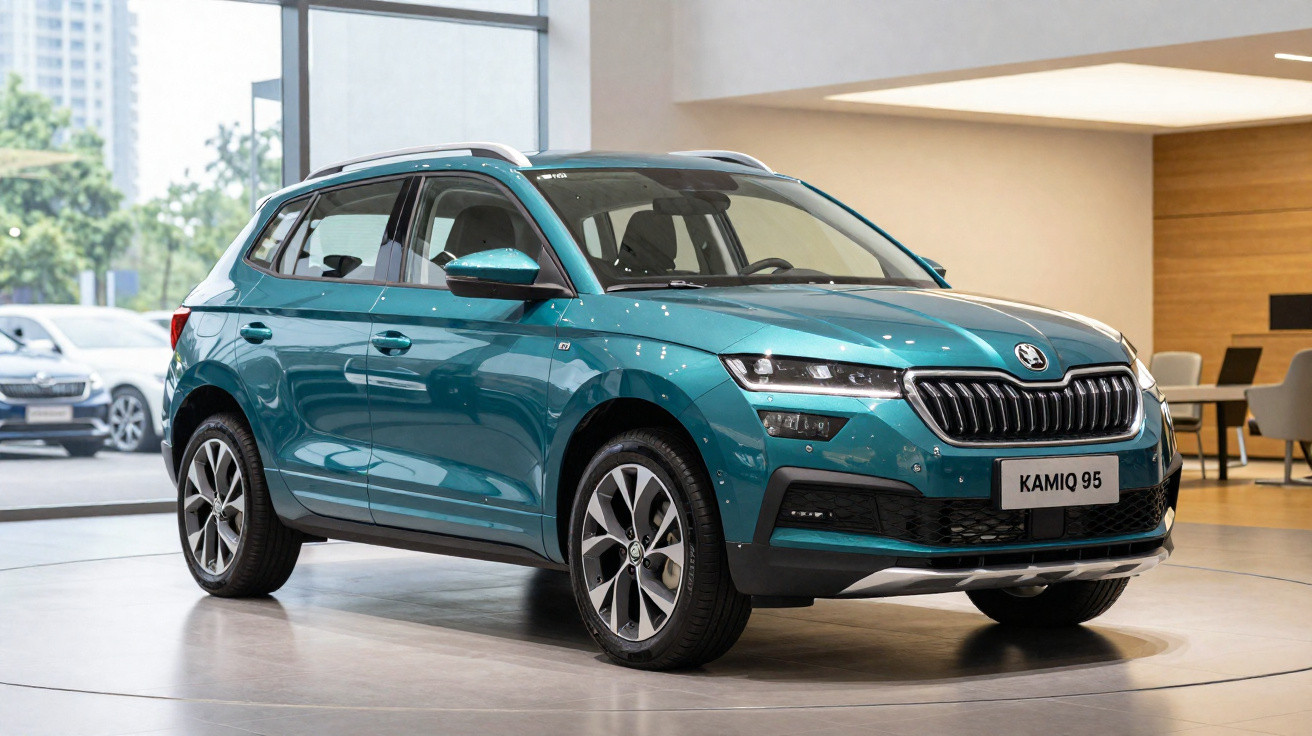
“At first it feels strange, then it grows on you” could easily be the saying that best sums up my experience with the Skoda Kamiq, the Czech brand’s B-SUV.
It feels “strange” initially because... well, just look at it. It is unlikely to win any beauty contests and, much like the Scala with which it shares so much, its looks and proportions seem to place it in something of a no-man’s-land.
What do I mean by that? We know the Kamiq belongs to the B-SUV segment, yet its styling does little to identify it as one. With a body free from the usual SUV design cues - there is not even plastic cladding around the bodywork - the Skoda Kamiq is more readily mistaken for a conventional car that simply sits slightly higher than usual.
It is certainly distinctive, but among the huge number of alternatives in this segment, the Kamiq may be the one with the least immediate visual appeal.
Yet I quickly found that the Kamiq’s strengths extend far beyond its looks - quite the opposite. Its pragmatic nature soon comes to the fore and, before you know it, you have reached the “grows on you” part of the saying.
What is more, it achieves this despite being the least expensive Kamiq you can buy: the 1.0 TSI 95 PS Ambition. Perhaps because it is the most basic version, it does not distract with superfluous details, allowing you to focus purely on the essentials... which, for the most part, proved very good indeed.
Family-friendly
One of its key selling points - perhaps the key one - is the space it offers, which ranks among the best in the segment. Rear legroom and headroom match those of the larger Skoda Karoq, and only when attempting to accommodate three people on the rear bench does the Kamiq reveal itself as a more compact B-SUV. Within this class, only the Dacia Duster matches its interior dimensions, while the Honda HR-V is the sole model to offer more legroom.
Its virtues are not limited to spaciousness. Unlike most rivals in the segment, rear passengers also benefit from tall side windows that provide excellent outward visibility, as well as air vents - in the entry-level version, no less...
Its only shortcoming is the lack of greater flexibility in its solutions. For instance, the rear bench does not slide fore and aft as it does in its Volkswagen T-Cross cousin or the Renault Captur.
Déjà vu...
Move to the front seats and the sense of familiarity is striking. Its close relationship with the Scala could not be more obvious than when you look at the dashboard, as it is exactly the same.
It is not the most exciting design, but neither is it offensive nor bothersome. There is nothing to criticise, however, about the logical placement of its various controls or the sound ergonomics of the available switchgear. It takes very little time to learn how to “navigate” this interior.
This may be the entry-level trim, but, as is typical of Skodas, it still feels robust. The build quality is solid and, while there is no shortage of hard, unpleasant-to-the-touch materials around the cabin, the main contact points always use more carefully chosen, nicer-feeling materials.
Some aspects of its operation nevertheless need reconsidering - they are not quite so simply clever...
On the one hand, there are practical, easily reached physical controls for the air conditioning... well, for controlling certain air-conditioning functions. They essentially allow you to select Auto mode and the temperature. If you want to adjust the fan speed, you must press “Menu” and do it through the... infotainment system.
The same applies to enabling and disabling the driving assistance systems. Want to switch off the annoying lane-keeping system, Lane Assist? There is no dedicated button. The easiest method is to enter a menu in the instrument panel’s trip computer... and you have to repeat the process every time you start the car, as it does not remember your preference.
Behind the wheel of the Skoda Kamiq
The Skoda Kamiq’s pragmatism is equally apparent from the driver’s seat. There can hardly be a B-SUV with better visibility, an art that is somewhat neglected nowadays and one of my most frequent criticisms not just of rivals, but of many other cars too.
Its excellent all-round visibility is paired with a genuinely impressive turning circle, making city driving and tighter manoeuvres child’s play - there is no rear-view camera, but the rear parking sensors are more than adequate.
Once in the driver’s seat, finding a good driving position is easy - and it is not as high as in other B-SUVs. Even here, the Kamiq distinguishes itself from its competitors by feeling closer to a conventional car. The driver’s seat includes lumbar adjustment, a feature that is rare to find, especially in the most affordable version. On the other hand, it is still started with a key rather than a button.
On the move, the Skoda Kamiq proved notably comfortable - a Renault Captur or Peugeot 2008 may be more comfortable, but not by much - while combining this trait with pleasing dynamic precision and well-controlled body movements.
Push on harder and it is not as entertaining as its SEAT Arona cousin, or the Ford Puma and Hyundai Kona rivals, but neither does it become dull. It also displays greater composure than, for example, the French models on twistier, rougher roads.
Its strong family credentials are further supported by its long-distance ability, with high-speed stability and overall refinement above the class average. Cabin sound insulation is not class-leading, but it is far from problematic, keeping road, mechanical and wind noise well contained.
The figures do not do it justice
The modest figures on the specification sheet do not fully reflect the 1.0 TSI’s 95 PS. Volkswagen Group’s turbocharged 1.0-litre three-cylinder remains one of the finest engines of its type on the market, regardless of power output.
Not only does it show healthy eagerness, strong responsiveness and reassuring ease at higher revs, it also delivers a convincing degree of refinement in use, feeling more polished than Ford’s 1.0 EcoBoost, for example - even so, the EcoBoost remains my preference because it is even more... “effervescent”.
The five-speed manual gearbox also plays its part: its ratios suit the engine’s flexibility well and its shift action has a satisfyingly mechanical feel. It is only a shame that neither the gearshift travel nor the clutch pedal travel is shorter.
It also proved generally frugal. At steady, moderate speeds (90 km/h), consumption settled at 4.2–4.3 L/100 km, rising to 6.8 L/100 km on the motorway. Unsurprisingly, it is in town that it has the biggest appetite, with consumption varying between 7.5 L/100 km and 8.0 L/100 km.
Is it the right car for me?
Just as the Scala seems to be the missing link between a car and an estate, the Kamiq appears to sit between a car and an SUV. There can be no question, however, about its pragmatism and pleasing consistency, making it one of the best-executed B-SUVs for family use.
Even as the entry point to the range, the Skoda Kamiq 1.0 TSI 95 PS Ambition fulfils its role effectively and feels highly complete. The more expensive versions are more appealing thanks to their additional equipment and even greater performance, but they almost seem extravagant.
Perhaps the Kamiq’s greatest threat is not its cousins or its B-SUV rivals, though, but rather the... Scala itself, with which it shares so much.
Why? B-SUVs add space, versatility and practicality to the superminis from which they are derived - in some cases even surpassing C-segment family cars, a class above. This is also something that can, to some extent, be said of the Skoda Kamiq when it is compared with the Fabia.
However, given the close relationship between the Kamiq and the C-segment Scala - they share engines, equipment and the interior - it is impossible not to compare them, especially as their prices are so similar. Both start at just over €21,000 and, with the current offers, are set to fall below €20,000.
And, from my perspective, the Scala has the advantage.
It does everything the Kamiq does, but is dynamically superior because everything sits closer to the ground, while also offering even more room for passengers and luggage thanks to its extra 12 cm in length. The Scala is one of the C-segment benchmarks for interior accommodation.
That fact gives the Skoda Kamiq a peculiar position within the B-SUV universe.

Comments
No comments yet. Be the first to comment!
Leave a Comment