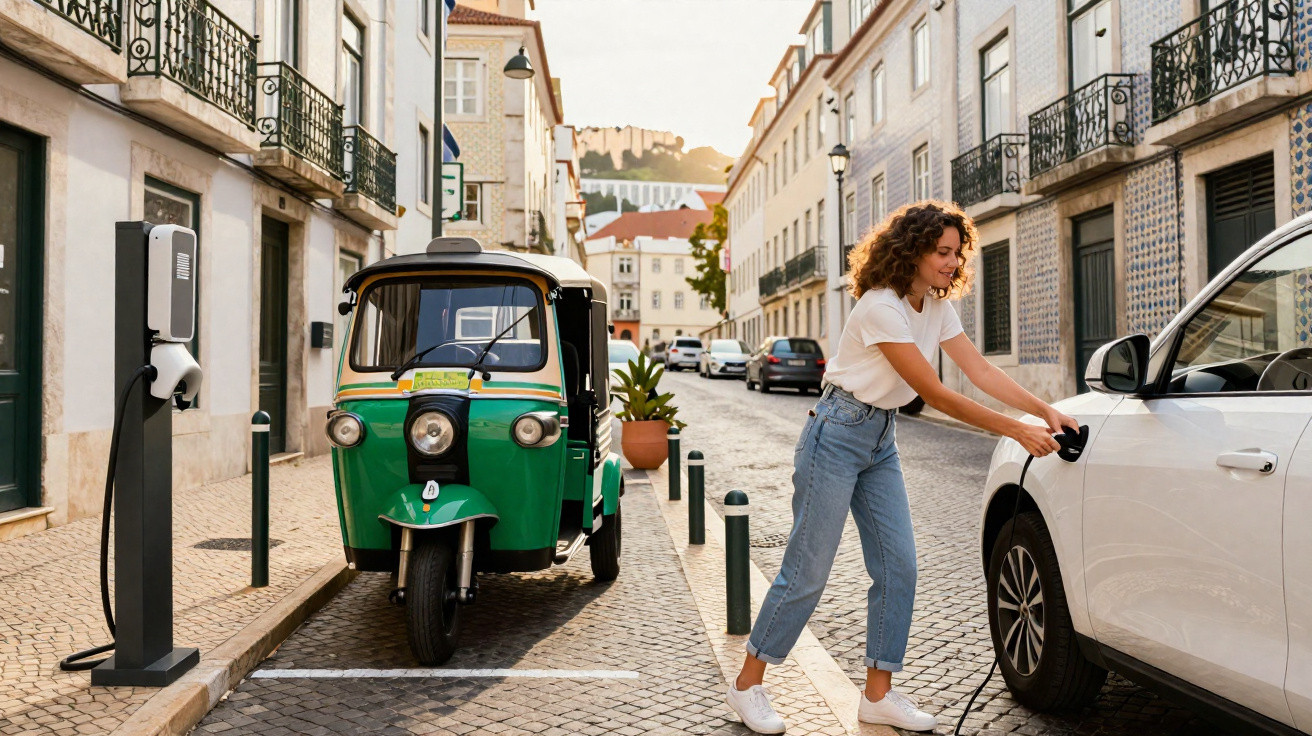
The president of the Santa Maria Maior Parish Council, in Lisbon’s historic heart, has unveiled an ambitious mobility plan that would ban cars that are not electric or hybrid from driving in the area.
Developed through a participatory process involving residents, traders and experts, the proposal would permit only low-emission cars - alongside certain exemptions - to travel within this district, which has already been designated a Low Emission Zone (ZER).
The scheme aims to cut daily traffic in the area by around 40,000 cars. At present, between 130,000 and 140,000 vehicles pass through the parish’s streets every day.
The Mobility Plan for the Historic Centre, presented on Friday to Lisbon’s Municipal Assembly by Miguel Coelho (PS) - president of the Santa Maria Maior Parish Council since 2013 - also sets out to reduce greenhouse-gas emissions by approximately 60,000 tonnes a year.
Although responsibility for mobility policy lies with Lisbon City Council rather than the parish council, Santa Maria Maior hopes the plan will encourage public debate and help shape future decisions affecting this part of the capital.
“We believe that, in the next term of office, whoever is in charge, all the conditions are in place to agree a mobility plan for the parish.”
Miguel Coelho, president of the Santa Maria Maior Parish Council, quoted by SIC Notícias.
Speed limits also under review
Alongside the driving restrictions, the plan would lower the maximum speed limit to 30 km/h throughout the parish, with enforcement through speed cameras. It also proposes additional pedestrian streets and controlled-access areas, while safeguarding parking for residents and traders.
Which exemptions would apply?
The Santa Maria Maior Parish Council’s mobility plan includes several exemptions from the traffic restrictions: residents, who would need to undergo dual verification by the parish council and EMEL; people with reduced mobility; vehicles accessing car parks; rescue and emergency vehicles; security-force vehicles; loading and unloading vehicles; and public transport.
The proposals would also exempt parish council and Lisbon City Council vehicles, taxis - though only those with low emissions - and tourist transport vehicles, including TVDE ride-hailing services and tuk-tuks.
What would happen to TVDE services and tuk-tuks?
However, the Santa Maria Maior Parish Council regards the latter vehicles as “sources of disturbance and pollution”, and the proposed mobility plan sets out separate rules for them.
These would establish designated operating areas for picking up and setting down passengers, with stays limited to no more than 15 minutes, in the block bounded by Rua da Madalena, Rua do Comércio, Rua dos Fanqueiros and Rua da Alfândega.
The Santa Maria Maior Parish Council covers the neighbourhoods of Alfama, Baixa, Chiado, Castelo and Mouraria.





Comments
No comments yet. Be the first to comment!
Leave a Comment