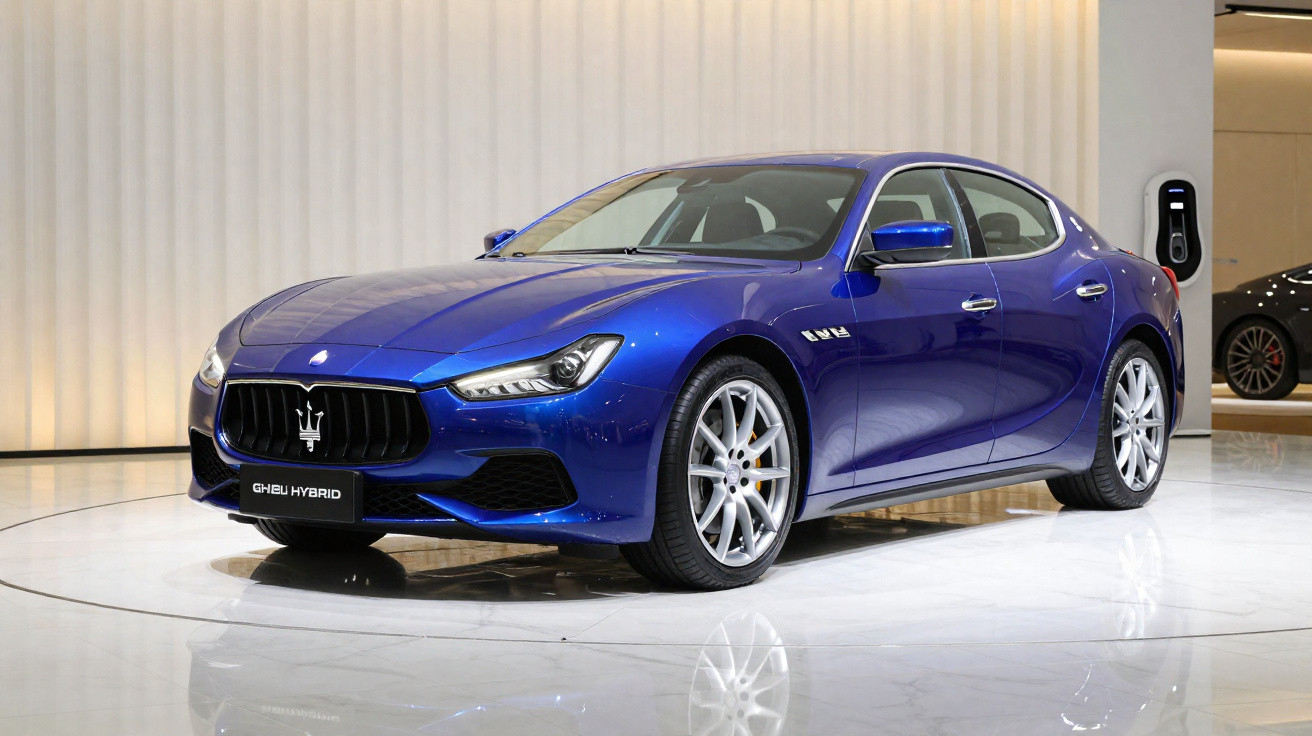
Because of Covid-19, the new Maserati Ghibli Hybrid has become the Trident brand’s first-ever electrified model. It marks the opening chapter of a new era for the Italian manufacturer, although the starring role had originally been intended for the MC20, its new mid-engined supercar.
The MC20 did not take that role because its May unveiling was postponed until September. As you may recall, Italy - along with much of the rest of the world - was in a state of emergency for reasons familiar to everyone.
This first move may seem somewhat restrained. Despite its Hybrid name, it is in fact a 48 V mild-hybrid, but it gives the Ghibli renewed appeal by introducing a new petrol engine.
Four cylinders for the first time
For the first time since going on sale in 2013, the Ghibli is available with an inline four-cylinder engine. Until now, it had only been offered with V6 powerplants.
It uses a turbocharged 2.0-litre unit - a new version of an engine already found in Alfa Romeo models. Its 48 V mild-hybrid system also incorporates an e-Booster, an electric compressor that has enabled further gains in power and torque.
The result is 330 hp at 5750 rpm and 450 Nm at 4000 rpm - 20 hp and 50 Nm less than the V6 currently on sale. Power is sent to the rear wheels, via a limited-slip differential and an eight-speed automatic gearbox. These figures allow the Ghibli Hybrid to reach 100 km/h in 5.7 seconds and achieve a top speed of 255 km/h - respectively 0.2 seconds slower and 12 km/h lower than the 3.0 V6 twin-turbo. Not bad at all…
Maserati Ghibli Hybrid efficiency and 48 V technology
The principal benefit of this new powertrain lies in its claimed consumption and CO₂ emissions, which are considerably lower than those of the V6. These are not yet final figures, however, as the homologation process has not been completed. Maserati quotes 8.5–9.6 l/100 km and 192–216 g/km for the Ghibli Hybrid - reductions of 2.5 litres and 63 g respectively compared with the V6.
The 48 V mild-hybrid arrangement uses a BISG, or belt-integrated starter generator, while the battery is installed at the rear. Among the system’s functions is the recovery of kinetic energy during deceleration or braking, converting it into electrical energy for storage in the battery.
More updates
As well as bringing a new four-cylinder engine and a mild-hybrid system, the new Maserati Ghibli Hybrid receives a revised front grille, whose internal bars have been redesigned. It also gains reshaped rear lights with a boomerang-inspired light signature - do they bring the 3200 GT to mind?
The Ghibli Hybrid also features several blue decorative details: on the three side air vents, the brake callipers, and the spoke of the oval surrounding the Trident on the rear pillar. These elements will identify all Maserati hybrid models.
Technology has been updated too, with the new Maserati Connect suite of connectivity features and related services, as well as the Maserati Intelligent Assistant (MIA) infotainment system. Running on an Android Automotive platform, it includes a new 10.1″ high-definition display. The instrument panel is new as well, featuring digital dials and fresh graphics.
Further Maserati electrification is on the way
The Maserati Ghibli Hybrid may be the brand’s first, albeit slightly delayed, step towards electrification, but further models will follow in quick succession. First will come the hybrid MC20 later this year, followed in 2021 by Maserati’s first and unprecedented pair of electric cars: the successors to the GranTurismo and GranCabrio.

Comments
No comments yet. Be the first to comment!
Leave a Comment