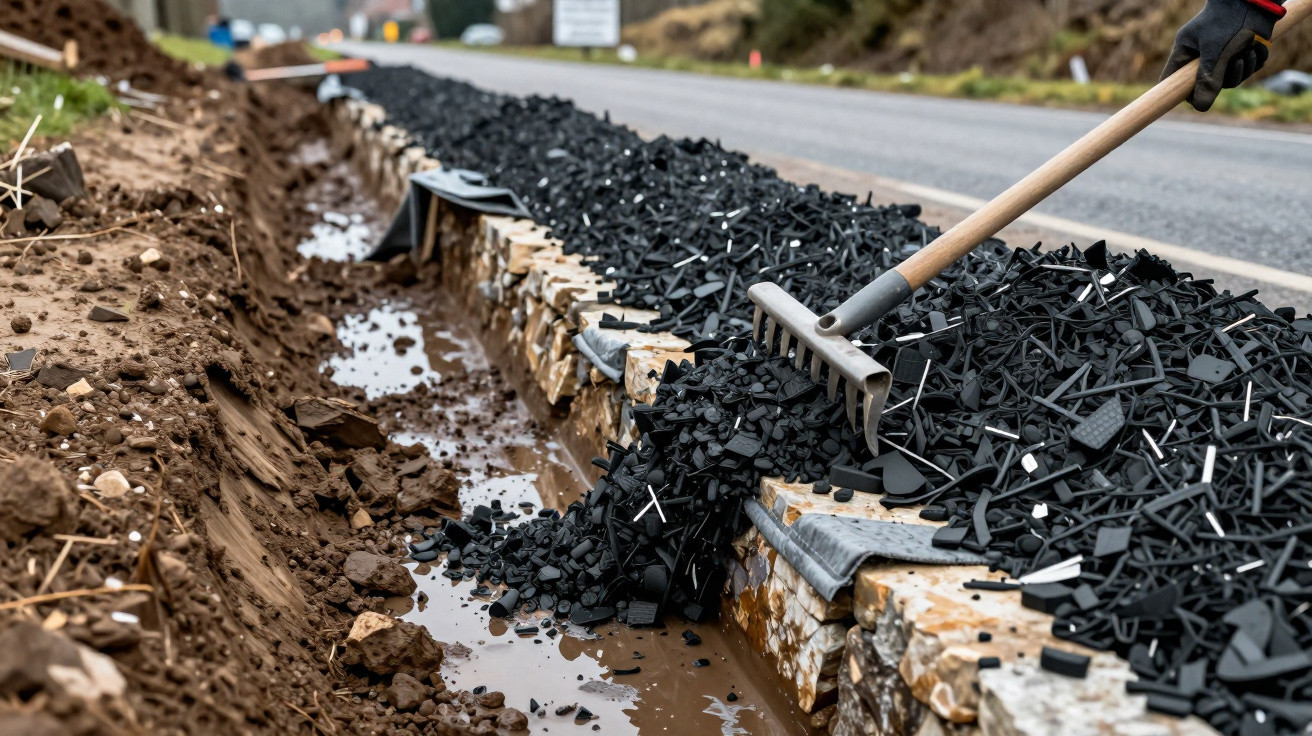
A muddy access track is rarely fixed for long by simply tipping more stone into the wheel ruts. If water is trapped beneath the surface, fresh aggregate can be pressed into the soft ground, leaving the road as uneven as before when the next wet spell arrives.
A road trial in Maine, US, explored a more unusual approach: a layer of shredded end-of-life tyres beneath a gravel road. The aim was not to make rubber the running surface, but to create a lightweight, free-draining layer below it that could help manage soft ground and winter frost. It is a specialist engineering method, not a shortcut for repairing a farm track or driveway.
What the engineers installed
The trial took place on part of Dingley Road in Richmond, Maine. According to reports on the project, the installation used material from roughly 20,000 discarded tyres beneath around 183 metres of gravel road.
The tyres were shredded into pieces measuring approximately 5cm to 7.5cm across. These were placed in a layer below the road’s upper aggregate, with gravel installed above to provide a conventional surface for traffic.
The project was monitored through winter conditions to examine how temperatures and road performance varied through the different layers. That matters because a road may appear sound at the surface while the soil beneath is saturated, frozen or losing strength.
The striking figure is the tyre count, but the real point is the design of the layers beneath the road.
Why gravel roads turn into mud
A gravel road is not just a layer of loose stone. Its surface, sub-base and underlying soil need to work together to spread vehicle loads and move water away.
Problems often begin when rainwater cannot escape. Traffic then forces stone into saturated soil and draws fine material upwards. Wheel ruts deepen, puddles form, and the surface can become slippery or impassable.
Where temperatures fall below freezing, water within the road structure can also cause damage. Freezing water expands, while thawing can leave the ground softer and less able to support vehicles. The outcome may be potholes, heaving or sudden weak spots.
This can affect:
- farm and forestry access tracks;
- private estate roads;
- rural driveways;
- construction access routes;
- unmade roads over clay, peat or other weak ground.
Britain’s wet autumns and winters make drainage essential on these routes. Frost damage is more likely in colder inland, upland and northern areas, but local soil, exposure and road construction are just as important as the weather forecast.
What shredded tyre aggregate can do
Tyre-derived aggregate behaves very differently from crushed stone. In a properly designed installation, those differences may be useful.
1. It reduces the weight placed on weak soil
Shredded rubber is much lighter than mineral aggregate. Replacing part of a deep stone layer with a lighter engineered fill can reduce the pressure imposed on very soft subsoil.
That does not mean it will strengthen poor ground by itself. The road still needs a suitable formation, load-spreading layers and drainage.
2. It creates voids for water movement
The irregular tyre pieces leave gaps between them. When the layer is properly contained and protected from fine soil, these voids can help water move through the structure rather than remain beneath the surface.
Fine material migrating into the gaps would reduce that benefit. This is why separation and filtration layers, where required by the design, are so important.
3. It may moderate frost penetration
Rubber has different thermal properties from dense mineral stone. A tyre-derived layer may reduce the rate at which cold reaches the soil below in some settings.
It cannot prevent frost in every condition, and it is not a substitute for drainage. Water management remains the first priority on any unmade road.
4. It can provide a use for processed waste tyres
End-of-life tyres need controlled collection and treatment. Using processed tyre material in an appropriate civil-engineering application can be one route for recovering value from a difficult waste stream.
The road build-up matters more than the material
Burying loose tyre fragments beneath a track and covering them with any available gravel would be a poor and potentially unsafe approach. The success or failure of such a scheme depends on the whole road design.
A typical engineered sequence
- Investigate the ground. Establish the soil type, wet areas, likely traffic loads and position of any services.
- Prepare the formation. Remove unsuitable material where necessary and shape the ground to the specified level.
- Use separation layers where designed. Geotextiles can help prevent soil and aggregate from mixing, but the product and installation must suit the site.
- Place the tyre-derived aggregate. The material must be installed to the required depth and kept within the designed area.
- Construct the aggregate layers above. A correctly graded sub-base and surface layer spread loads and provide a stable running surface.
- Create a crossfall or camber. Water should run towards drains or verges rather than sit in wheel tracks.
- Provide a safe drainage route. Ditches, grips, culverts and outfalls all need to be clear and suitable for the amount of water expected.
The tyre material in the Maine project was buried beneath gravel. It was not left exposed to traffic, sunlight or routine grading.
When it is unlikely to be the right answer
Tyre-derived aggregate is a specialist option for particular ground conditions. It may be considered where the subsoil is exceptionally weak, where reducing the weight of fill is useful, or where frost behaviour is a significant design concern.
For many ordinary potholes and ruts, the cause is simpler: blocked ditches, a flat surface, damaged edges, poor-quality stone or a road base already mixed with mud. Rebuilding drainage and replacing contaminated aggregate may be more effective and less complex.
Heavy vehicles require particularly careful design. The depth of each layer, expected axle loads, road width, drainage path and maintenance arrangements all need proper assessment. A method suitable for a lightly used track may not be suitable for a delivery route, public road or site used by construction plant.
A durable unmade road sheds water first and carries traffic second. It cannot do either job well if the foundation remains saturated.
Common mistakes on muddy tracks and private roads
The lessons from the trial apply even when recycled materials are not involved.
- Adding stone directly onto mud. Aggregate can disappear into wet soil without a stable base or separation layer.
- Leaving the surface flat. Water collects in wheel tracks unless there is an appropriate crossfall or camber.
- Treating ruts as the only problem. Ruts are usually a symptom of water, weak formation or failing edges.
- Using unsuitable aggregate. Excess fines can hold water and become slurry; overly large stone can be hard to compact and uncomfortable to drive over.
- Neglecting ditches and culverts. A road cannot drain if its outfall is blocked or damaged.
- Using recycled material without a specification. A recycled product still needs to be suitable for its intended use and installed correctly.
Safety, environmental and legal points
Do not bury whole tyres or shredded rubber as an informal repair to a driveway, field entrance or private track. Waste tyres and tyre-derived materials must be handled appropriately, and poorly managed tyre stockpiles can present a serious fire hazard.
In the UK, projects involving tyre-derived material may require advice from a qualified civil engineer and checks with the relevant environmental regulator and local planning or highway authority. The rules can vary according to the location, volume of material, proximity to watercourses and whether the work affects a public highway.
Before any excavation, check for underground services. Keep vehicles and people away from unsupported trench edges, and do not direct runoff towards neighbouring land, buildings, watercourses or public roads.
A practical lesson for British landowners
The Maine experiment is not an invitation to put tyres beneath every muddy road. Its value is in showing how a road foundation can be designed around water, weak soil and winter conditions rather than treated as a surface-only problem.
If a track repeatedly turns to mud, start with a practical inspection after rain. Identify where water enters, where it should leave, whether the stone has mixed with soil, and whether the base is failing below the ruts. Clearing drainage may be enough; more serious problems may justify a redesigned sub-base, geotextile separation or professional ground investigation.
That work is less dramatic than burying 20,000 discarded tyres, but it is far more likely to produce a track that remains usable through a British winter.
















Comments
No comments yet. Be the first to comment!
Leave a Comment