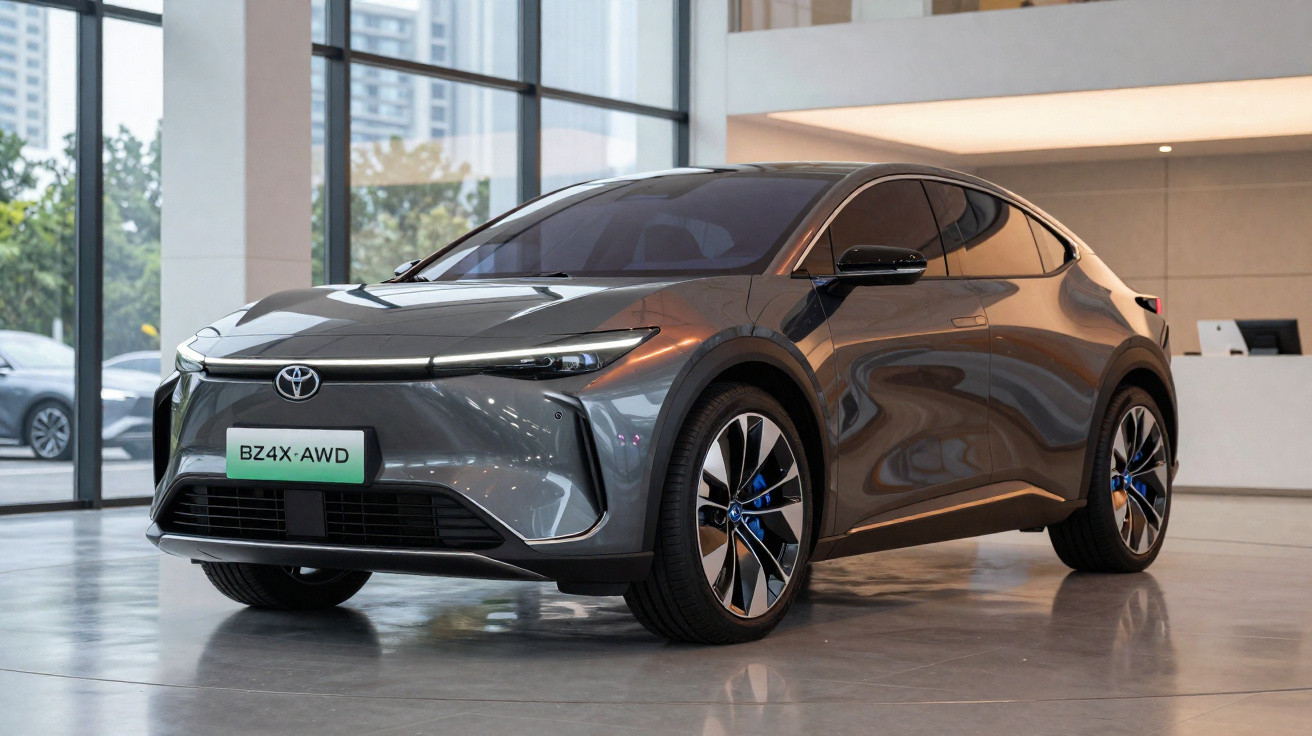
The Toyota bZ4X has been improved in several areas. We have already driven the most powerful, best-equipped version, which has one major drawback: it will not be available in Portugal.
Almost four years after it first went on sale, the Toyota bZ4X has received its first major update. From the images alone, it is difficult to see what has changed, but at the international dynamic launch we attended in Sotogrande, Spain, it became clear that there is almost an entirely new bZ4X beneath the bodywork.
Visually, the old and new versions need to be parked side by side for the differences to become apparent. That was precisely the aim of Takanori Ito’s design team, as we discovered when we spoke with the chief designer. Development of this “new” Toyota bZ4X has been ongoing since the original car entered the market, in a continuous process of refinement.
Keeping the styling close to that of the original was deliberate, not least because this is not a new generation. However, the bumpers are new, with sharper and more clearly defined lines, rather than giving the impression of several separate elements attempting to form one whole, as on the outgoing model.
The wheels feature a fresh design, while the lower section of the body has also been revised. Closer inspection reveals new door mirror housings, along with glossy black wheel-arch cladding in place of the previously unpainted plastic trim. Together, these changes give it a more sophisticated appearance and improve the drag coefficient (Cx) from 0.29 to 0.27.
Ergonomics take centre stage
Inside, the changes to the 2026 Toyota bZ4X are far easier to spot. Both the dashboard and centre console have been redesigned, with the latter now mounted 10 centimetres lower and incorporating two wireless charging pads.
The central touchscreen has grown to 14 inches and cleverly integrates physical rotary climate-control dials. It is also now positioned more centrally and symmetrically. The instrument display retains the same size and graphics, but the entire unit has been repositioned to make it easier for the driver to see.
There are no changes to interior space, although some of the materials have been upgraded. Even so, the features that make the cabin feel calmer are the new acoustic glass in the front doors and the addition of more sound-deadening material, particularly in the cabin floor and wheel arches.
Driving the bZ4X AWD
I have to admit that I ended up driving the best version of the 2026 Toyota bZ4X at this launch. It combines the highest of the three available trim levels, Lounge, with the larger 73.1 kWh battery and a fully electric twin-motor powertrain, with one motor on each axle, producing a healthy 252 kW (343 hp).
The AWD badge confirms the presence of four-wheel drive, which allows for a little enjoyment away from the tarmac, especially with X-Mode selected for more optimised traction control. However, the Toyota bZ4X remains an electric SUV, albeit one with a generous 21 cm of ground clearance. Is it an off-roader? Absolutely not. Instead, the Toyota bZ4X AWD is better viewed as an “all-conditions” vehicle.
Four-wheel drive adds an extra measure of security when dealing with icy or snowy roads, or particularly heavy rainfall - situations that are rare in this part of the world. It also offers more control on unpaved tracks. Nevertheless, no one is likely, in theory at least, to choose a Toyota bZ4X for that sort of fun.
With 343 hp, this is Toyota’s second most powerful model ever, surpassed only by the 435 hp GR Supra A90 “Final Edition”. Combined with the four-wheel-drive system, this gives the Toyota bZ4X a degree of agility as well as better performance than expected. Naturally, though, it is not a sports car, and that becomes evident as soon as the roads become more twisting.
Updated electric system
More significant than its dynamic performance is one of the key upgrades made to the 2026 Toyota bZ4X: the revised electric system. The new battery pack is 170 mm wider - requiring additional structural reinforcement - and is now offered in two gross capacities: 57.7 kWh and 73.1 kWh.
Only the larger-capacity battery is available in the AWD version. In this configuration, the manufacturer claims a maximum range of 516 km (468 km with 20-inch wheels), alongside average energy consumption of 14.5 kWh/100 km (15.8 kWh/100 km with 20-inch wheels).
During the route driven at the dynamic launch, however, I managed considerably better figures despite the car being fitted with the larger 20-inch wheels: I recorded averages between 13 kWh/100 km and 14 kWh/100 km, which was a pleasant surprise.
The charging system has also been updated. While direct-current (DC) charging remains at 150 kW - with 28 minutes claimed for a battery charge from 10% to 80% - alternating-current (AC) charging is now available at 22 kW as an option, fitted to the Lounge version I drove. In this case, charging from 10% to 100% takes 3.5 hours.
One of the Toyota bZ4X’s strongest selling points remains the warranty included with the electric-system battery: a minimum of 70% charging capacity for 10 years or 1,000,000 kilometres.
AWD not available in Portugal
There is a certain irony in the fact that the only bZ4X I was able to drive at this presentation is precisely the one that will not be sold in Portugal. The Toyota bZ4X AWD Lounge is the current range-topping model, bringing together the best available features for this car: greater power, the larger battery, four-wheel drive and the most comprehensive equipment list.
Highlights include the 22 kW charger, 20-inch wheels, a digital interior rear-view mirror, and electrically adjustable, ventilated and heated seats, among other luxuries.
Curiously, despite not being available, Toyota has indicated a Portuguese price for this version: €54,590 (or €44,382 + VAT for businesses). The brand says it is not the version best suited to the local market.
The Toyota electric SUV range in Portugal therefore starts with the entry-level Exclusive version, which uses the smaller 57.7 kWh battery and has a claimed 442 km WLTP range, priced at €44,990 (€36,577 + VAT).
Even so, the main focus for the Portuguese market will be the Premium version - which we have also driven - featuring the larger 73.1 kWh battery but only one electric motor on the front axle. In this specification, maximum power is 224 hp, while range rises to 569 km (WLTP). Its base price is €48,690 (€39,585 + VAT).


Comments
No comments yet. Be the first to comment!
Leave a Comment