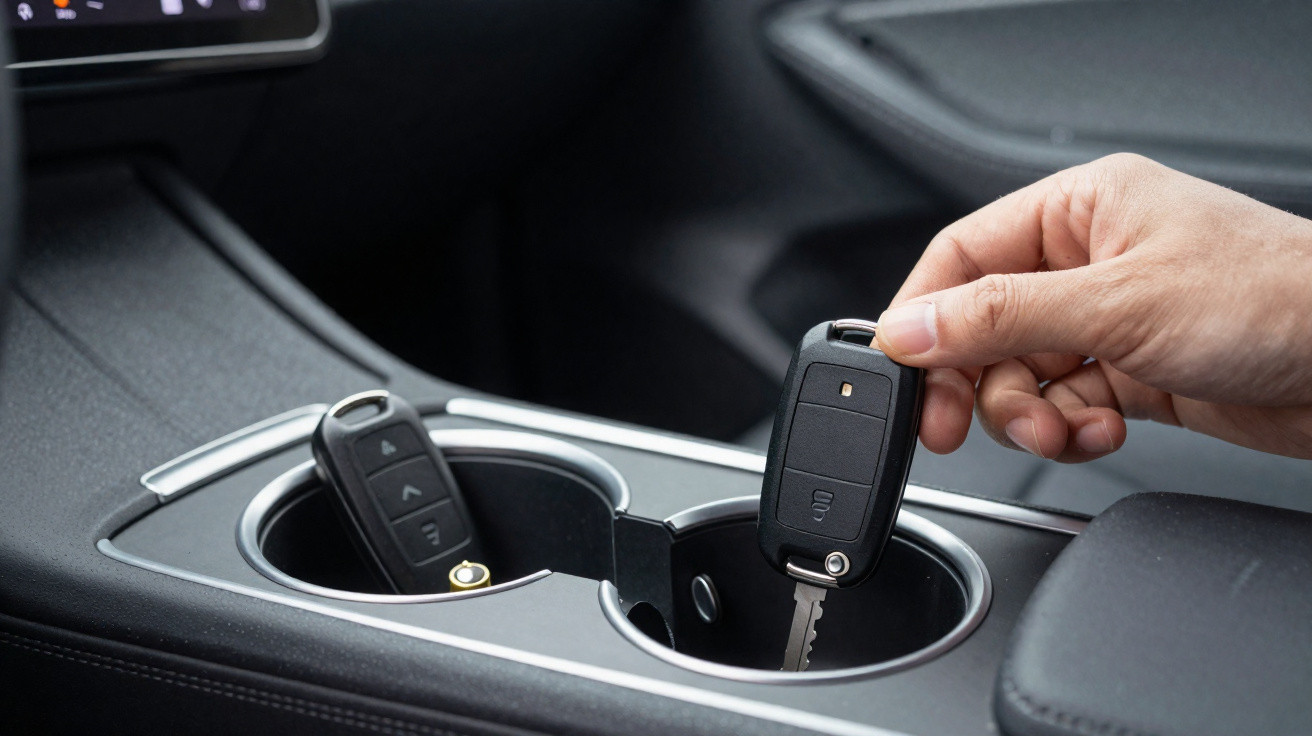
A key fob that will not unlock or start the car is an irritatingly common problem, particularly in a supermarket car park, on a wet school-run morning or when you are already late. In some push-button-start cars, the practical solution is to put the fob in a specific place - and that place can be a cup holder.
The important detail is the small key or fob symbol. On certain models it marks an emergency reader that can recognise the fob when its coin-cell battery is too weak for normal keyless operation. It is not a universal feature, however: the handbook for your exact car is the only reliable guide.
What the key symbol in a cup holder means
Keyless-entry systems normally communicate with the fob over a short distance. This allows you to unlock the doors, open the boot and start the engine without inserting a traditional key.
Those everyday remote functions rely on the fob battery. When it is weak or flat, the car may show a “key not detected” warning, fail to unlock, or refuse to start when you press the button.
Many fobs also contain an identification chip which can be read at very close range by the car’s backup reader. Depending on the model, this reader may be under a cup holder, in a centre-console tray, beside the steering column or close to the start button.
A cup holder is not automatically an emergency-start position. Use it only if there is a symbol or your handbook specifically identifies it as the key reader.
Why a flat fob battery does not always leave you stranded
The emergency reader works differently from the usual remote system. It is designed to identify an authorised fob held directly against, or placed in, the designated position.
That means the fob may still authorise the engine to start even if its buttons no longer work. It does not mean that every dead-looking fob can be rescued this way. The system may fail if the fob has been water-damaged, physically broken or has lost its programming.
It will not solve a flat vehicle battery either. The emergency reader can confirm that the key is present, but it cannot provide the power needed for the dashboard, starter motor or engine-management system.
Find the backup reader before you need it
The best time to locate the emergency-start point is on your drive, rather than in rain or darkness. Possible locations include:
- the base of a marked cup holder or centre-console tray;
- a panel beside or beneath the start/stop button;
- an area around the steering column;
- a dedicated slot in the dashboard, armrest or centre console;
- a marked position inside the glovebox.
Look carefully for a small key or fob icon. It may be moulded into dark plastic and difficult to spot in poor light. Some vehicles do not have a visible symbol at all.
Search your handbook index, or its digital version, for phrases such as “emergency start”, “flat key battery”, “key not detected”, “starting with a discharged key” or “mechanical key”. Save the relevant page on your phone if your manufacturer provides a digital handbook.
How to start the car with a weak fob battery
Procedures vary, so follow your vehicle handbook in preference to any general instructions. The usual process is as follows.
1. Unlock the door with the mechanical key if needed
Most fobs contain a small mechanical key released by a catch or slider. The driver’s door lock may be exposed or hidden behind a removable cover on the handle.
Use the key and any trim cover gently. Do not force plastic parts with a screwdriver or other improvised tool, as clips and paintwork can be damaged. The handbook should show the correct release point.
The alarm may sound after mechanical entry. This can be normal because the car was not unlocked electronically.
2. Prepare the car normally
For an automatic, keep the selector in Park and press the brake pedal. For a manual, apply the handbrake, select neutral and fully depress the clutch.
Make sure the area around the pedals is clear and that the vehicle is safely parked before trying to start it.
3. Position the fob exactly where instructed
Put the fob flat on the marked reader point or into the designated holder. If the reader is beneath a cup holder, remove cups, coins and other items so the fob can sit directly over the marked area.
Do not assume that leaving the fob loosely in the console will be enough. Its position can matter.
4. Follow the specified starting method
Some cars require you to hold the fob against the reader while pressing Start. Others require the fob to touch the start button itself, while some use a dedicated key slot.
Once recognised, the vehicle should start in the normal way. If the alarm was triggered by using the mechanical key, starting the car may silence it.
Try the process once while the fob battery is still working. A five-minute check at home is much easier than learning it at the roadside.
If the car still says “key not detected”
First, check the handbook again and reposition the fob precisely. A reader located behind a trim panel or below a cup-holder insert may require the fob to be placed in one particular orientation.
If that does not work, consider other possible causes:
- the 12-volt vehicle battery may be weak or flat;
- the starting sequence may be wrong for your model;
- the fob may be damaged, wet or incorrectly programmed;
- the gear selector, steering lock or another immobiliser-related fault may be preventing a start;
- an aftermarket accessory or spare key close to the reader may be causing confusion.
Avoid repeated starting attempts for long periods, particularly if the dashboard lights are dim or the engine turns slowly. If you are stranded, contact your breakdown provider, the manufacturer’s roadside-assistance service, or a suitably qualified mobile auto locksmith.
Common mistakes to avoid
A few assumptions make this straightforward feature more confusing than it needs to be.
- Treating every cup holder as a key reader. Most are simply cup holders.
- Expecting the reader to cure a flat car battery. It only identifies the fob.
- Using the mechanical key to try to start a push-button car. It normally unlocks the door only.
- Forcing a hidden lock cover. Check the handbook before removing trim.
- Leaving a spare fob in the vehicle. It is a security risk and does not give you a useful backup when you are away from the car.
- Fitting the wrong coin-cell battery. Use the specified type and fit it in the stated orientation.
Replacing the fob battery safely
A weakening fob battery may reveal itself through reduced unlocking range, intermittent buttons or dashboard warnings. Cold weather can make an already weak battery less reliable, so it is worth dealing with early in autumn and winter.
Buy the battery type specified in the handbook from a reputable motor factor, supermarket, chemist or electronics retailer. Some fobs are designed for straightforward battery replacement; others can be damaged if opened incorrectly, in which case a dealer, garage or auto locksmith may be the safer choice.
Coin-cell batteries are hazardous if swallowed. Keep new and used batteries away from children, and seek urgent medical advice if you think a child may have swallowed one. Recycle old batteries at a proper collection point rather than putting them in household waste.
Never use a damaged, swollen or leaking battery, and do not attempt to recharge a disposable coin cell.
Make this a five-minute job at home
Next time you are parked safely, inspect the cup holders, centre console and area around the start button for a key symbol. Then confirm the emergency-start method in your handbook and find the mechanical key in the fob.
If your car does use the cup holder as its backup reader, remember the simple rule: a flat fob battery does not necessarily mean you are stranded. Put the fob directly on the marked point, follow your car’s correct starting sequence and replace the battery as soon as practical.












Comments
No comments yet. Be the first to comment!
Leave a Comment