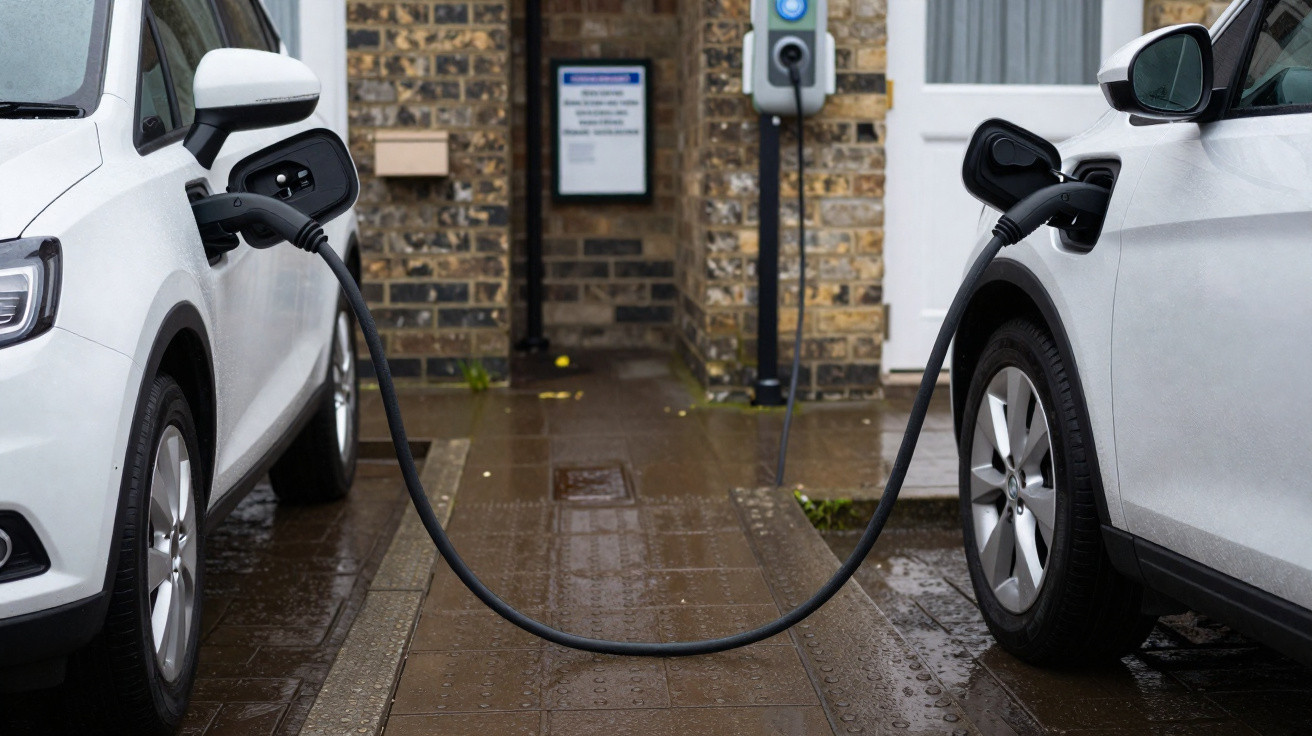
Buying an electric car while living in a terraced house can reveal an awkward gap between the promise of convenient home charging and the view outside the front door. If the car is parked on the road and your electricity supply is inside the house, running a cable across the pavement may look like the obvious answer.
It usually is not. A public pavement is not an extension of your property, and a cable across it can obstruct pedestrians or breach local highway rules. The practical route is to check your council’s policy, investigate any approved cross-pavement schemes and make a charging plan that does not put other road users at risk.
Home charging is not just about the car and the charger. It can depend on the pavement, parking layout and rules on your individual street.
Why charging from a terraced street is complicated
Drivers with a driveway can often have a dedicated chargepoint fitted, provided the electrical installation and property arrangements are suitable. For people in terraces, flats or homes opening directly on to the street, the vehicle may need to be parked on the carriageway instead.
That creates three connected difficulties:
- The pavement must remain accessible for wheelchair users, people with sight loss, pushchairs and anyone with limited mobility.
- A space outside your home is not guaranteed, even if you have an approved way to route a cable.
- Council policies differ, so an option available in one authority area may not be offered a few streets away.
Some councils are considering or operating cross-pavement charging schemes, including cable channels set into the footway. Others are focusing on lamp-column chargers, charging hubs or larger on-street networks. In some areas, there may be no suitable local scheme yet.
A cable cover is not automatic permission
A heavy-duty cable protector may help protect a lead from damage, but it does not make it acceptable to place a cable across a public footway. It can still create a trip risk, restrict wheelchair access or conflict with a council’s highway policy.
The pavement is normally part of the public highway. Local highway authorities may take action where an obstruction has been placed there without permission, particularly if it creates a hazard. The risk is not limited to daytime: people use residential streets overnight, including pedestrians, delivery workers and neighbours returning home.
Wet leaves, rain, poor lighting and uneven paving can make even a low-profile obstacle difficult to spot.
Check these points first
- Find the highway authority. This may be a county council, unitary authority, London borough or metropolitan borough rather than a parish or town council.
- Read its EV and highways guidance. Search for terms including ‘cross-pavement charging’, ‘cable channel’, ‘cable gulley’ and ‘on-street EV charging’.
- Ask for a clear answer in writing. Informal advice from a neighbour or a conversation with a council officer is not the same as approval.
- Check the electrical requirements. Fixed charging equipment should be selected and fitted by an appropriately qualified electrician.
- Think about where you actually park. A permitted arrangement may still be impractical if spaces outside your home are rarely available.
What a cable gulley can and cannot do
A cable gulley is a purpose-designed channel installed in or beneath the pavement, allowing a charging lead to run below the walking surface. Where a council offers such a scheme, it can be safer than laying a cable and cover over the footway.
It is not, however, a DIY job. Cutting into paving, lifting slabs or creating a channel without permission can damage the highway, interfere with underground services and leave an unsafe surface. Work on public land needs the relevant authority’s agreement.
Where available, a scheme may set rules on:
- the approved equipment and installation location;
- the finish of the paving and drainage arrangements;
- installation, maintenance and repair costs;
- responsibility if the pavement needs future works;
- cable type and how it must be used;
- insurance or other conditions required by the council.
A cable gulley does not reserve a parking space. It only provides a safer cable route when your car is lawfully parked in the right position.
A flush cable channel may reduce an obstruction, but it cannot guarantee parking outside your house or replace accessible public charging.
Realistic charging options without a driveway
There is no single answer for every street, but it is worth comparing the available choices before buying an EV or relying on one charging method.
1. Use public charging as the main routine
Rapid chargers can suit longer journeys, while slower public chargers may work well during a supermarket visit, leisure session or overnight stay. Before relying on a location, check its opening hours, connector type, parking restrictions and usual availability.
Prices can vary significantly. Compare the tariff per kilowatt-hour with any connection charge, parking payment, membership requirement and possible overstay fee. The nearest charger is not always the most convenient or best value.
2. Register interest in on-street charging
In England, councils may use funding such as the Local Electric Vehicle Infrastructure programme when planning charging for households without off-street parking. Other parts of the UK have their own arrangements and local priorities.
Projects can take time because authorities need to assess demand, electricity capacity, pavement widths, parking controls, accessibility and procurement. Registering interest is still useful: it gives the council evidence of local demand. Ask whether it has a request map, consultation, survey or mailing list.
3. Charge at work where possible
Workplace charging can be more convenient than home charging for drivers who park for several hours and have predictable mileage. Check the cost, charging speed, booking rules and whether bays need to be shared with colleagues.
4. Match charging to your mileage
Many EVs do not need charging every night. If your weekly mileage is modest, one or two planned charging sessions may be enough. Your needs will depend on battery capacity, journey lengths, driving conditions and nearby charger availability.
Allow more margin in winter. Cold weather, cabin heating, wet roads and longer night-time journeys can increase energy use, while charging sites may be busier during holiday periods.
Electrical and pavement safety come first
Without an approved cross-pavement arrangement, do not run a lead over the footway, through an open window or from an unsuitable socket. Do not assume that a domestic extension reel is safe for EV charging simply because it reaches the car.
Some EVs are supplied with a portable plug-in charging cable for limited use. Follow the vehicle and equipment instructions carefully. EV charging can place a sustained load on an electrical circuit, and poor connections, damaged leads, unsuitable extensions and water ingress can cause overheating or electric shock.
Use these basic safeguards:
- Follow the vehicle and charging-equipment manufacturer’s instructions.
- Use charging equipment in good condition and stop using it if cables, plugs or connectors are damaged.
- Have fixed electrical work assessed and installed by a qualified electrician.
- Keep connectors clean and dry before use.
- Never run a cable where it could be crushed by a vehicle, trapped in a door or block a route.
- Do not attempt to repair a damaged public charger; report it to the charging operator.
Common mistakes to avoid
The most common error is treating a quiet pavement as private space after dark. It remains a public route, and its accessibility matters at all times.
Other mistakes include:
- buying an EV before checking realistic local charging options;
- assuming a neighbour’s cable arrangement has official permission;
- installing a pavement channel without highway authority approval;
- looking only at the electricity price and overlooking parking or overstay charges;
- choosing a charger without checking reliability, access hours or connector compatibility;
- expecting an announced council scheme to be available quickly;
- assuming an approved cable channel gives you a right to park outside your house.
Making the case for better local provision
A useful request to the council is specific. Explain how many homes on the street lack driveways, where residents currently park, how far away the nearest usable chargers are and whether pavement width or accessibility creates particular challenges.
Contact the council’s highways, transport or EV team and ask about consultations and future plans. Local councillors can also raise a clear local need. Keep accessibility at the centre of the discussion: a charging solution that blocks the pavement is unlikely to be a durable one.
Until an approved option is available, use legitimate public or workplace charging where possible, plan around your real mileage and keep the footway clear. That is less convenient than a cable from the front door, but it is safer for neighbours and more likely to comply with local rules.













Comments
No comments yet. Be the first to comment!
Leave a Comment