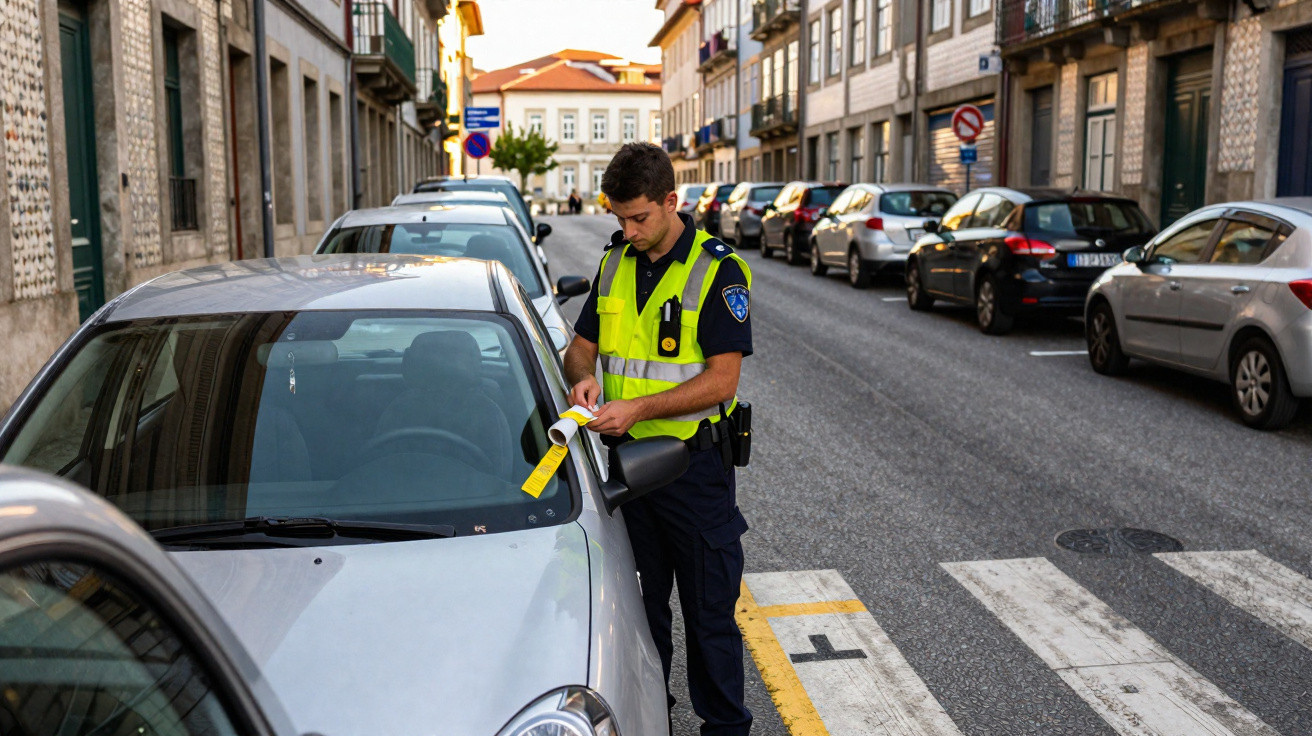
On Costa Cabral and Constituição streets, traders and residents confirm that parking offences are a daily occurrence.
Costa Cabral Street and Constituição Street are among the roads in Porto where the highest numbers of fines are issued for illegal parking. Local shopkeepers and residents confirm that breaches happen every day and say they bear the consequences. To tackle the issue, they suggest increasing the number of car parks and available parking spaces or, ultimately, banning cars from the city centre.
Illegal parking on Costa Cabral and Constituição streets
A walk of only a few metres along these roads, near Praça do Marquês, is enough to find examples of infringements. Cars parked on pavements, improperly left in loading and unloading bays, or stopped in a second lane are commonplace, and everyone passing through the area feels the impact of this disregard for the rules.
“People stop everywhere. They leave their cars and do not care about anything else. It makes traffic much more difficult, simply because drivers do not want to walk a little further and would rather stop outside the places they need to visit,” Maria José Vasconcelos, an employee at Sapataria Jónia on Costa Cabral Street, told JN.
Too many cars
The presence of schools, music academies and sports clubs on this road makes the situation worse, particularly at peak times. Whenever vehicles stop to drop off or collect children, other motorists have to weave around them in the carriageway to keep moving.
Those dealing with the effects of illegal parking also point to the sheer volume of vehicles as a problem. António Martins, one of the people responsible for the Lacinho kiosk on Constituição Street, argues that it is one of the city’s key issues.
“There are too many cars on the road. A good way of controlling the problem would be to prevent traffic, as is done in other European cities. In Stockholm (Sweden) or Amsterdam (the Netherlands), city centres are not occupied by vehicles. They are only for loading and unloading, or for residents at the end of the day,” said António Martins, who has lived in Porto for 71 years.
In this trader’s view, the shortage of parking also forces people to leave their cars in prohibited places. Nevertheless, he proposes another way to address the issue. “It would be better if people used public transport more, instead of all travelling by car and using petrol. It would make more sense to create bus lanes on Constituição Street to give this form of transport genuine priority,” António Martins suggested.
Paid parking
Further on, at Praça do Marquês, José Rodrigues shares António’s view about the lack of spaces for motorists. “Every street has paid parking. Where are people supposed to leave their cars? If they have time, they look for another space; if not, they leave them anywhere,” says the 76-year-old pensioner.
Pressure around Hospital de S. João
The problem becomes more severe in areas with high footfall, such as Alameda do Professor Hernâni Monteiro, where Hospital de S. João is located. Around the healthcare facility is the Asprela university campus, with thousands of students, and every available gap is used for parking, even when this goes against the signage.

















Comments
No comments yet. Be the first to comment!
Leave a Comment