What is it?
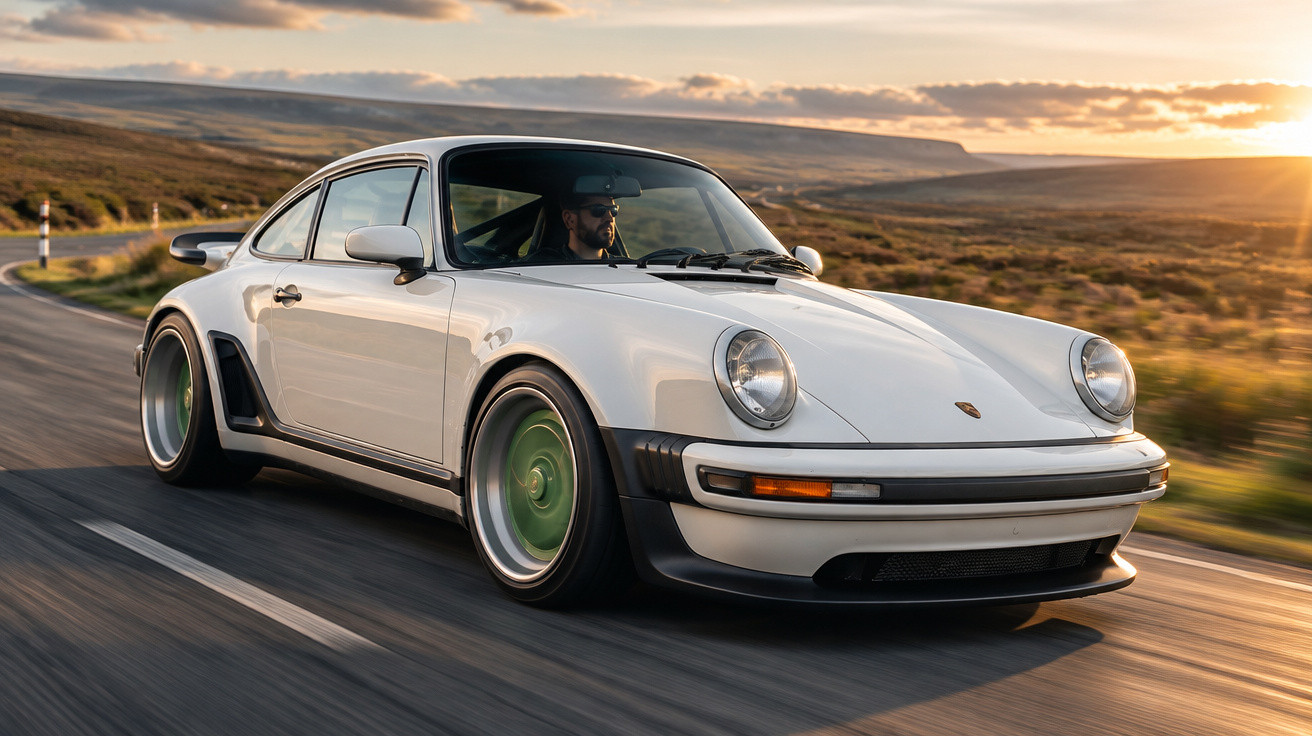
Complicated is the short answer. It is a restomod Porsche 911 based on the 964, reworked by Singer as a tribute to the fabled 930 Turbo from the mid-1970s. Arriving at the half-century mark for turbocharged Porsches, it is quite a present from Singer. And what a machine it is.
Following the familiar Singer formula, the car is taken apart and rebuilt to a higher standard. Its body is carbon fibre throughout, apart from the steel doors, which preserve that satisfyingly substantial closing thud. Nearly every curve and radius has been revised, although you would struggle to spot the changes without an original alongside it. Most people would, anyway.
At the back sits a 3.8-litre, bored-out version of the ‘Mezger’ flat-six, extensively re-engineered and fitted with a pair of variable-vane Borg-Warner turbochargers borrowed from a 992-era car. The standard output is 450bhp, though this can rise to 510, alongside around 400lb ft. There are no official figures, but the TG-patented bum-dyno suggests 0-62mph in the high threes, chiefly because these cars weigh only 12-1,300kg. Credit Singer for resisting the temptation to create an internet-baiting 750bhp monster simply because it could. This is about equilibrium, not Top Trumps.
Every example is rear-wheel drive and uses a six-speed manual, too. And, by crikey, the formula works.
Photography: Jonny Fleetwood
It’s rather pretty, isn’t it?
Taste is subjective, of course, but there can be few cars more photogenic than this, and in our view many of them are restomods. Make of that what you will. Either way, this is an extraordinary concentration of detail built around the bones of a 964. The front bumper clearly references its inspiration, but does so in a smoother, neater and more aerodynamic way.
The headlights use LEDs, but avoid the overdone, multi-faceted sparkle that can resemble misplaced Christmas decorations. The bumper bellows have become vents, while the side ‘shark fin’ features are now engine intakes. The original’s famous rubber whale-tail spoiler is replaced by a longer, taller carbon item, designed less for outright downforce than stability at speed. It is a heightened interpretation of the Turbo rather than an unrecognisable remake. Like excellent cosmetic surgery, you can tell work has been carried out, yet find yourself wondering precisely where. It is plainly a classic, but it looks magnificent.
What versions of the Singer Porsche 911 Turbo are available?
There is an interesting approach to the notion of versions, as every Singer-modified 911 is effectively individual. That is largely because the options list is almost overwhelming. Singer has, however, created two distinct Turbo styles for photography and press purposes, each aimed at a slightly different preference.
The fundamentals remain identical: all Turbos have either 450/510bhp, a six-speed manual gearbox and rear-wheel drive. It is unclear how many 450bhp cars will actually be commissioned. All-wheel drive was examined but judged unnecessary for now. The suspension, dampers and traction-control systems are shared, as are their set-up settings.
The white car shown here leans a little more towards the occasional track day. It has fixed-back manual carbon bucket seats with fabric inserts, reduced sound insulation and carpeting, a half cage, no rear seats and more visible carbon fibre. It also gains a centre-fill fuel tank, loses the rear wiper and weighs slightly less.
The green car has more of a touring brief, with electrically adjusted leather seats, wood trim, a rear wiper and a less elaborate front-wing fuel filler. It also has proper rear seats, no cage and additional carpet. In other words, buyers can mix and match or move more decisively towards whichever character appeals most. Both feel exceptional in their quality and finish.
What is it like to drive?
Busy. During two days of testing on the northern Pennines, it soon became clear that Singer has not tried to sand away too many of the traditional 911’s rough edges. Over broken surfaces, the Turbo can feel taut and fidgety. Build some speed, though, and it starts working much more effectively: the suspension and damping wake up, and it is mostly brilliant - as well as very much not like the original.
It has something of a rally car’s character, in that it needs load running through it to soften its sharpness. This is nevertheless a stiff car, equipped with modern suspension kinematics, damping and tyres, and that is evident. Grip is plentiful and predictable, while the Bosch traction control remains unobtrusive. Select Sport or Track and the rear moves around more, but it never feels snappy or inconsistent. Nor should you wrestle with the steering: as with many 911s of this era, the wheel wants to wriggle in your hands, yet allowing it to deal with bumps itself makes the car feel far calmer.
The brakes are derived from the DLS, with carbon-ceramics on the white car and steel discs on the green one. Frankly, the carbon brakes were close to perfect, so if the funds are available, why not?
It sounds good, too. It is not as operatic as the DLS, but it is entertaining. There is more of a roar than a defined note, with abundant induction noise and the occasional chirrup from the electric wastegates. It pops, bangs and crackles, but none of it is the digital pretence of a pop’n’bang map; it is simply fuel and a hot exhaust doing what they do.
This is not a cheap thrill based solely on speed. To draw the best from it, you must properly drive it, coordinating hands, feet and brain to place every gear change and line correctly. Threading it through a sequence of bends may not be the quickest way to travel, but it is about 99-times more rewarding than uncomplicated power. In an age of easily obtained electric horsepower, it recalls what you genuinely enjoy about driving. This is the sort of car whose dashboard you pat after a good run, and one you always look back at after parking. You cannot ask for much more than that.
Remember, though, that it is not a ‘Singer Porsche’. It is a Porsche 911 given the Singer treatment, because Singer does not manufacture cars. The logic is that Porsche has a formidable legal department, while Singer Vehicle Design is a specialist re-imagineer (sic) with complete respect for the original ingredients. Singer’s products are born above all from a love of Porsches, even if the company strips them back to their atoms before rebuilding them as something more boutique.
That affection is apparent here. This is not the loud, showy DLS Turbo, but a more thoughtful interpretation. That only makes it more consistently desirable.
How much does all this cost?
Take a deep breath. This conversion costs around £850-ish grand. That does not include the donor 964 - which need not be an original Turbo - nor taxes or shipping from Singer’s Californian workshop. You need to be seriously wealthy to own one. And, should you question whether there is demand for a car costing nine or ten times as much as an unrestored 930 Turbo, Singer says its order book exceeds 300 and its waiting list stretches to three years, which answers the question rather neatly.
Is it worth it? That is a matter for you and your bank manager. We would say yes.
14 minutes 48 seconds


Comments
No comments yet. Be the first to comment!
Leave a Comment