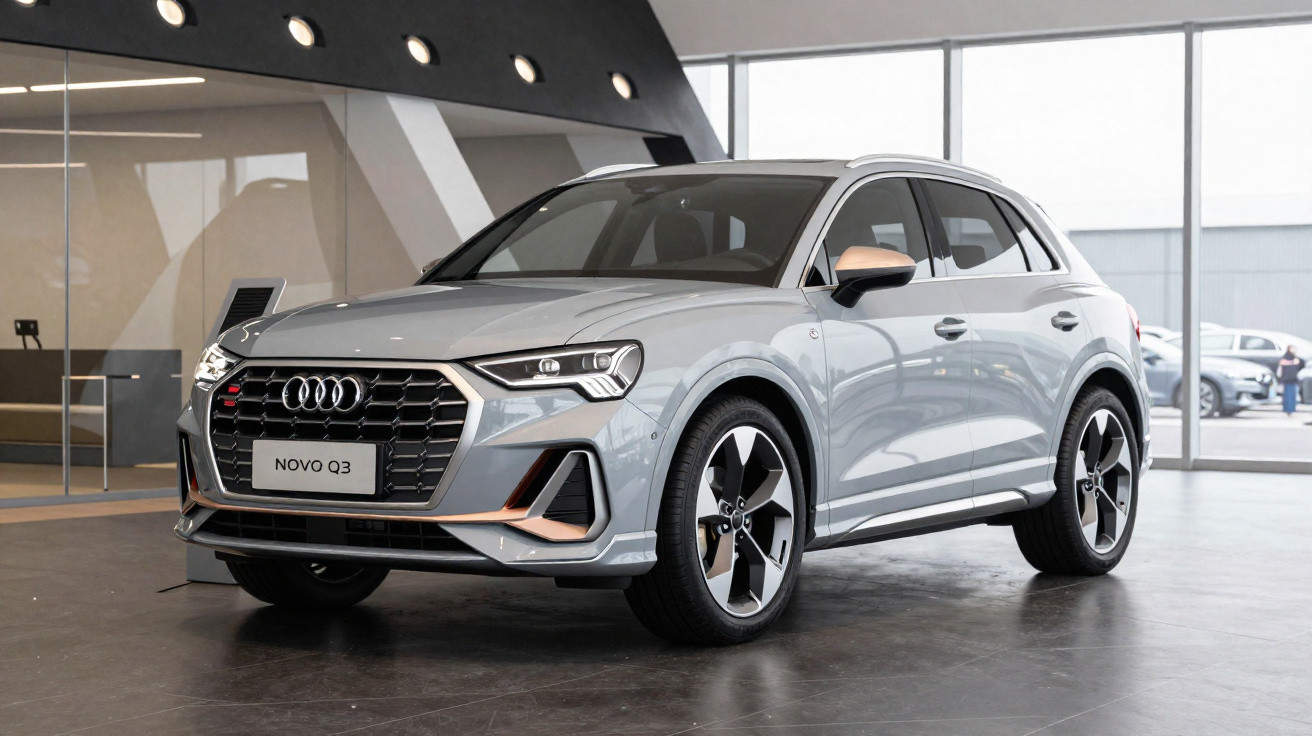
Even though plenty of drivers seem to forget about them, there is one car component that everyone uses regularly and which the new Audi Q3 does not have: an indicator stalk. In its place, the brand has introduced a new solution called the Integrated Switch Module.
Audi Q3 Integrated Switch Module replaces the usual stalks
Rather than the two conventional stalks, there is now a horizontal bar positioned behind the steering wheel, with control clusters at each end. The controls for the gearbox are on the right, while those for the “indicators” and windscreen wipers sit on the left.
From what we saw in a video released by the brand (follow the link), it does not appear to work very differently from the system drivers already know. To operate the indicators, for instance, the module on the left simply needs to be moved up or down, depending on the direction required.
Pulling it activates the full-beam headlights, as it does in current cars, while pushing it forwards keeps them switched on permanently.
Indicator and wiper controls on the left-hand module
The remaining controls operate the windscreen wipers and rear window wiper. A brief press switches them on or performs a single wipe, while a longer press activates the “washers”.
A small rotary control is used to adjust the rain sensor’s sensitivity or to keep the windscreen wipers running continuously - something drivers are unlikely to need very often.
With all of these controls grouped on the left side of the module, the right-hand side is free for the usual transmission functions: R, N and D or S. These stand for Reverse, Neutral, Drive and Sport. The button for activating the Park (P) function is positioned on the side.
Will it be fitted to more models?
This module is one of the key new features of the latest Audi Q3 generation. According to the Ingolstadt manufacturer, it could be introduced across all other Audi models if it is well received.
At first glance, its operation appears far simpler and more intuitive than the solutions adopted by Tesla or Ferrari, both of which have chosen to place all, or almost all, controls on the steering wheel.
That is because Audi’s approach does not seem to involve any major changes to the way drivers are already used to operating these functions.


Comments
No comments yet. Be the first to comment!
Leave a Comment