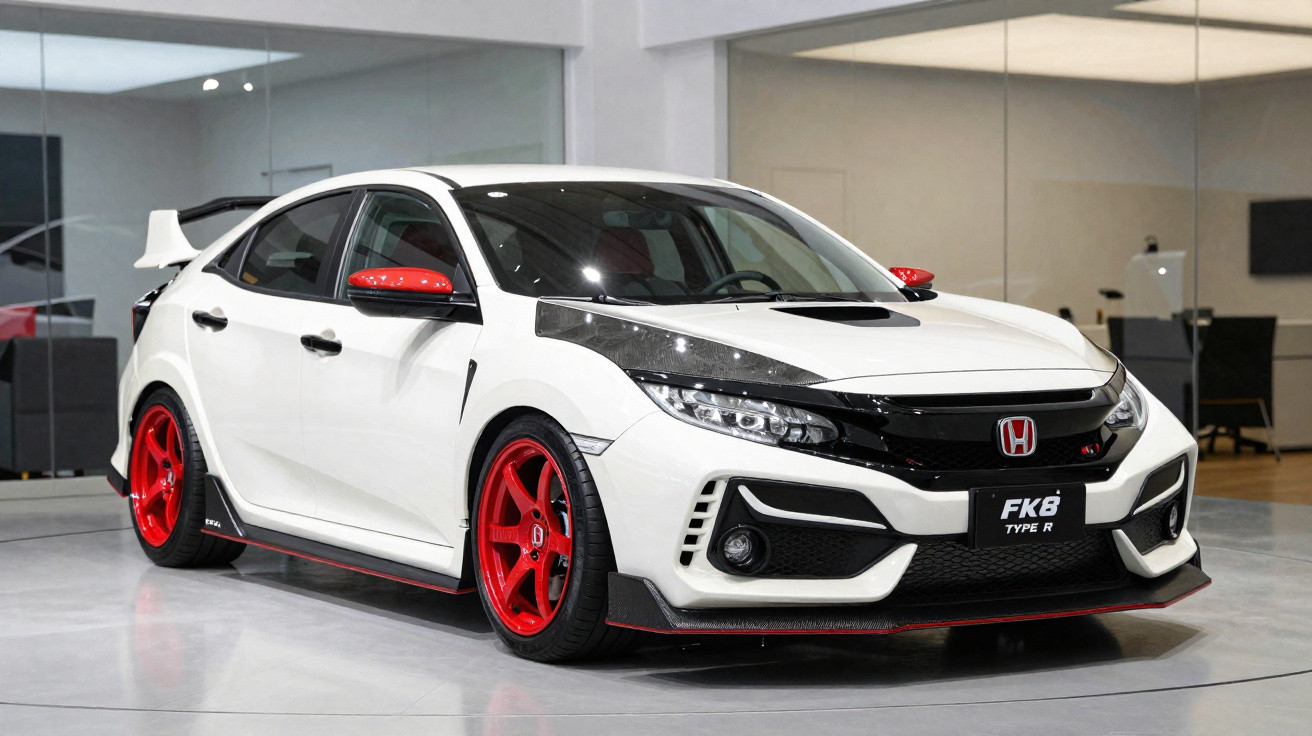
The Honda Civic Type R FK8 was updated not long ago, and after driving it, one thing has been reaffirmed: it remains the benchmark among “all-at-the-front” hot hatches, with front-mounted engines and front-wheel drive. It is the segment’s apex predator and still unbeaten - although the Mégane R.S. Trophy-R may have something to say about that. However, it costs almost €30,000 more and is nowhere near as versatile in everyday use as the Civic Type R.
We headed to the Serra de Montejunto to give the machine the workout it deserves. As you may already have noticed, Razão Automóvel’s YouTube channel has a new face: please welcome Miguel Dias. Guilherme makes the introductions for Miguel’s channel debut, and for this first “trial by fire”, there could hardly be a better car than the Civic Type R.
Honda Civic Type R FK8 on the Serra de Montejunto
Alongside Miguel Dias’s first appearance, Guilherme also reveals his first-generation Renault Twingo on the channel for the first time. This unlikely yet capable support vehicle is used during filming - and it could not be further removed from a Honda Civic Type R. It is a video not to be missed:
What has changed on the Honda Civic Type R?
There was no need for extensive changes - especially as there was a risk of spoiling it… - to improve something that was already good, or even very good.
There are fresh styling details, including inserts in the false air intakes and outlets, as well as a redesigned front grille. It is now 13% larger to improve engine cooling. Inside, the steering wheel is now trimmed in Alcantara, while the manual gear lever has been reshaped with a teardrop design and fitted with a 90 g counterweight to make its action better.
Chassis and braking upgrades
Mechanically, nothing has changed: the 320 hp 2.0 Turbo remains one of the finest and most powerful engines in its class. The chassis, however, has received several revisions. The rear lower suspension arm bushes are 8% stiffer, the front bushes are new too, and new low-friction ball joints have been added for sharper steering.
The braking system also receives new bi-material front discs, reducing unsprung mass by 2.5 kg. In addition, brake pedal travel before the brakes engage has been cut by 15 mm.
Perhaps the greatest criticism levelled at this generation of Honda Civic Type R concerns its engine note - or, more accurately, the lack of one. The Japanese hot hatch’s update has not fixed that issue, but it is now equipped with Active Sound Control (ASC). In other words, a supplementary synthesised sound layer is overlaid on the real engine noise and played through the car’s audio system, with only occupants inside the cabin able to hear it.
Well… You cannot have everything, and it is certainly no obstacle to the Civic Type R continuing as the reference point in its class.


Comments
No comments yet. Be the first to comment!
Leave a Comment