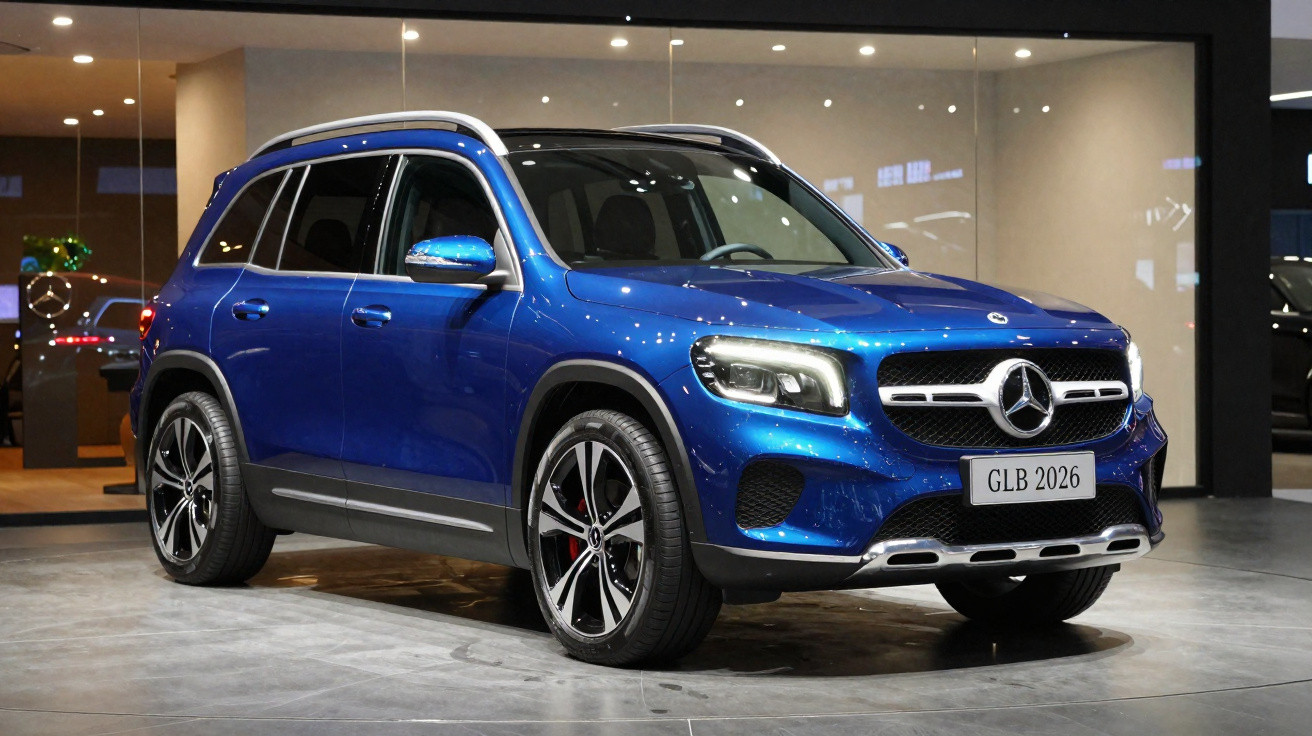
The technology comes from the CLA, but the Mercedes-Benz GLB 2026 adds more room while retaining an exclusive advantage in its segment: seating for up to seven.
Mercedes-Benz is retiring two models at once: the combustion-engined GLB and the electric EQB. Their replacement will be a single model that keeps the GLB name, arrives as an electric vehicle, and will later also be offered with combustion engines.
It uses the CLA’s technical foundations, including the MMA platform, 800 V architecture and the same powertrains - electric and combustion. It is the third model planned for this platform, with the next one set to be the GLA successor, due towards the end of the year.
Large families welcome in the Mercedes-Benz GLB 2026
The SUV continues to appeal to larger families - an increasingly rare species, particularly in Europe - by retaining a seven-seat option. It has also improved on its predecessor. The Mercedes-Benz GLB 2026 is larger, with the most significant change being a 6 cm increase in wheelbase, directly creating extra legroom in the second and third rows.
Although the car I drove was the five-seat version, I tried the three-row layout: the final row can accommodate occupants up to 1.75 m tall, while getting in and out is reasonably straightforward. That is a notable achievement in a car measuring under five metres long.
Rearward visibility is very good, aided by rear and front cameras that make manoeuvring simpler. From the second row, the higher seating position relative to the front seats - creating a theatre-style effect - is welcome, as is the ability to slide the seats forwards and backwards in two asymmetrical sections and adjust the backrest angle.
The completely flat floor in the second row also improves comfort for those travelling there, and passengers measuring 1.90 metres can sit without any restriction of movement.
Boot capacity has increased by between 15 litres and 45 litres, depending on the position of the second-row seats, while the storage space under the bonnet remains unchanged at 127 litres.
Familiar interior
From behind the wheel, the dashboard first seen in the CLA returns, incorporating up to three displays beneath one continuous surface, which the brand calls the MBUX Superscreen.
To help users make the most of this hardware, the MB.OS operating system brings extra functions, a more effective and intuitive navigation system using Google Maps, and a virtual assistant designed for more fluid and natural voice interaction with the car.
Perceived quality is merely acceptable. The upper dashboard has a structurally hard surface, though it is softened by a thin soft-touch layer. There are soft linings in the door pockets and glovebox, along with good finishing around the overhead lighting area and some wood inlays that look and feel pleasing. However, there are no soft coverings on the centre and rear pillars, nor in the rear door pockets.
Mercedes-Benz GLB 2026 uses the CLA’s powertrains
The first examples of the new Mercedes-Benz GLB will reach Europe in June and, as happened with the CLA, they will initially be fully electric. The range begins with two “EQ Technology” versions: the 250+ with rear-wheel drive and the 350 4MATIC with four-wheel drive.
The GLB 250+ is the entry point to the range, producing 200 kW (272 hp). Fitted with an 85 kWh NMC lithium-ion battery, it claims a maximum range of 631 km (WLTP). It accelerates from 0 to 100 km/h in 7.4 seconds and has a top speed of 210 km/h.
The GLB 350 4MATIC raises output to 260 kW (354 hp). Here, a second 80 kW (109 hp) electric motor on the front axle operates only when required and disconnects in just 0.2 seconds. The result is a 0-100 km/h time of only 5.5 seconds, with a slightly lower 614 km range using the same battery.
In both cases, the electric system has a nominal voltage of 800 V, enabling DC rapid charging at up to 320 kW, meaning 260 km of range can be recovered in 10 minutes. It can also optionally be charged at 400 V stations. On AC power, the 22 kW onboard charger is bidirectional, allowing the GLB to power external devices.
To maximise efficiency, the electric drivetrain uses a two-speed gearbox. The second ratio generally engages above 110 km/h, optimising motorway consumption. There are four energy-regeneration levels, including one-pedal driving, which can bring the GLB to a complete stop.
More versions are expected during the year. One will be a more affordable electric model, the GLB 200, with 165 kW (224 hp), a 58 kWh LFP battery and 431 km of range. The other development will be the introduction of 48 V mild-hybrid variants. These will use the same arrangement as the CLA, combining a turbocharged 1.5-litre four-cylinder petrol engine with an eight-speed dual-clutch automatic gearbox.
Zig-zagging through Mallorca
The GLB 250+ was tested on Mallorca, across very twisty mountain roads, more urban routes and some faster roads. The first positive impression concerns the steering response, which is notably direct at 2.6 turns lock-to-lock and communicative, although it feels too light in Eco and Comfort driving modes. Ideally, it would have slightly more weight in every mode.
The brakes confirm the major progress Mercedes-Benz electric cars have made since adopting the “one-box” construction, delivering a much more immediate and linear response than that experienced in the EQS and EQE.
On the other hand, the energy-recovery settings are clearly differentiated, ranging from zero to one-pedal driving. This makes urban driving smoother and more relaxing, while also helping in sportier driving by making turn-in more effective.
The Mercedes-Benz GLB 2026 suspension also deserves praise for the comfort it delivers over poor surfaces. In certain situations, though, it is apparent that this is a tall car, with some body lean through bends and a tendency to bob over more undulating tarmac. It is not excessive, but there is a sense that the effect could be amplified with less sporty tyres; our GLB wore 255/40 tyres at the front and 235/45 tyres at the rear, all fitted to 20-inch wheels.
Being a rear-wheel-drive electric vehicle also helps prevent a loss of front-axle grip in tighter bends taken at higher speeds.
Performance is at a very good level, with instant acceleration during rolling speed increases that is especially useful for overtaking. The effect is strongest in Sport mode, whereas Eco mode makes only up to 70% of total power available unless the driver pushes past the accelerator pedal’s kickdown point.
Route did not favour consumption
As for energy consumption, this type of route - winding mountain roads that encourage more spirited driving - does not help achieve averages close to the official figure.
That was confirmed: at the end of a 70 km route, the recorded average was 22.5 kWh/100 km, clearly above the homologated 18.3. Yet, even during this first drive, on more everyday journeys at a calmer pace, real-world range may be closer to 500-550 km than the claimed 631 km.
Ultimately, the Mercedes-Benz GLB 2026 lacks the ability of the low, sleek CLA to “cut through the air”…
Mercedes-Benz GLB 2026 prices
The first Mercedes-Benz GLB 2026 models will reach the roads in June, priced from €58,200 for the 250+ version. That is around €2,000 more than the CLA.
Prices are already available for the remaining versions:

Comments
No comments yet. Be the first to comment!
Leave a Comment