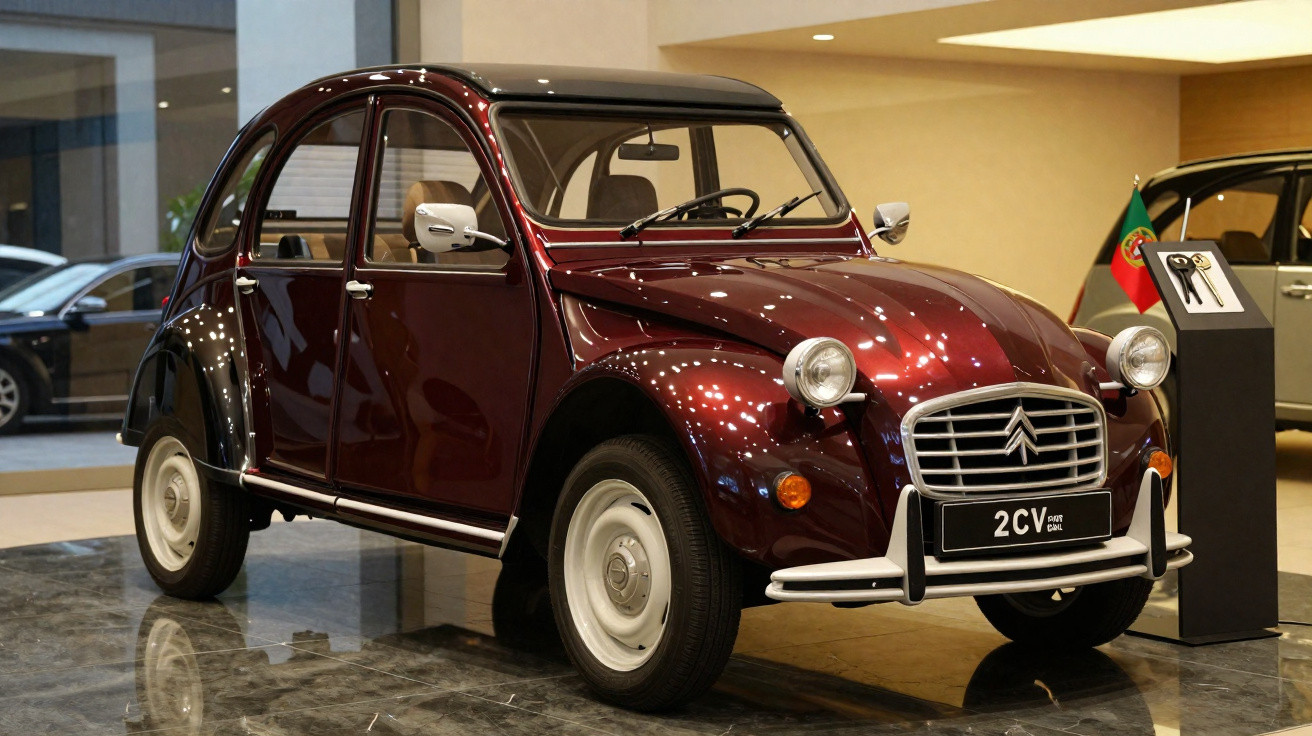
The last Citroën 2CV built “spoke”… Portuguese. At 16:30 on 27 July 1990, the final 2CV - one of the marque’s most iconic models and one of motoring’s most recognisable cars - rolled off the assembly line in Mangualde.
A band was even on hand to mark the solemn occasion: the end of a long commercial life that had begun in 1948 and produced more than 5.1 million vehicles.
Citroën 2CV production ends in Portugal
Production ended exclusively in Portugal, where it had begun in 1988, making the country the 11th location to manufacture the 2CV.
Although production only reached Portugal at a very late point in the 2CV’s career, the Portuguese-built cars were acknowledged as being more refined than those made in France. Our 2CVs featured additional sound insulation between the engine bay and passenger compartment.
Charleston, the final Citroën 2CV
The final car to leave the Mangualde assembly line was no ordinary 2CV. It was a Citroën 2CV 6 Charleston, set apart from other 2CVs by its two-tone paintwork, whose colours were divided along the sides by a distinctive curved line.
Its story was an unusual one. Initially launched as a limited-edition 2CV, it rapidly became the model’s last major commercial success during the 1980s, when the 2CV’s wider career was already in decline.
Citroën unveiled this special edition at the 1980 Paris Motor Show. Alongside the signature two-tone bodywork - originally finished in black and Delage red - its other major feature was the return of round headlamps. Contemporary standard 2CVs had rectangular units, but the round lamps were intended to “satisfy purists”, as Citroën’s official press release put it.
From limited edition to regular range model
Announced as a special edition limited to 8000 units, it proved so popular - whether because of its two-tone bodywork, unique interior trim or round headlamps - that the French marque added the 2CV 6 Charleston to the regular model range.
Further colour combinations followed the original special edition’s black and Delage red. That version also had red headlamp surrounds, whereas the other variants used chrome ones. The rarest paired black with Helios yellow (1982–1983); another combined two shades of grey, one lighter (Cormorant) and the other darker.
The 2CV 6 Charleston was based on the 2CV 6 Club trim level. Its single-spoke steering wheel identified it as a range-topping 2CV, as it had done since 1976.
It was distinguished by its specific grey fabric interior trim and a black plastic strip. The limited Charleston edition also used houndstooth upholstery for the seats, while later Charlestons featured grey trim with diamond-pattern motifs.
Back in Mangualde, the Citroën 2CV 6 Charleston that became the last 2CV ever built wore the two-tone grey bodywork. This particular car was later bought by Claude Hébert, who was the director of the Mangualde factory at the time.
This unusual year of 2020 therefore brought two anniversaries: 30 years since Citroën 2CV production ended - in Portugal, no less - and 40 years since the launch of the much-loved, popular Charleston.
About “The Last of…”. The motor industry is undergoing its greatest period of change since the motor car itself was invented. With significant developments occurring all the time, this series aims to keep track of events and record the moment when something ceased to exist and entered history, most likely never to return - whether in the industry, at a marque or even with a model.



Comments
No comments yet. Be the first to comment!
Leave a Comment