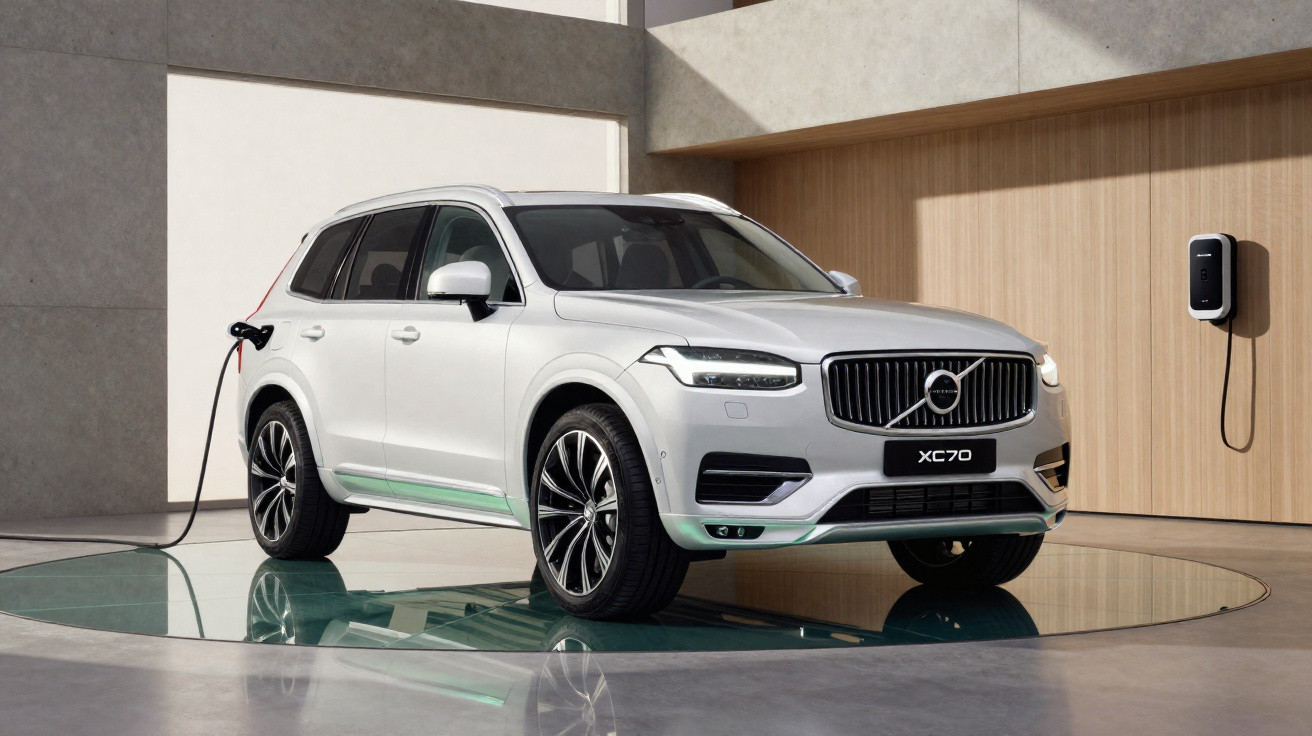
The Volvo XC70 has shed its “rolled-up trousers” estate-car identity and is now an SUV, sized to sit between the XC60 and the larger XC90.
We had already seen it, but Volvo has now officially unveiled it with new images. Its calling card is electric range: up to 200 km on the generous CLTC cycle. This is the Swedish brand’s plug-in hybrid with the longest electric range to date. Add the fuel in the tank and its total range exceeds 1200 km.
Two battery options for the Volvo XC70
The Volvo XC70 uses the new Scalable Modular Architecture (SMA), developed specifically for plug-in hybrid vehicles, and can be fitted with one of two high-capacity batteries: 21.2 kWh and 39.6 kWh - the latter larger than those in fully electric models such as the Dacia Spring and BYD Dolphin Surf.
The smaller battery uses LFP (lithium iron phosphate) chemistry and delivers a claimed range of up to 100 km (CLTC); it is fitted to the two-wheel-drive versions. Reaching 200 km in electric mode requires the 39.6 kWh battery, which uses NMC (nickel, manganese, cobalt) chemistry and is paired with the all-wheel-drive models.
Thanks to their battery capacity, the XC70 supports rapid DC charging. Although Volvo has not disclosed charging outputs, it has confirmed that the battery can be charged from 0% to 80% in just 23 minutes.
As with Hyundai and Kia electric models, for example, the Swedish SUV is also offered with bidirectional charging. In practical terms, it can power external equipment.
The new Volvo SUV is not short of power. Beneath the bonnet is a turbocharged 1.5-litre petrol engine producing “just” 160 hp, but the addition of up to three electric motors - depending on whether it is front- or all-wheel drive - ensures strong combined system output.
In front-wheel-drive form, maximum combined system power is 234 kW, equivalent to 318 hp. The all-wheel-drive version reaches 340 kW, or 462 hp, allowing the XC70 to complete the customary 0-100 km/h sprint in 5.3 seconds.
Typically Volvo design
There is no mistaking it visually. The XC70 adopts a design language in line with the brand’s latest products, closely resembling the new EX90 through its clean, uncluttered lines.
At the front, the lighting signature inspired by Thor’s Hammer takes centre stage, although this motif is used solely for the daytime lighting signature. The headlamps themselves sit lower down, at the outer edges of the bumper.
While the exterior was already familiar, the interior is new. Technology is among the Swedish SUV’s main highlights, with a 12.3″ digital instrument cluster, a 15.4″ central display and a 92″ head-up display (!).
Is it coming to Europe?
The new XC70 is the first Volvo developed specifically for the Chinese market, raising doubts over whether it will ever reach Europe. The Swedish brand has already confirmed that it intends to bring it over, although nothing has been finalised.
In China, the new SUV is expected to take the place of the XC60, which has already been on the market for eight years and is considerably more expensive.
Pre-orders have already opened in China, where the XC70 is available from 299,900 yuan (approximately €35,900) and 329,900 yuan (approximately €39,500) for the front-wheel-drive and all-wheel-drive versions respectively.
The XC60 starts at 523,900 yuan (approximately €68,100), although it is only available as the 455 hp T8 PHEV. Its electric range also does not exceed 90 km (CLTC).




Comments
No comments yet. Be the first to comment!
Leave a Comment