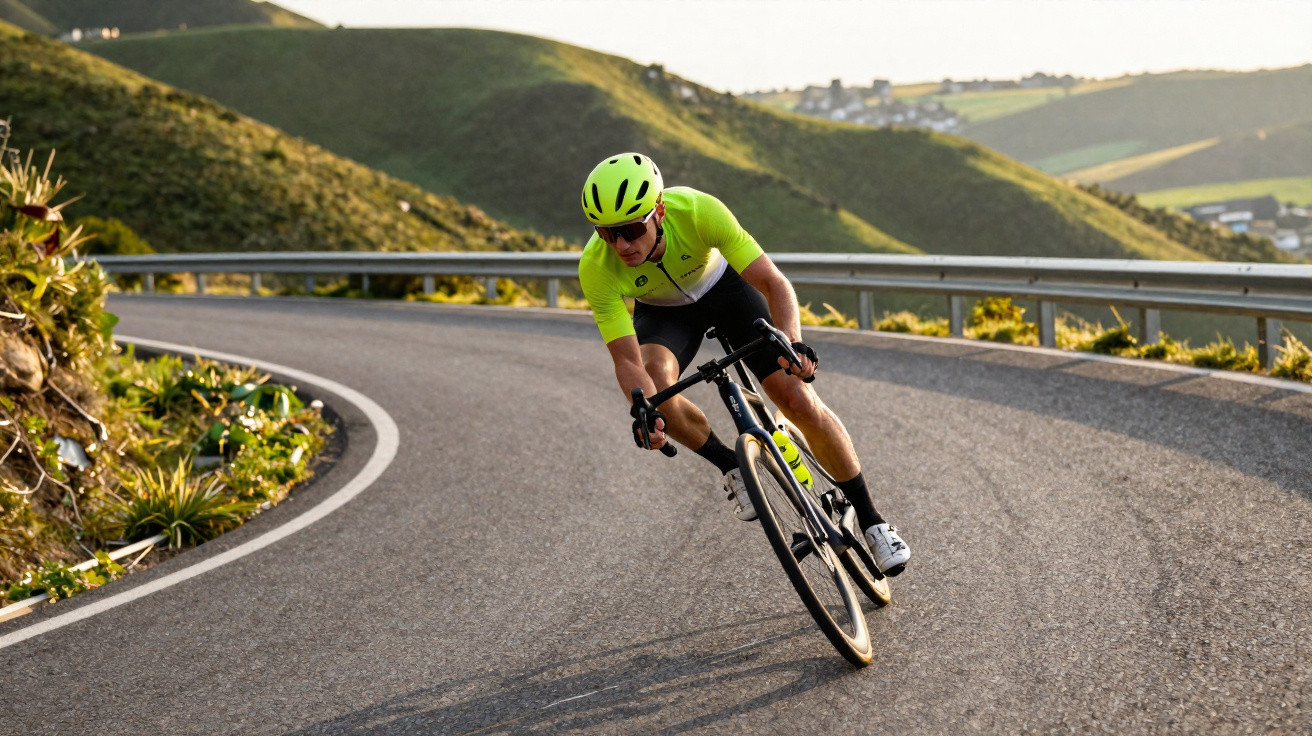
68 km/h flashes up on the speedometer, and the rider’s fingers clamp around the brake levers. A small bump in the tarmac makes the front wheel hop for a moment – and suddenly every bend feels like Russian roulette. Another cyclist sweeps past, relaxed, low over the bike and breathing steadily. No shaking, no tension. Later, down in the valley, a paramedic says just one thing: “Do you know, with one simple trick you could have avoided half of those crashes.”
That sentence lingers – particularly when he adds: “We should all be taught this.”
Why cycling descents so often go wrong
Anyone who rides regularly knows the point at which enjoyment turns into fear. You roll down a mountain pass, gather speed, narrow your focus and pull your shoulders up towards your ears. Before long, you are braking out of panic rather than with a plan. Every uneven patch of road seems threatening, and each corner feels like a possible crash. Somewhere in the back of your mind, a quiet thought waits: “If something happens now, that’s it.”
This is exactly when most mistakes occur. Not at the top of the hill, and not while setting off slowly, but in the transition between “I’m fine” and “I’m no longer in control”. Accident reports often state, rather bluntly: “Lost control on the descent.” Behind that line are fractions of seconds – and years of habits that nobody ever corrected.
In A&E departments, clinicians repeatedly encounter the same pattern. A study by Innsbruck University Hospital found that almost half of serious road-bike accidents in the Alps happen on descents. No lorry and no drunk driver: simply travelling too fast in the wrong position. One paramedic said that the usual injuries include broken collarbones, fractured wrists and traumatic brain injuries. These are all injuries that would often be less severe if the rider fell in a more controlled way. A cycling coach from South Tyrol puts it like this: “Many people climb like professionals and descend like passengers.”
The issue is not solely a lack of technique, but also a misunderstanding. Many people assume that descending safely mainly comes down to good brakes, a good helmet and a cautious speed. Those things help, without question. However, the decisive factor lies elsewhere: in how your body is “anchored” on the bicycle. Tension reduces precision. Sitting incorrectly shifts your centre of gravity to a place that physics punishes mercilessly. A sober conclusion from accident research is: “It is not speed that kills, but loss of control.”
The sure-fire trick: the “two-point position” for safe descents
The trick often mentioned by doctors and accident researchers sounds almost absurdly simple: on descents, learn to deliberately anchor yourself at two stable points. Not through your arms. Not through your hands. Instead, place your weight between the saddle and pedals. You could call it the two-point position. It determines whether your body reacts instinctively in the wrong way or the right way when something goes wrong.
Start setting yourself up before the descent becomes steeper. Move your hips slightly rearwards, keep your arms relaxed and softly bent, and hold either the drops or brake hoods securely without gripping them rigidly. Most of your weight should be through the pedals, rather than the handlebars. In bends, press the outside pedal down so you can clearly feel the pressure through that leg. The saddle is the second anchor point: not merely somewhere comfortable to sit, but a tangible reference point for your pelvis. This creates a stable triangle: bike – pedals – pelvis. That is the triangle that supports you when things go wrong.
It sounds basic, yet remarkably few cyclists genuinely practise it. Many hang half-stretched over their bike when descending, with their shoulders pushed far forwards and their weight pressing into their hands. One common error is braking from the arms rather than from the body. Another is looking too close to the front wheel because fear is already focused two bends ahead. Let’s be honest: hardly anyone practises their descending position in a car park every day before it matters. We set off, hope nothing happens, then wonder about those moments of fright.
People who work extensively with injured cyclists tend to express it with striking clarity.
“The biggest safety problem on descents is not a missing helmet, but a missing centre of gravity,” says sports physician and paramedic Dr Martin H., who has worked at cycling races for 15 years. “If we taught people early on how to position their weight properly, we would see far fewer serious crashes. We should all be taught this – at every cycling school and in every club training session.”
The practical benefits of this two-point position can be broken down into several key effects:
- Greater control of the front wheel because your entire body weight is not hanging from the handlebars
- A more stable centre of gravity that carries you through bends as though on rails
- Improved responses to potholes, as your arms and legs can work as “suspension”
- Less panic braking because you can modulate braking force more precisely
- Less uncontrolled forward flipping in a serious incident, as your body is not catapulted forwards
What changes when we rethink descending
Anyone who deliberately uses the two-point position on a longer descent notices an unusual effect. Speed no longer feels like an enemy, but something you can, to an extent, “ride”. Small corrections through corners suddenly become easier. The bike runs more calmly. The shaking in your hands fades away. Interestingly, many riders say that this stance also makes them ride more proactively. Their gaze shifts further ahead because their body is no longer in alarm mode.
The method has a second, less obvious benefit: it eases mental pressure. When you understand your position as a safety anchor, you do not have to decide afresh on every descent how “brave” you feel that day. You have a kind of default programme to rely on. Mistakes will still happen, of course, but they play out differently. A front-wheel slip no longer automatically means losing control; often, it is simply an adrenaline surge and a few faster heartbeats.
Perhaps that is the real essence of this understated technique: it shifts the focus from “don’t crash” to “come down safely”. Many doctors would like this way of thinking to become more widespread – not only among licensed racers, but also everyday cyclists, e-bike commuters and mountain-bike beginners. Physics does not ask whether someone is an ambitious amateur or merely riding to the local swimming lake. It treats everyone equally.
| Key point | Detail | Benefit for the reader |
|---|---|---|
| Two-point position | Weight through the pedals and pelvis, arms relaxed, centre of gravity low | Greater stability on descents, lower crash risk |
| Preparation rather than panic | Take up the position before the steep section and look well ahead | A calmer riding experience and better responses to unexpected situations |
| Avoid typical errors | Do not overload your hands, avoid a rigid posture and do not panic brake | Less loss of control and reduced injury severity in a serious incident |

















Comments
No comments yet. Be the first to comment!
Leave a Comment